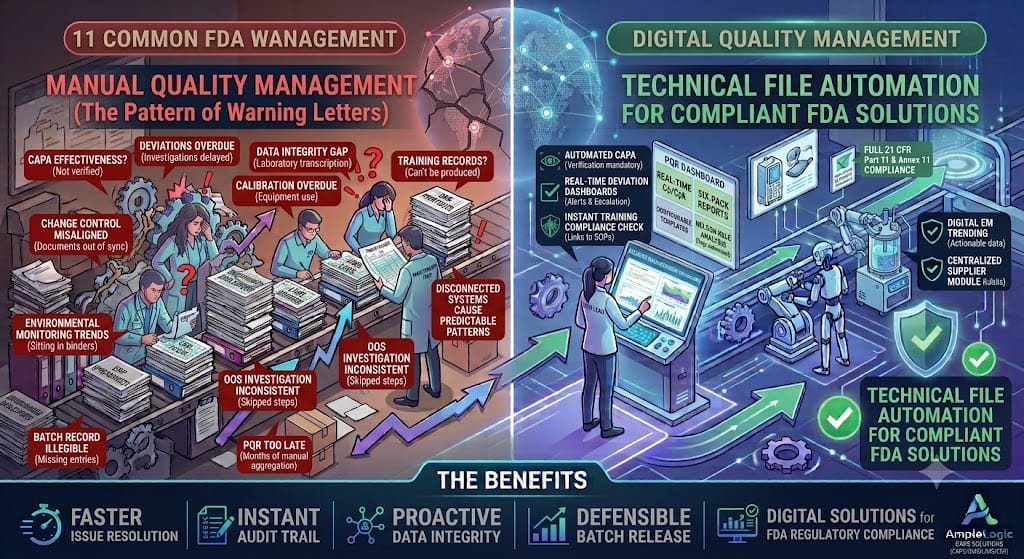
An FDA warning letter rarely comes from one dramatic failure. It usually comes from a pattern the agency has seen a thousand times before: a CAPA that never quite closes, a deviation investigation that took eleven weeks instead of five, a training record that can't be produced during the walkthrough. None of these are exotic problems. They're the predictable result of running a quality system on paper, spreadsheets, and shared drives that don't talk to each other.
The good news is that every one of the patterns below is well understood, and every one of them has a digital fix that pharma, biotech, and medical device teams are already using in production. Here's what shows up again and again in 483s and warning letters, and what closes the gap.
1. CAPA effectiveness never actually gets verified
Investigators frequently cite CAPAs that were closed without proof the corrective action worked. A connected CAPA management system keeps the effectiveness check as a mandatory workflow step, not an afterthought, so a CAPA can't close until the evidence is attached.
2. Deviation investigations run past their own deadlines
Paper-based deviation logs make it easy to lose track of due dates across sites. Automated escalation and real-time dashboards flag an open deviation before it becomes an overdue one.
3. Data integrity gaps in laboratory records
Manual transcription between instruments and paper logbooks is one of the most cited data integrity issues in FDA letters. Direct instrument integration in a modern LIMS removes the transcription step entirely, so results move from instrument to record without a human retyping them.
4. Training records that can't be produced on demand
"Show me this operator's training file" is a common inspector request, and it's astonishing how often it can't be answered quickly. A training system that links directly to SOP revisions makes qualification status visible in seconds, not days.
5. Change control that doesn't reach every affected document
When a specification changes but the linked SOPs, training modules, and batch records don't update in step, the system falls out of sync with itself. Connected workflows trigger every downstream update automatically.
6. Equipment used without current calibration
Calibration overdue by even a day is enough to draw a citation if that equipment generated GMP data. Digital scheduling with real-time alerts keeps calibration status visible before a batch, not after.
7. Environmental monitoring trends that go unreviewed
Manual EM data often sits in binders until the annual review, by which point a trend has already become a problem. Continuous digital trending surfaces drift while there's still time to act on it.
8. Supplier qualification records that lag behind reality
Approved vendor lists maintained in spreadsheets tend to drift from what's actually being purchased. A centralized supplier module keeps qualification, audits, and scorecards in one place.
9. Out-of-specification results investigated inconsistently
OOS investigations that skip steps or lack a documented root cause are a frequent citation. Standardized digital workflows with built-in phase gates keep every investigation following the same rigor, every time.
10. Batch records with missing or illegible entries
Handwriting issues remain a real reason for rejected batch records. Electronic batch execution removes the legibility question altogether and prevents a step from being skipped.
11. Annual product quality reviews compiled too late to catch a trend
When a PQR takes months of manual data pulling, the review becomes a historical exercise instead of a quality tool. Automated data aggregation makes the review current enough to actually inform decisions.
What this adds up to
None of these eleven items require a heroic effort to fix individually. What they have in common is that they're symptoms of disconnected systems: quality, lab, training, and manufacturing data that live in separate places and have to be manually reconciled. Connect them, and most of this list stops being a risk.
If you want to see how these workflows come together on one platform, AmpleLogic's electronic quality management system is built specifically around closing these gaps for FDA-regulated manufacturers.


