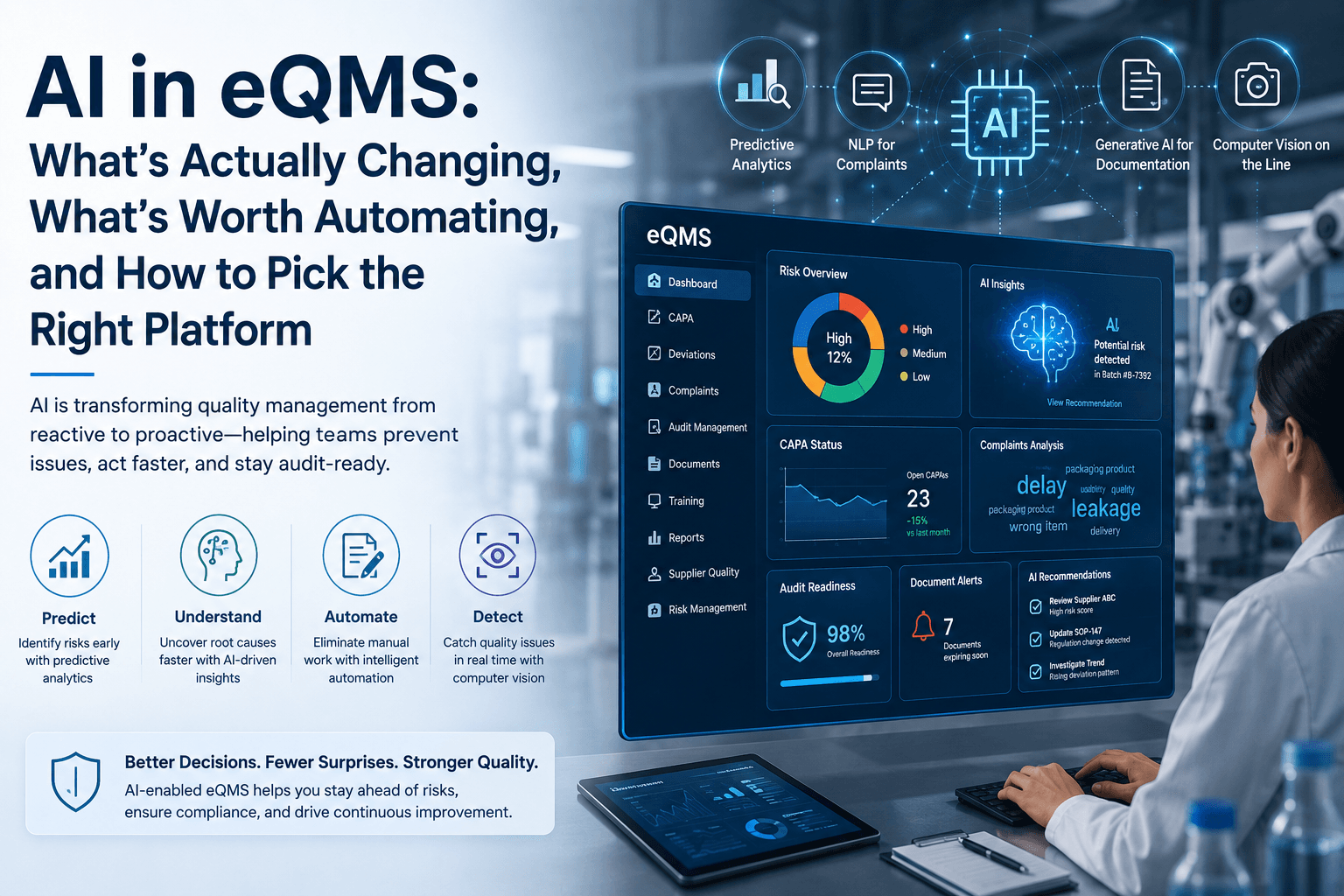
Quality teams have heard the AI pitch a hundred times by now. New tool, new dashboard, same old promise: less paperwork, more peace of mind. So, it's fair to be a little sceptical. But something genuinely different is happening in electronic quality management systems right now, and it's worth separating the real shift from the marketing noise.
For most of the last two decades, eQMS platforms have functioned as glorified filing cabinets. Useful ones, sure searchable, auditable, better than paper. But still reactive. A deviation happens, someone logs it, someone investigates, someone routes it for sign-off. The system records history; it doesn't anticipate anything.
That's the piece AI is genuinely changing not how things get filed, but how early you find out something's wrong.
From record-keeping to early warning
The clearest difference between a traditional eQMS and an AI-enabled one comes down to timing. Traditional systems tell you what already went wrong. AI-powered ones are starting to tell you what's about to go wrong, based on patterns buried in equipment logs, batch records, and years of audit history that no human has the bandwidth to cross-reference manually.
A few trends are driving this, and they're worth knowing by name if you're evaluating vendors this year:
Predictive CAPA. Instead of opening a corrective action after a non-conformance, systems can now flag the conditions that tend to precede one and let teams intervene before it becomes a CAPA at all.
Faster root cause analysis. Rather than a team running another "5 Whys" session from scratch, AI tools can scan historical maintenance and batch data in minutes to surface correlations a human investigator might never connect.
NLP for unstructured complaints. Adverse event reports, customer emails, handwritten notes from the floor all the messy text data that used to sit unread now gets parsed, categorized by severity, and routed automatically.
Generative AI for documentation. SOP drafts, audit summaries, first-pass deviation reports generative tools are taking the blank-page problem off quality professionals' plates, leaving the actual judgment calls to humans.
Computer vision on the line. Cameras paired with ML models are catching defects in real time, classifying severity, and triggering the right workflow before a bad batch gets further down the production line.
None of these replace a quality manager's judgment. They just make sure that judgment gets applied earlier, with better information.
Where to start automating
If you're trying to figure out where AI earns its keep first, don't start with the flashiest use case start with the most repetitive one. Document routing is a good example: instead of someone manually tracking who needs to review what, AI can route based on workload and flag outdated SOPs the moment a regulation shifts.
Supplier quality is another underrated win. Instead of waiting for a supplier audit to reveal a problem, continuous monitoring of delivery performance and inspection trends can catch a supplier sliding before it becomes your problem too.
And for audit readiness, the value isn't AI doing the audit for you it's AI quietly checking your current processes against the latest FDA, ISO, or EMA guidance on an ongoing basis, so nothing slips through unnoticed between formal reviews.
What separates a real platform from a buzzword
Not every AI-powered eQMS deserves the label. A few things genuinely separate a future-ready platform from a dressed-up legacy system:
It must be built for regulated industries specifically generic software wasn't designed around 21 CFR Part 11 or Annex 11, and it shows. It needs to integrate cleanly with your existing ERP, LIMS, and MES, because AI is only as smart as the data it can see. It should be explainable if an auditor asks why the system flagged something, "the algorithm said so" isn't an acceptable answer. And it needs to be usable enough that your team adopts it, because the most sophisticated model in the world is worthless sitting unused in a dashboard nobody opens.
Rolling it out without breaking anything
Adoption tends to go better in phases rather than all at once. Clean your historical data first AI is only as good as what you feed it. Pilot on one high-friction process rather than overhauling everything simultaneously. Keep a human in the loop reviewing AI recommendations early on and let the system earn more autonomy as it proves itself. And don't treat it as "set and forget" regulatory expectations shift, and your AI's recommendations need periodic tuning to keep up.
The bigger shift
Quality departments have spent a long time being treated as the compliance police necessary, but reactive. AI is part of what's letting that change. The teams adopting predictive analytics, NLP, and computer vision aren't just cutting administrative overhead; they're repositioning quality as something that protects the business proactively, not just after the fact.
The technology is ready. The bigger question for most organizations isn't whether to adopt AI in their eQMS it’s whether their current platform can support it.


