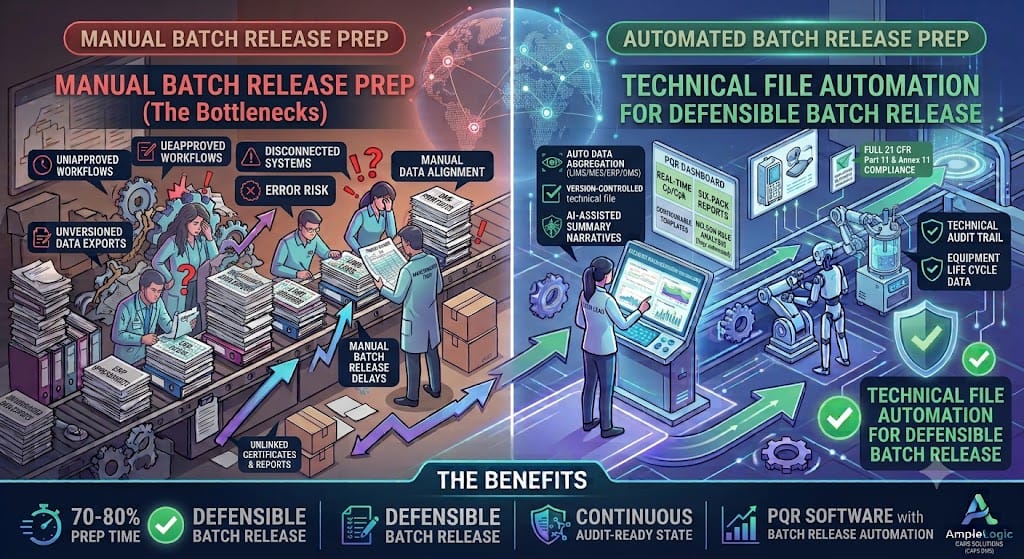
Regulators expect every batch of drug product to be backed by a documented, defensible review of its quality history before it reaches a patient. That expectation is not new. What has changed is how much data now feeds that review, and how many systems it lives in: LIMS, MES, ERP, DMS, and a handful of spreadsheets nobody wants to admit are still in use. Pulling all of that together by hand is where release timelines actually break down.
Why manual PQR compilation slows batch release
A traditional Annual Product Quality Review, or the periodic reviews that feed a release decision, means someone on the quality team exporting data from multiple systems, reconciling formats, and building trend charts in a separate statistics package. Every one of those handoffs is a place where a number can be transcribed wrong, a data set can be left out, or a deadline can slip. None of that is a reflection of the team's diligence. It's simply what happens when the source systems don't talk to each other.
What changes when the data aggregation is automated
AmpleLogic's APQR software pulls manufacturing, quality, and laboratory data directly from LIMS, eQMS, MES, ERP, and DMS, so the review is built from the same source records inspectors will ask to see, not a manually rebuilt copy of them. That has a few direct effects on release timelines:
Batch-wise trending and Cp/Cpk/Pp/Ppk analysis generate automatically instead of being built by hand in a separate tool
Six-Pack reports and Nelson Rule violation detection are available the moment data lands, not weeks later at review time
AI-assisted summary narratives and OCR data extraction cut down the drafting time for the written portions of the report
Configurable PQR templates by product, site, and market keep the report format consistent without a rebuild for every region
Teams using this kind of automated aggregation have reported cutting review preparation time by roughly 70 to 80 percent, largely because the data pull that used to take days now happens continuously.
Keeping the release decision defensible
Speed only matters if the review holds up during an inspection. Because the underlying platform is built around 21 CFR Part 11 and Annex 11 requirements, and aligned to GMP expectations across FDA, EMA, MHRA, WHO, ICH Q7, and ICH Q10, every figure in the automated report traces back to its source record. That traceability is what turns a faster review into a more defensible one, not just a quicker one.
What this means for your team
Faster batch release isn't about cutting corners on review. It's about removing the manual data-wrangling that adds time without adding assurance, so your quality team can spend their attention on the trends and exceptions that actually need a human judgment call. If your PQR process is still built around exported spreadsheets and a separate charting tool, that's usually the first place to look for time back in the release cycle.
You can see how the workflow fits your current systems on the APQR software page, including how it connects with your existing LIMS and MES.


