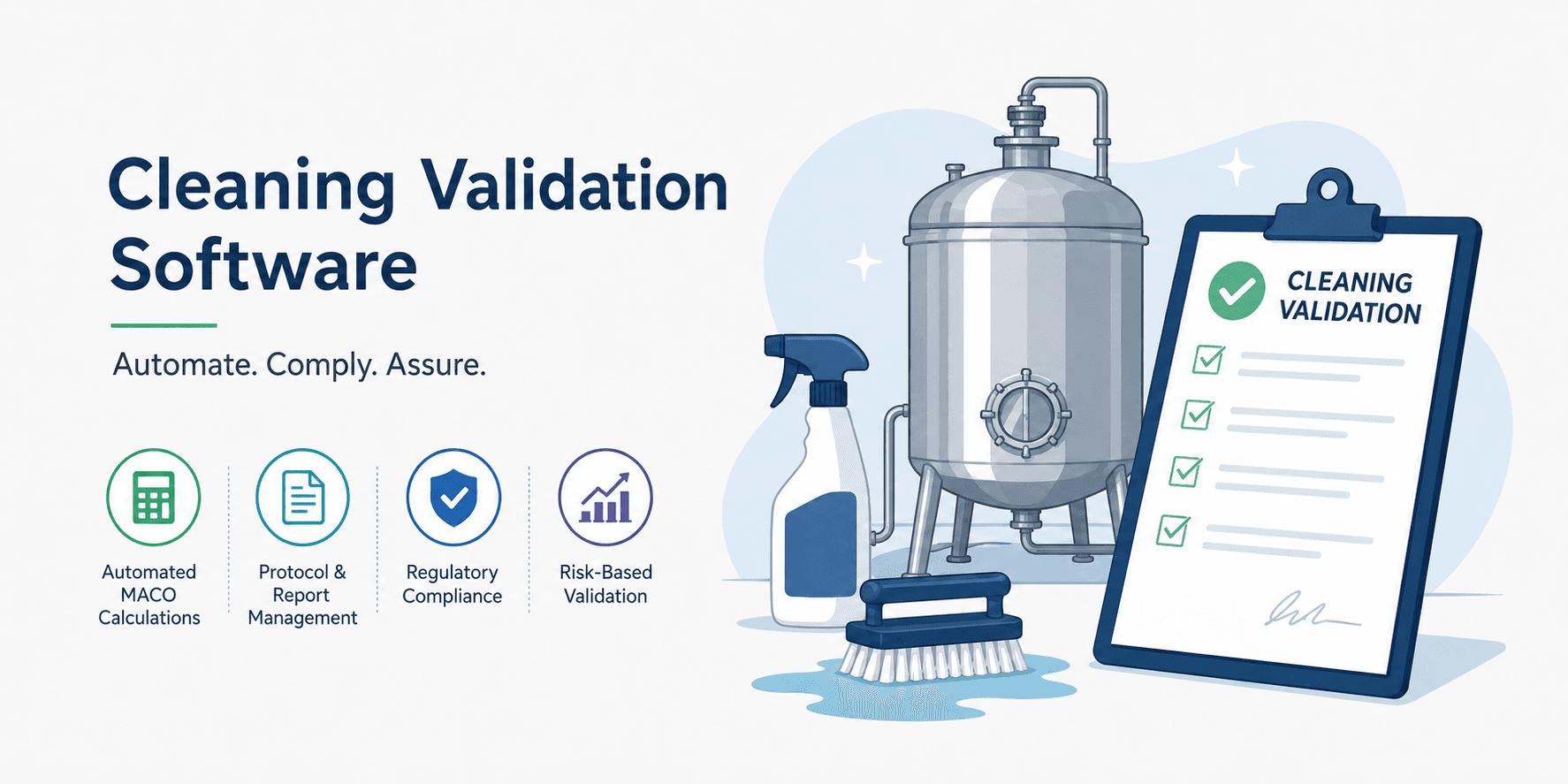
In pharmaceutical manufacturing, cleaning validation is more than a regulatory requirement. It is a critical process that protects product quality, patient safety, and regulatory compliance. As manufacturing operations become increasingly complex, traditional cleaning validation methods based on spreadsheets, manual calculations, and disconnected documentation systems are struggling to keep pace.
Today, leading pharmaceutical companies are turning to Cleaning Validation Software to automate validation activities and reduce operational risks. By digitalising the entire validation lifecycle, organisations can achieve faster approvals and have greater accuracy. By this they can be audit-ready anytime.
What is Cleaning Validation Software?
Cleaning Validation Software is a digital platform designed to manage, automate, and can keep a track of every activity that takes place in pharmaceutical cleaning validation. It helps organisations demonstrate that manufacturing equipment is consistently cleaned consistently to predefined acceptance criteria, preventing cross-contamination between products.
Modern systems automate critical activities such as:
MACO (Maximum Allowable Carryover) calculations
Residue limit determination
Worst-case product identification
Validation protocol generation
Risk assessment management
Approval workflows
Audit trail maintenance
Regulatory documentation
Instead of using many spreadsheets and paper records, companies can manage all their cleaning validation activities through one central platform. This helps keep everything organised in one place. Companies can easily. Manage cleaning validation activities. The centralised platform makes it simpler to handle all cleaning validation activities.
Why Traditional Cleaning Validation Processes Fall Short
A lot of pharmaceutical companies and manufacturing units still use manual ways to check if their equipment is clean. These methods might be okay for meeting the rules but they cause a lot of problems, for the pharmaceutical manufacturers.
Common Problems with Manual Validation
Calculation errors in MACO assessments
Inconsistent residue limit calculations
Time-consuming protocol preparation
Difficulty maintaining document traceability
Limited visibility into validation status
High audit preparation effort
Data integrity concerns
Delayed product release cycles
As regulatory expectations continue to evolve, these inefficiencies are causing problems and making it harder to follow the rules. The company has to deal with bottlenecks and the risk of not complying with the regulations is getting bigger. The regulatory expectations are getting tougher. The inefficiencies are making it harder to meet them.
The Growing Need for Automated Cleaning Validation
Regulatory agencies such as the FDA, EMA, and WHO increasingly emphasize data integrity, risk-based validation approaches, and lifecycle management principles.
Organizations are therefore investing in automated cleaning validation systems that can:
Standardize validation procedures
Reduce human errors
Accelerate approval cycles
Maintain complete traceability
Support 21 CFR Part 11 compliance
Improve inspection readiness
Digital transformation is no longer optional for pharmaceutical companies seeking long-term operational excellence.
Key Features of Modern Cleaning Validation Software
1. Automated MACO Calculations
MACO calculations are among the most critical aspects of cleaning validation. Manual calculations often require extensive cross-checking and validation.
Advanced cleaning validation software automatically calculates allowable carryover limits using:
Therapeutic dose information
PDE (Permitted Daily Exposure) values
HBEL (Health-Based Exposure Limits)
Equipment surface area data
Product potency information
This significantly reduces calculation time while improving accuracy.
2. Intelligent Worst-Case Product Selection
Identifying the most difficult-to-clean product is essential for developing an effective validation strategy.
AI-powered systems analyze multiple variables, including:
Toxicity profiles
Solubility characteristics
Batch sizes
Equipment utilization
Residue adhesion properties
This enables validation teams to make scientifically justified decisions based on risk.
3. Automated Protocol and Report Generation
Protocol preparation often consumes substantial resources across QA, QC, and Validation teams.
A digital cleaning validation system can automatically generate:
Validation protocols
Risk assessments
Summary reports
Approval documentation
Audit-ready evidence packages
Automation reduces documentation effort while maintaining consistency.
4. Risk-Based Cleaning Validation
Modern GMP guidelines encourage risk-based validation methodologies.
Advanced platforms support:
Risk scoring models
Contamination risk assessments
Product grouping strategies
Validation lifecycle management
Continuous monitoring activities
This allows organizations to focus resources on the highest-risk processes.
Regulatory Compliance Made Easier
One of the biggest advantages of implementing cleaning validation software is simplified compliance management.
The platform helps organizations align with:
FDA 21 CFR Part 210 and 211
21 CFR Part 11
EU GMP Annex 15
ICH Q7
ICH Q9
ALCOA+ Data Integrity Principles
By maintaining secure audit trails, electronic signatures, and version-controlled documentation, companies can demonstrate compliance during inspections with minimal preparation.
How Cleaning Validation Software Improves Operational Efficiency
Digital validation platforms deliver measurable business benefits beyond compliance.
Key Operational Advantages
Faster validation cycle completion
Reduced documentation workload
Improved cross-functional collaboration
Better resource utilization
Reduced audit preparation effort
Enhanced process visibility
Real-time monitoring and alerts
Simplified change management
Organizations can move from reactive validation management to proactive compliance control.
What Makes AmpleLogic Cleaning Validation Software Different?
Unlike traditional point solutions that focus only on calculations, AmpleLogic provides a complete Cleaning Validation System that covers the entire validation lifecycle.
Key Differences in other CVS Systems and Amplelogic CVS
End-to-end cleaning validation management
AI-powered MACO calculation engine
Automated residue limit calculations
Intelligent worst-case product identification
Integrated risk assessment tools
Audit-ready documentation management
Low-code workflow configuration
Seamless integration with LIMS, ERP, MES, eQMS, EDMS, EMS, and LMS platforms
The platform centralizes validation data while ensuring complete traceability from protocol creation to final report generation.
The Future of Pharmaceutical Cleaning Validation
As pharmaceutical manufacturing industries today are adapting digital solutions for their entire workflows. This means that automated validation systems are really important now for making sure everything is done correctly and that the manufacturing process runs smoothly.
Artificial intelligence, predictive analytics and integrated validation management are changing how organizations follow cleaning validation. Companies that use digital solutions today will be better positioned to manage regulatory expectations. They will also reduce compliance risks. Improve manufacturing efficiency with these digital solutions. This will lead to improved manufacturing efficiency and reduced compliance risks.
Cleaning validation remains one of the most important quality assurance activities in pharmaceutical manufacturing. However, traditional manual processes can no longer support the speed, complexity, and compliance demands of modern operations.
By implementing AI-powered Cleaning Validation Software, organisations can automate critical calculations and streamline the entire documentation process. By this they can actually strengthen regulatory compliance and improve overall efficiency.
Pharmaceutical companies that are in search of a scalable, compliant, and future-ready solution, AmpleLogic's Cleaning Validation System offers a platform that transforms validation from a manual burden into a strategic advantage.


