Pharmaceutical manufacturers operate in an environment where consistency, compliance, and product quality are non-negotiable. A process that performs well during validation does not automatically remain in control throughout commercial production. This is where Continued Process Verification (CPV) becomes essential.
CPV is the third stage of the FDA Process Validation lifecycle. Its purpose is to provide ongoing assurance that manufacturing processes remain in a validated state while consistently delivering products while meeting all the predefined quality standards. Modern pharmaceutical companies are increasingly moving away from spreadsheets which follow manual reviews and adopting digital CPV software to gain real-time visibility into process performance.
What Is Continued Process Verification?
Continued Process Verification is a systematic approach to monitor manufacturing processes during routine commercial production. It focuses on tracking Critical Process Parameters (CPPs) and Critical Quality Attributes (CQAs) to identify trends, variability, and potential process drift before they impact product quality.
Rather than reviewing data after a deviation occurs, CPV enables organizations to continuously evaluate process performance and maintain a state of control throughout the product lifecycle. FDA guidance identifies CPV as a critical component of Stage 3 Process Validation, ensuring ongoing process reliability and regulatory compliance.
Why Traditional CPV Programs Struggle
Many pharmaceutical organizations still rely on manual methods to manage CPV activities. Process data is often scattered across LIMS, MES, ERP systems, laboratory instruments, and spreadsheets. As a result, quality teams spend significant time collecting, consolidating, and analyzing information.
Common challenges include:
Manual data aggregation from multiple systems
Delayed detection of process drift
Inconsistent statistical analysis methods
Time-consuming report preparation
Limited visibility into CPP and CQA trends
Difficulty maintaining inspection readiness
These challenges can delay decision-making and increase the risk of quality events.
Key Features of Modern CPV Software
Automated SPC Charting
Statistical Process Control (SPC) is at the heart of effective CPV. Modern CPV software automatically generates control charts, trend analyses, and process capability calculations without requiring manual data exports.
Automated SPC tools help manufacturers:
Monitor process stability
Identify special-cause variation
Track capability indices such as Cp and Cpk
Detect emerging quality risks early
By eliminating manual chart creation, organizations can focus on interpretation and corrective actions rather than data preparation.
Intelligent Alerting
One of the biggest advantages of digital CPV systems is the ability to identify issues before they become deviations.
Advanced platforms use configurable alerts to notify teams when:
CPPs move outside expected trends
CQAs show abnormal variation
Nelson Rule violations occur
Process capability begins to decline
This proactive approach allows organizations to intervene before product quality is affected.
Real-Time Data Ingestion
Effective process monitoring depends on access to accurate and timely information.
Modern CPV platforms integrate with:
LIMS
MES
ERP systems
eBMR solutions
Quality management systems
Manufacturing equipment and instruments
By creating a single source of truth, organizations gain real-time visibility into process performance across products, batches, and manufacturing sites.
Automated APQR Reporting
Annual Product Quality Reviews (APQRs) require extensive process performance data. When CPV and APQR operate in separate systems, data collection becomes repetitive and resource intensive.
Integrated CPV software automatically feeds process monitoring results into APQR workflows, reducing manual effort while improving consistency and traceability. This helps quality teams prepare regulatory reports more efficiently.
How AmpleLogic CPV Software Supports Continuous Verification
AmpleLogic Continued Process Verification Software is designed specifically for pharmaceutical and life sciences organizations seeking greater visibility and control over manufacturing operations.
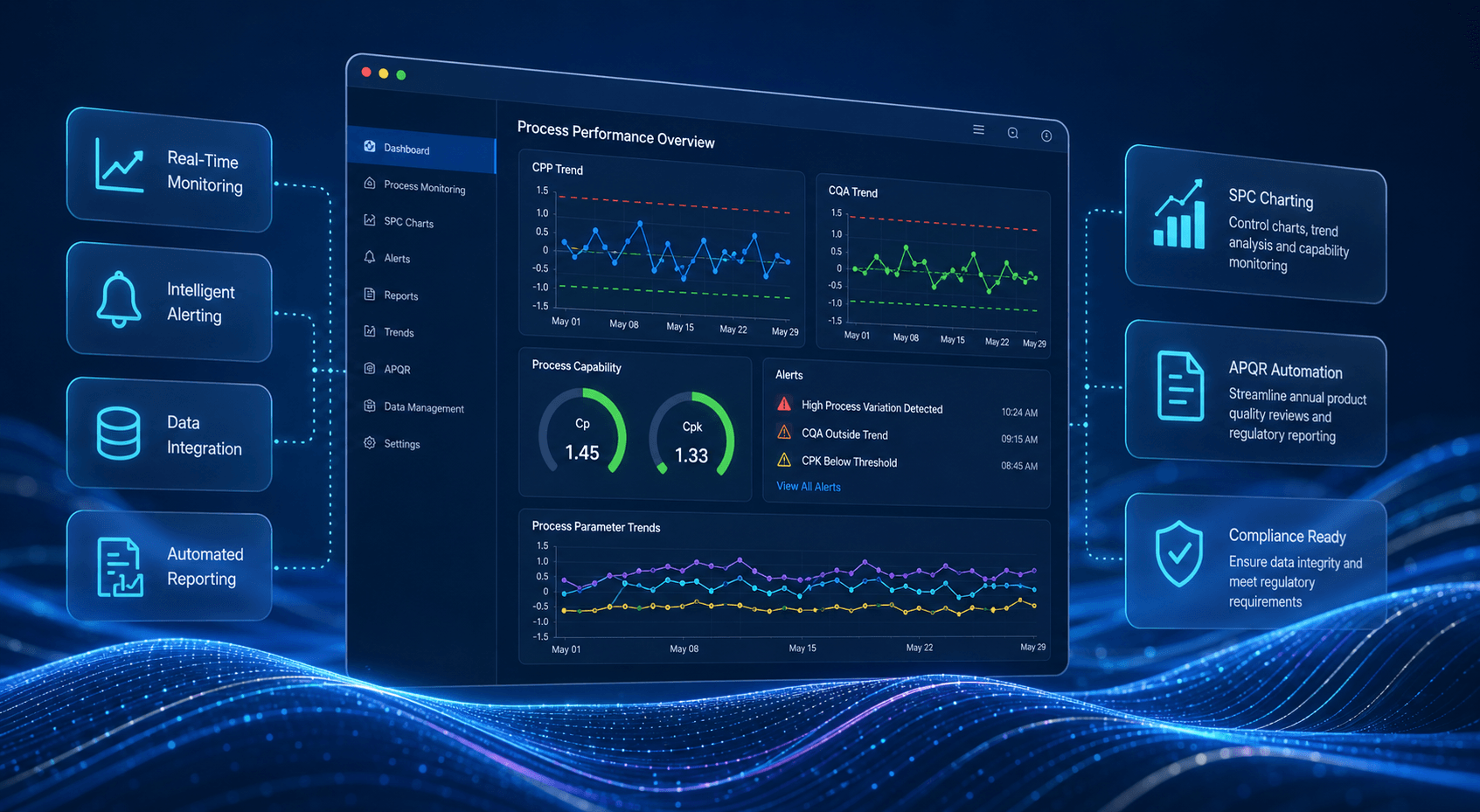
The platform combines:
Real-time CPP and CQA monitoring
Automated SPC charting
Intelligent process drift alerts
AI-driven trend analysis
Process capability monitoring
APQR integration
Audit-ready reporting
Unlike traditional approaches that rely heavily on manual reviews, AmpleLogic enables continuous monitoring throughout the validation lifecycle. Quality and manufacturing teams can track process performance in real time, investigate trends faster, and maintain compliance with global regulatory expectations.
The Future of CPV Is Proactive
As pharmaceutical manufacturing becomes increasingly data-driven day-by-day, organisations need more than periodic reviews and static reports. They are in search of a more digitalised platform. They require continuous visibility into process performance, automated statistical analysis, and proactive quality management.
Digital CPV software helps manufacturers move from reactive investigations to predictive decision-making. With real-time monitoring, automated SPC charting, intelligent alerting, and seamless APQR integration, companies can improve operational efficiency while maintaining a validated state of control.
For organizations that are in search of strengthening process validation programs and reduce manual effort, AmpleLogic CPV Software provides them a modern approach to continued process verification that aligns quality with compliance, and manufacturing excellence.


