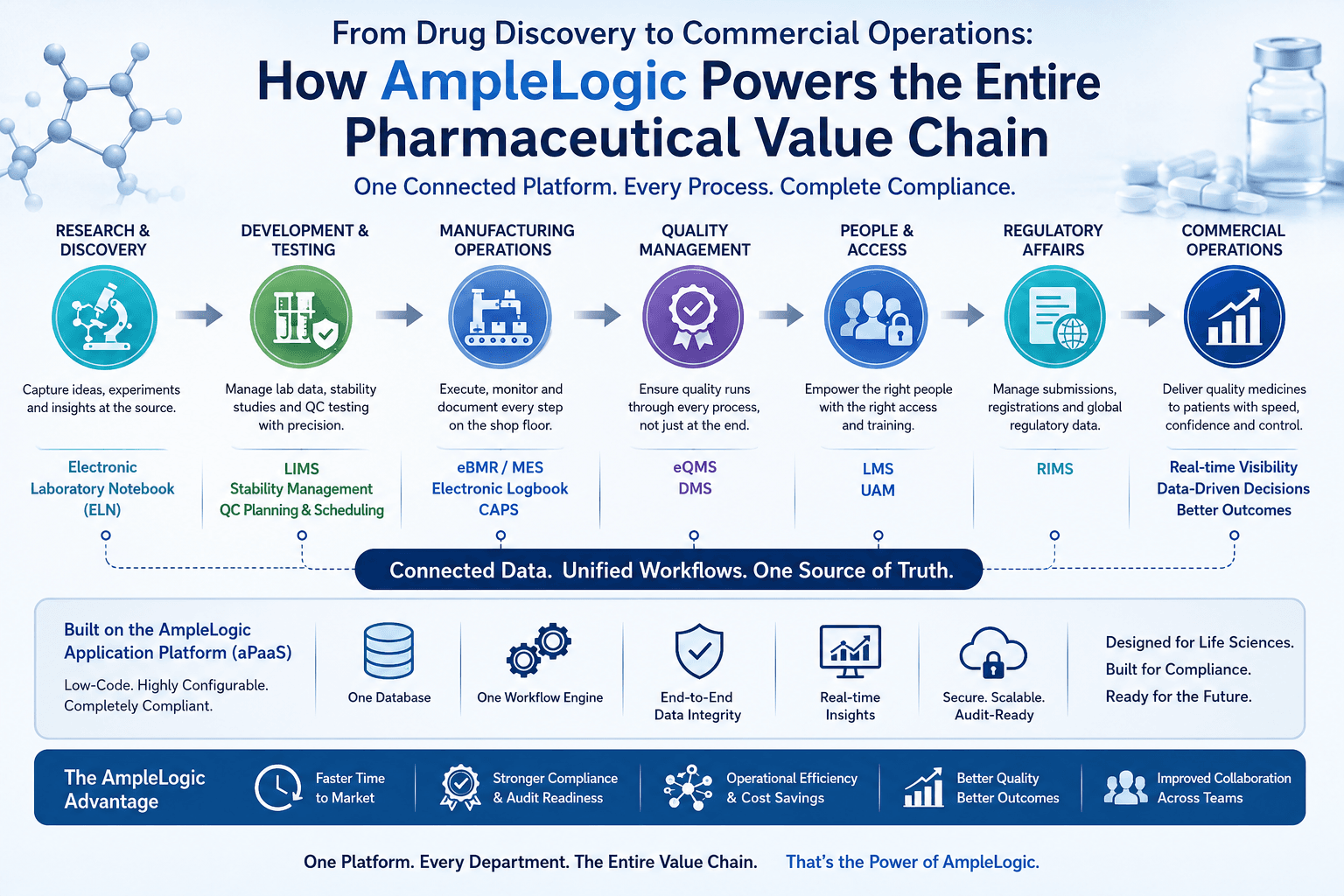
Walk into most pharmaceutical companies today and you'll find something strange: a research scientist logging results in one system, a QC analyst pulling data from another, a plant supervisor filling out a batch record in a third, and a regulatory affairs manager tracking submissions in a fourth. None of these systems talk to each other. Every hand-off between them means someone re-typing data, chasing an approval over email, or reconciling two spreadsheets that were supposed to say the same thing.
This isn't a staffing problem. It's an architecture problem. And it's one of the biggest reasons drug development timelines stretch longer than they need to.
The pharmaceutical value chain from the moment a molecule is discovered in a lab to the moment a finished product reaches a patient's hands is really one continuous process. But most of the software built to support it was never designed that way. It was built module by module, vendor by vendor, over decades, which is how a single mid-sized pharma company can end up running anywhere from five to ten disconnected platforms just to manage quality, lab, and manufacturing operations.
AmpleLogic took a different starting point: what if the entire value chain ran on one platform instead of ten?
Where It Starts: Research and Discovery
Every drug begins as data experiment logs, molecule structures, assay results, and the reasoning that connects them. This is where AmpleLogic's Electronic Laboratory Notebook (ELN) comes in, replacing paper notebooks and disconnected spreadsheets with a structured, compliant way to capture scientific work as it happens. The goal at this stage isn't just record-keeping; it's making sure the intellectual groundwork of discovery is searchable, defensible, and ready to carry forward into development without getting lost in translation.
Development and Testing: Where LIMS Earns Its Keep
Once a candidate molecule moves into development, the volume of lab data explodes. Stability studies, analytical testing, method validation, sample tracking all of it needs to be managed with a level of rigor that spreadsheets simply can't provide. AmpleLogic's Laboratory Information Management System (LIMS) handles this layer, and it's paired with dedicated Stability Management and QC Planning & Scheduling modules to keep testing campaigns organized and shelf-life studies on track.
This is also where AI starts doing real work rather than just being a buzzword. Root-cause suggestions, automated report summaries, and pattern detection across large testing datasets mean lab teams spend less time compiling numbers and more time interpreting them.
Manufacturing: From Recipe to Reality
A validated formulation is only useful if it can be manufactured consistently, batch after batch, at scale. AmpleLogic's electronic Batch Manufacturing Record (eBMR), which functions as a full Manufacturing Execution System (MES), digitizes the shop floor guiding operators through each step, enforcing electronic signatures, and capturing deviations the moment they happen instead of days later during a paper review.
Supporting this layer are the electronic Logbook system, which retires paper logbooks across manufacturing facilities, and the Calibration & Preventive Maintenance System (CAPS), which keeps equipment audit-ready without manual tracking sheets. Together, they turn the plant floor into a source of real-time data instead of a black box that quality teams must interrogate after the fact.
Quality: The Thread That Runs Through Everything
Quality isn't a single department in a compliant pharma operation it's a discipline that must run through research, development, and manufacturing simultaneously. AmpleLogic's Electronic Quality Management System (eQMS) is built to sit at that intersection, managing deviations, CAPAs, change controls, and audits with workflows that stay connected to the lab and plant data generating them in the first place.
Document control follows the same logic. The Document Management System (DMS) doesn't function as an isolated repository it's tied into the same workflow engine as eQMS, so an SOP update, a training requirement, and an audit trail all move in sync rather than as three separate manual steps.
Two newer additions round out this layer: Annual Product Quality Review (APQR) and Continued Process Verification (CPV) software, which pull data automatically from LIMS, eQMS, MES, and ERP systems to generate statistical reports Six-Pack analyses, Cp/Cpk calculations, Nelson Rule detection that used to require exporting everything into Minitab or SPSS by hand.
People and Access: The Layer Everyone Forgets
Compliant operations depend as much on trained, correctly permissioned people as they do on validated systems. AmpleLogic's Learning Management System (LMS) handles GxP training and competency tracking, including AI-generated assessment questions that go beyond simple recall. Sitting alongside it, the User Access Management (UAM) system centralizes who can access what, across every facility and every module a detail that becomes critical the moment an auditor asks who had permission to approve a batch release.
Regulatory: Closing the Loop
None of these matters if a product can't get to market and stay there. The Regulatory Information Management System (RIMS) manages submissions, registrations, and regulatory correspondence across markets, keeping regulatory affairs teams working from the same underlying product and quality data as everyone else in the organization rather than rebuilding it from scratch for every filing.
Commercial Operations: The Payoff of a Connected System
By the time a product reaches commercial manufacturing, the real advantage of a unified platform becomes obvious. A quality issue flagged on the shop floor connects automatically to the relevant batch records, the CAPA it triggers, and the trend data feeding into the next APQR without anyone manually stitching the pieces together. Cross-system data aggregation isn't a special project; it's the default behaviour of the platform.
This is the difference between software that documents compliance and software that actively supports it.
Why the Value Chain Approach Matters
None of AmpleLogic's individual modules are radical on their own. LIMS, eQMS, MES, and DMS all exist as standalone products from other vendors. What's different is the decision to build them on a single low-code Application Platform as a Service (aPaaS), sharing one database and one workflow engine instead of stitching together point-to-point integrations after the fact.
That architectural choice is what turns "we have software for every department" into "we have one system that understands the whole product lifecycle." For an industry where a delay in one function a stability result, a change control, a training gap can hold up an entire batch release, that difference is measured in weeks and, ultimately, in patient access to medicine.
Pharma companies don't need ten more-point solutions. They need their existing data to stop living in silos. That's the problem AmpleLogic set out to solve, one module and one connected workflow at a time.


