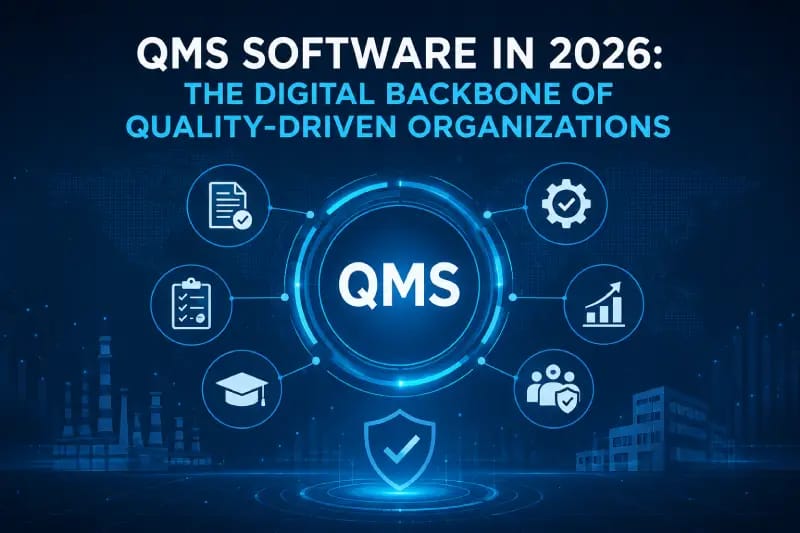
QMS Software in 2026: The Digital Backbone of Quality-Driven Organizations
Quality is no longer just a department, it's a strategy. In an era where regulatory scrutiny is rising and product complexity is accelerating, organizations that leverage intelligent Quality Management Systems don't just stay compliant, they gain a measurable competitive edge.
What Is QMS Software?
A Quality Management System (QMS) platform is a digital infrastructure that centralizes, manages, and automates the full spectrum of quality processes from document control and audit scheduling to corrective action tracking and supplier evaluation.
Unlike manual or siloed approaches, a modern QMS connects every quality touchpoint in one unified environment, enabling real-time visibility, automated workflows, and audit-ready compliance with standards like ISO 9001, ISO 13485, 21 CFR Part 11, and FDA requirements.
Organizations using dedicated QMS software report significantly fewer non-conformances and faster time-to-compliance because quality is embedded into daily workflows, not bolted on at audit time.
Core Capabilities That Define a Robust QMS
Centralized Document Control: - Version-controlled documents with real-time revisions, approvals, and access tracking eliminate the risk of obsolete versions circulating across teams. Every change is logged; every approval is traceable.
CAPA & Non-Conformance Management: - Automated workflows guide teams from issue detection through root-cause investigation to resolution and verification. Nothing slips through the cracks, and every action is audit ready.
Audit Management: - Schedule, execute, and track internal and external audits with built-in checklists and findings management. Preparation time drops significantly when audit evidence is already organized and accessible.
Training & Compliance: - Training assignments are automatically triggered by SOP updates, with real-time compliance dashboards giving management visibility into gaps before they become findings.
Risk Management: - Systematic identification, assessment, and mitigation of quality risks, before they escalate into incidents, recalls, or regulatory observations.
Supplier Quality Tracking: - Evaluate, qualify, and continuously monitor supplier performance with scorecards, audit histories, and deviation alerts integrated into the broader quality ecosystem.
The QMS Landscape: What Leading Solutions Offer
The market spans highly configurable enterprise platforms to purpose-built solutions for regulated industries. Key players include Octave Reliance (formerly ETQ), QT9 QMS, Arena Quality, Siemens Opcenter X Quality, Dot Compliance, MasterControl, and Greenlight Guru, each optimized for different industry verticals, regulatory regimes, and organizational scales.
What separates good QMS implementations from great ones isn't just the feature set. It's configurability, ease of adoption, and integration depth with existing ERP, MES, and LIMS systems. A platform with 40 modules that nobody uses is worth less than a focused solution that becomes part of how people work.
How to Choose the Right QMS for Your Organization
Industry compliance alignment: - Ensure the platform supports your specific regulatory framework: FDA 21 CFR Part 11, EU MDR, ISO 9001, ISO 13485, GxP, or IATF 16949. Generic quality tools often fall short when inspectors arrive.
Scalability for growth: - A system that works for 50 users should scale seamlessly to multi-site, multi-region enterprise deployments without a full re-implementation.
ERP & MES integration: - Quality data should flow bidirectionally with core operations systems, not live in an isolated silo. Disconnected quality data creates blind spots and manual reconciliation burdens.
User adoption design: - A QMS that's hard to use is a QMS that gets bypassed. Low-friction interfaces drive the behavioural change that real compliance depends on.
Analytics & continuous improvement: - Real-time dashboards, trend analysis, and quality KPIs should empower proactive decisions, not just retrospective reporting after something has already gone wrong.
Why AmpleLogic for Your QMS Journey
AmpleLogic brings deep domain expertise in regulated industries pharma, life sciences, and manufacturing combined with a track record of configuring, deploying, and optimizing QMS platforms that get used.
Our approach bridges the gap between software capability and real-world quality operations. We don't just implement tools; we align technology selection to your quality maturity model, regulatory obligations, and long-term growth roadmap.
Whether you're evaluating platforms for the first time, migrating from a legacy system, or optimizing an existing deployment, AmpleLogic's consultants ensure your QMS investment delivers measurable outcomes — faster audit cycles, fewer non-conformances, and a quality culture that scales with your business.
The most impactful QMS implementations share one common thread: they treat quality software not as a compliance checkbox, but as an operational intelligence layer that informs every business decision.
Ready to modernize your quality operations?
Connect with an AmpleLogic QMS specialist to map the right platform to your compliance requirements and business goals.
AmpleLogic | Pharma Software Solutions | LIMS, eQMS, eBMR & More


