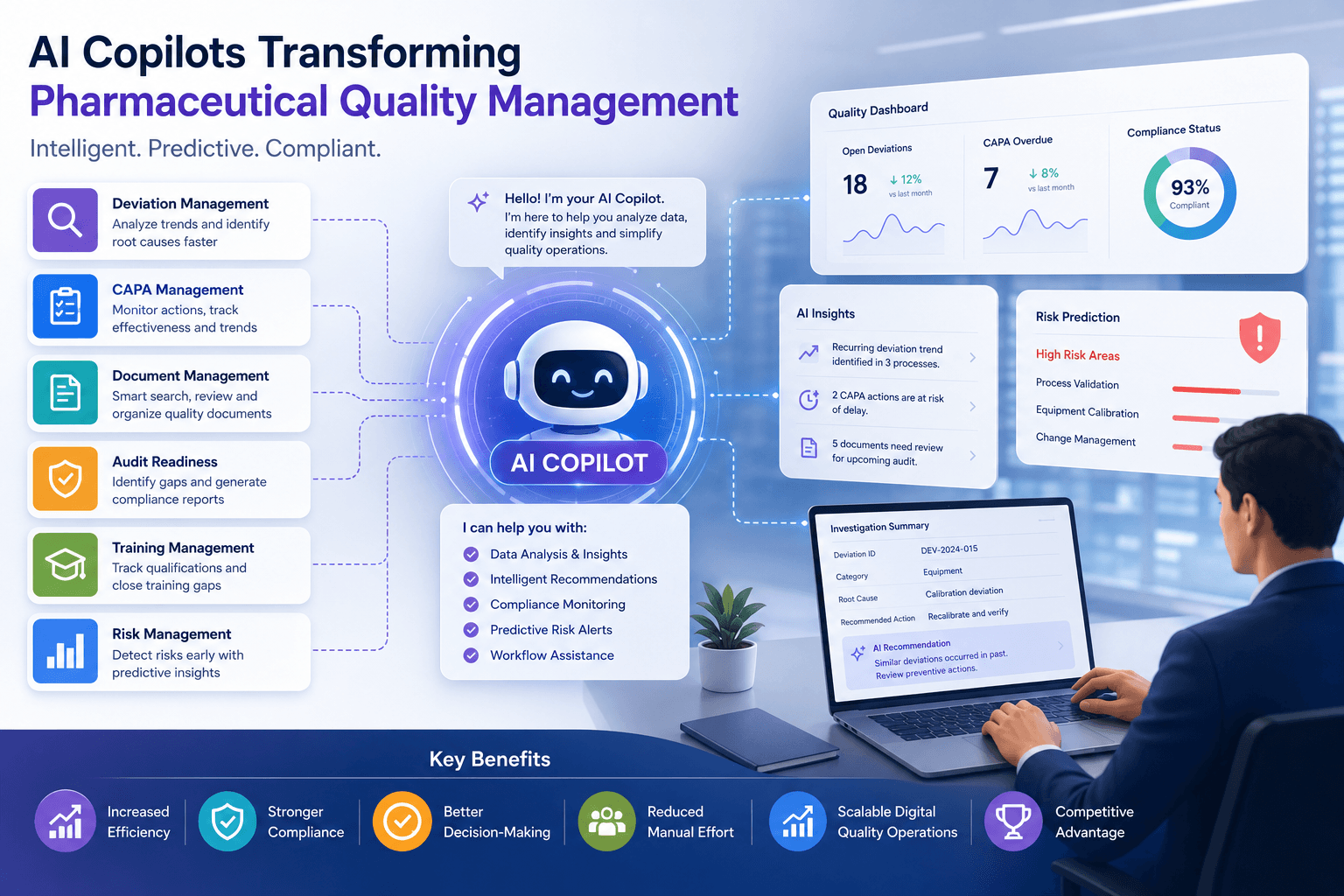
The pharmaceutical sector is changing at an accelerated pace with digital transformation, intelligent automation, and evidence-based decision making becoming key drivers in this sector. Although traditional automation technologies have allowed for the simplification of processes and reduction of effort on the part of pharmaceutical companies, a new era of innovation is already underway – AI Copilots for Pharmaceutical Quality Management.
Contemporary pharmaceutical firms have to handle vast amounts of quality data, compliance obligations, and regulatory demands. With increasing complexity, there comes the need for intelligent systems that will offer more than mere automation; intelligent systems that will help teams become more productive and compliant and allow faster decision-making.
This is where Intelligent Pharmaceutical Quality Management becomes important for shaping the future of quality operations in this field.
At AmpleLogic, we feel AI Copilots represent the next step beyond automation in terms of assisting pharmaceutical companies develop their quality operations.
What Are AI Copilots in Pharmaceutical Quality Management?
AI copilots represent smart virtual assistants built into software platforms utilized by the pharmaceutical industry, such as eQMS, LIMS, DMS, LMS, eBMR, and many other quality management software solutions.
AI copilots differ from conventional automation technologies that simply adhere to established instructions by being able to conduct data analysis, comprehend operation patterns, derive insights, and collaborate with users.
For instance, when applied in the field of pharmaceutical quality management, AI copilots may facilitate various activities for teams involved in:
• Conducting deviation investigations
• Monitoring CAPA processes
• Reviewing SOPs and documents
• Audit preparation
• Compliance control
• Risk management
• Data analytics
• Management of employee training programs
AI copilots are supposed to be an aid to quality teams rather than a substitute for people who perform their jobs.
Traditional Automation vs AI Copilots
Automation in traditional pharmaceutical applications tends to concentrate on tasks that are repetitive in nature and require rules-based actions like approvals, notifications, and document routing.
AI copilots take automation to a level of intelligence in the quality management process.
Traditional Automation
• Works on pre-defined workflow procedures
• Automates repetitive actions
• Necessitates data interpretation manually
• Has limited flexibility
• Is reactive in nature
AI Copilots
• Analyze historic and current data
• Give predictive analysis
• Aid in making decisions
• Analyze quality trends and risks
• Learn continuously for improvement
• Support proactive quality management
This shift from automated workflows to intelligent quality operations is proving beneficial for pharmaceutical firms to enhance efficiency and manage compliance effectively
Why AI Copilots Are Important in Pharmaceutical Quality Management
Pharmaceutical companies operate in highly regulated environments where compliance, accuracy, and documentation are critical. Managing quality processes manually can lead to delays, inefficiencies, and compliance risks.
AI copilots help organizations simplify and optimize these operations.
Faster Quality Investigations
Deviation investigations and root cause analysis often require reviewing large amounts of historical data and documentation. AI copilots can quickly analyze records, identify recurring patterns, and generate investigation summaries, helping teams complete investigations faster.
Improved Regulatory Compliance
Maintaining FDA, GMP, and global regulatory compliance requires continuous monitoring and accurate documentation. AI copilots can identify missing information, flag compliance gaps, and provide real-time alerts to support inspection readiness.
Smarter Decision-Making
AI-powered Pharmaceutical Quality Management Systems help organizations make faster and more informed decisions using real-time quality insights and predictive analytics.
Reduced Manual Errors
Manual data entry and document handling increase the risk of human error. AI copilots help validate records, identify inconsistencies, and guide users through standardized workflows.
Enhanced Operational Efficiency
By reducing repetitive tasks and simplifying quality processes, AI copilots allow pharmaceutical teams to focus more on strategic quality improvement initiatives.
Applications of AI Copilots in Pharmaceutical Quality Operations
AI copilots can support multiple pharmaceutical quality and compliance processes across manufacturing environments.
AI in Deviation Management
AI copilots can analyze previous deviations, detect recurring issues, and recommend possible root causes or corrective actions based on historical data.
AI in CAPA Management
AI-powered CAPA management systems can monitor action timelines, track effectiveness, and identify trends that may require preventive actions before issues escalate.
AI-Powered Document Management
Pharmaceutical companies manage thousands of SOPs, quality records, validation documents, and compliance files. AI copilots simplify document management by helping users quickly search, summarize, review, and organize documentation.
AI for Audit Readiness
Preparing for audits can be time-consuming and resource-intensive. AI copilots help organizations remain audit-ready by organizing records, identifying missing documentation, and generating compliance reports automatically.
AI in Learning Management Systems (LMS)
AI copilots integrated with pharmaceutical LMS platforms can monitor employee qualifications, recommend training programs, and identify compliance-related training gaps.
AI for Risk Management
AI-driven analytics help identify high-risk areas within manufacturing and quality operations before they impact product quality or regulatory compliance.
Benefits of AI-Powered Pharmaceutical Quality Management Systems
The integration of AI copilots into pharmaceutical software solutions offers several long-term benefits for organizations.
Increased Productivity
AI copilots reduce manual administrative work and improve workflow efficiency across pharmaceutical quality operations.
Better Compliance Management
Continuous monitoring and intelligent alerts help organizations maintain stronger regulatory compliance and inspection readiness.
Improved Data Visibility
AI copilots convert large volumes of pharmaceutical quality data into actionable insights that support better business decisions.
Scalable Digital Quality Operations
As pharmaceutical companies expand globally, AI-powered systems help manage increasing operational complexity without significantly increasing manual effort.
Competitive Advantage
Organizations adopting AI-powered Pharmaceutical Quality Management Systems can accelerate digital transformation and improve operational performance.
Challenges in AI Copilot Adoption
Although AI copilots offer significant advantages, pharmaceutical companies should address several key implementation challenges.
Data Quality and Integrity
AI systems rely on accurate and structured data to generate meaningful insights. Strong data governance practices are essential for successful AI adoption.
Regulatory Expectations
AI-powered pharmaceutical software must support compliance with FDA 21 CFR Part 11, GxP requirements, data integrity standards, and global regulatory expectations.
User Adoption and Training
Successful implementation requires employee training and change management to help teams effectively use AI-assisted systems.
System Integration
AI copilots should integrate seamlessly with existing pharmaceutical software platforms such as eQMS, LIMS, DMS, LMS, eBMR, and ERP systems.
The Future of AI in Pharmaceutical Quality Management
The future of pharmaceutical quality management is becoming more intelligent, predictive, and connected. AI copilots are expected to become a core component of next-generation pharmaceutical software platforms.
Future AI-powered quality systems may include:
Predictive quality analytics
Intelligent compliance monitoring
Automated risk forecasting
Real-time manufacturing intelligence
Conversational AI support
Self-learning quality systems
Advanced process optimization
These capabilities will help pharmaceutical companies move from reactive quality management toward proactive and predictive quality operations.
How AmpleLogic Supports Intelligent Pharmaceutical Quality Management
AmpleLogic’s Pharmaceutical Software Solutions are designed to help life sciences organizations accelerate digital transformation while maintaining regulatory compliance and operational excellence.
With advanced platforms including eQMS, LIMS, DMS, LMS, eBMR, CAPA Management, and Validation solutions, AmpleLogic enables pharmaceutical companies to streamline quality operations, improve data visibility, and build future-ready digital ecosystems.
As AI technologies continue to evolve, intelligent AI copilots will play an increasingly important role in enhancing pharmaceutical quality management and supporting smarter compliance operations.
AI copilots are transforming Pharmaceutical Quality Management by going beyond traditional automation and introducing intelligent operational support. These AI-powered systems help pharmaceutical organizations improve efficiency, strengthen compliance, reduce manual effort, and make faster data-driven decisions.
As the pharmaceutical industry continues its digital transformation journey, AI copilots will become essential for building scalable, compliant, and future-ready quality operations.
Organizations that adopt AI-powered pharmaceutical software solutions today will be better prepared to meet the growing demands of regulatory compliance, operational efficiency, and quality excellence in the years ahead.


