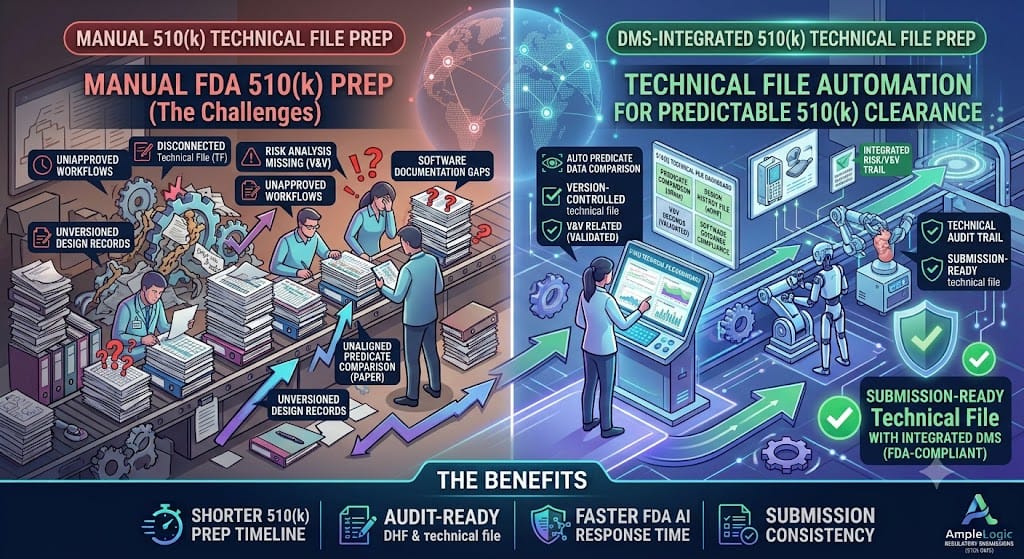
Most medical devices reaching the U.S. market get there through the 510(k) pathway rather than a full premarket approval. The concept is straightforward: show the FDA that your device is substantially equivalent to something already legally marketed. The execution, though, is where manufacturers spend months, and where documentation gaps quietly turn a routine clearance into a series of additional information requests.
What substantial equivalence actually requires
A 510(k) needs to demonstrate that your device has the same intended use as its predicate, and either the same technological characteristics or, where they differ, that those differences don't raise new questions of safety or effectiveness. In practice that means assembling a device description, intended use statement, comparison to the predicate, and performance data, whether that's bench testing, biocompatibility, software validation, or clinical data depending on the device class.
Where submissions typically stall
A few patterns show up repeatedly in FDA's requests for additional information:
Predicate comparisons that are asserted rather than documented with side-by-side data
Design control records that exist but can't be assembled quickly into a coherent technical file
Version mismatches between the design history file and what's actually referenced in the submission
Software documentation that doesn't match the device's actual risk classification under FDA's software guidance
Labeling that doesn't fully align with the intended use claims made elsewhere in the submission
Almost none of these are technical failures of the device itself. They're documentation control problems, which means they're solvable with a better system for managing the technical file, not a better argument in the cover letter.
Building a submission-ready technical file
The manufacturers who move through 510(k) review fastest tend to treat their design history file as a living, version-controlled document set from day one, not something assembled retroactively for the submission. That means every design input, verification and validation record, risk analysis update, and labeling revision is captured with a clear audit trail as it happens.
A document management system built for regulated industries supports this by keeping version history, approval workflows, and cross-references between related documents intact automatically, so when it's time to compile the technical file, the pieces are already organized and traceable rather than scattered across departments and drive folders.
What this means for your submission timeline
The 510(k) review clock itself is largely out of your hands once a submission is filed. What is in your hands is how long it takes you to assemble a complete, internally consistent technical file before that clock even starts, and how quickly you can respond if FDA comes back with questions. Both of those come down to how well your documentation has been controlled from the start of the design process.
If document version control and audit trail gaps are what's slowing your submission prep, the document management system page shows how a validated DMS keeps a 21 CFR Part 11 compliant record of every change across your design history file.


