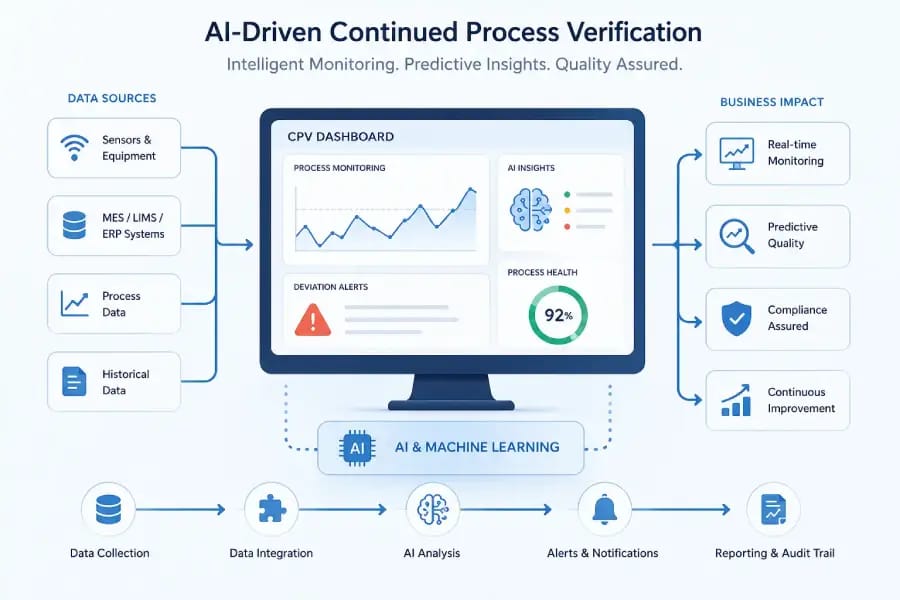
For pharmaceutical companies, product quality isn't a one-time task, it is constantly monitored and controlled. That is where Continued Process Verification (CPV) plays its role, which is getting intelligent, efficient, and reliable with the use of Artificial Intelligence. AI is bringing a transition from a manual and reactive system to an intelligent and data-driven system, resulting in higher productivity and improved quality, compliance and decision-making.
What is Continuing Process Verification (CPV)?
CPV is a third stage in the life cycle of process validation that refers to ongoing monitoring of the manufacturing process to ensure the process remains in a stable state and produces consistent product quality. In simpler terms, CPV ensures-
"Does the process continue to perform as expected post validation?"
According to best practices CPV supports the following processes-
Monitoring performance of the manufacturing process in real-time.
Detecting deviations in early stage.
Consistency of product quality.
Regulatory compliance.
Modern CPV methods leverage huge amounts of data, and the scale of manufacturing data is increasing. AI is leading the revolution for CPV.
Process Validation in Pharma
Before diving into the explanation of how AI enhances CPV, it is important to explain Process Validation in Pharma. Process validation is defined as an ongoing process of proving that manufacturing processes, consistently produce product that meet the required quality standards. It is further broken down into three steps in pharmaceutical manufacturing-
Process Design- The plan and procedures which describes how the product is manufactured.
Process Qualification- Rigorous confirmation of the process design by conducting experiments.
Continued Process Verification- Ongoing aspect post validation stage which continuously monitors and verifies the performance of the process.
Though the first two steps are critical, CPV is still as continuous and critical as ever.
The Role of AI in CPV in Pharma
The adoption of AI has started to change the overall aspect of CPV in the pharmaceutical sector by bringing about enhancements in data collection, analysis, and response. CPV previously involved manual data analysis and manual execution of various tasks that often lead to slow responses and errors. In the modern AI-driven world, automation and real-time data collection are becoming a norm.
Following are the major advantages of AI on CPV-
Large amount of manufacturing data processed in few seconds.
Detection of patterns and trends which may be difficult for a human being.
Prediction of process failure prior to actual occurrences.
Rapid decision making to enhance process and quality.
By continuous monitoring of critical processes and quality attributes, AI helps in optimizing the process for improved quality and reliability.
CPV Data Flow In Manufacturing
CPV Data Flow In Manufacturing is essential for an optimum performance of the manufacturing process which has been taken to the next level by AI. The typical Data Flow in a Digital Process Validation System can be defined as follows-
Data Collection from all the sensors, equipment and different systems.
Analysis of the collected data in real-time.
Generation of alerts for all the deviations.
Auditing and Reporting system.
By incorporating the use of AI , the overall process has been automated in the following ways-
Automation in data cleaning and integration.
Automation in seamless integration of different systems.
Providing real-time performance monitoring.
Predicting performance with the use of Artificial Intelligence and Machine learning models.
With these advancements a truly intelligent Digital Process Validation System can be formed.
Key Benefits of Using AI for CPV
The major benefits provided by AI for CPV include-
Real-time Monitoring- An AI-driven monitoring system runs 24/7 ensuring minimal human intervention and delayed detection of issues.
Predictive Quality Management- Predictive quality management features enable forecasting deviations in the process, and the risk of product failure can be minimized.
Improved Decision Making- By enabling better decision-making, the insights provided by the data can be effectively utilized for process optimization.
Reduced Human Error- An automation-driven system ensures minimal interference from human error at critical processes, thereby increasing accuracy.
Enhanced Compliance- A fully audit-ready workflow with traceable records from data to report makes the validation process compliant for inspectors.
Continuous Improvement- Data-driven trends and analysis helps in consistent process improvement.
From a reactive approach of quality control, CPV using AI has become an active method of quality assurance.
GAMP Compliant Process Validation Solution
For a heavily regulated industry like pharma, it is important to maintain compliance with standards such as GAMP.
A GAMP Compliant Process Validation Solution should assure-
The availability of necessary documents.
A risk-based approach to validation.
Data Integrity of the system.
System readiness for inspection.
An AI-driven system addresses these requirements by providing-
A standardized digital record-keeping for consistent and reliable documentation.
Full data traceability from source to final report.
Predictable and repeatable validation processes for all stages.
An AI driven CPV is a valuable tool for ensuring the system is always inspection-ready.
Digital Process Validation System: The Future of CPV
The world is moving from manual processes towards a Digital Process Validation System in pharmaceutical manufacturing for better product quality and efficiency.
Digital systems provide-
Centralized data management.
Automated workflows.
Real-time process visibility.
Better team communication.
By combining it with AI, the digital systems can offer advanced data analytics, predictive quality and automated alerts which further enhances the continuous process monitoring. The digitally transformed system will not only boost the productivity but will also bring significant improvement in the product quality.
Challenges in AI Adoption for CPV
Although the use of AI for CPV offers numerous benefits, certain obstacles might impede the successful integration.
Data Quality: Data accuracy and completeness are crucial for AI systems. Errors or deficiencies in data can lead to flawed outcomes.
System Integration: Integration of AI-powered systems with existing legacy infrastructure may present complexities.
Regulatory Compliance: AI models must be transparent and explainable for regulatory approval, posing a significant challenge.
Workforce Training: A skilled workforce capable of managing AI-driven tools is necessary.
Data interpretation-The complex data requires analysis and the insights need to be translated into comprehensible information for the benefit of the cross-functional team involved in the manufacturing process.
All these challenges can be readily managed by the right set of tools and techniques.
How AmpleLogic Supports AI-Driven CPV
AmpleLogic provides robust solutions that meets the current needs of CPV. Their platform provides-
An end-to-end Process Validation system.
Effective CPV data flow in manufacturing.
GAMP Compliant process validation workflow, thus meeting all the validation and inspection requirements.
Seamless integration with all enterprise-level systems and devices.
Robust real-time reporting.
Through the integration of AI with a GAMP Compliant Process Validation Solution, AmpleLogic helps pharmaceutical companies in improving the product quality and reliability, achieving regulatory compliance which minimizes business risk factors that helps achieve consistent process improvement.
The Future of Continued Process Verification
CPV is transforming into a digital, automated and intelligent system. It is obvious that AI would play a significant role in the future of CPV by improving the quality assurance through real-time monitoring and analysis of process parameters. The future of CPV would focus on using intelligent decision making and achieving continuous process improvement through smart systems. This would ultimately provide a significant competitive advantage to those pharmaceutical companies who embrace this approach.


