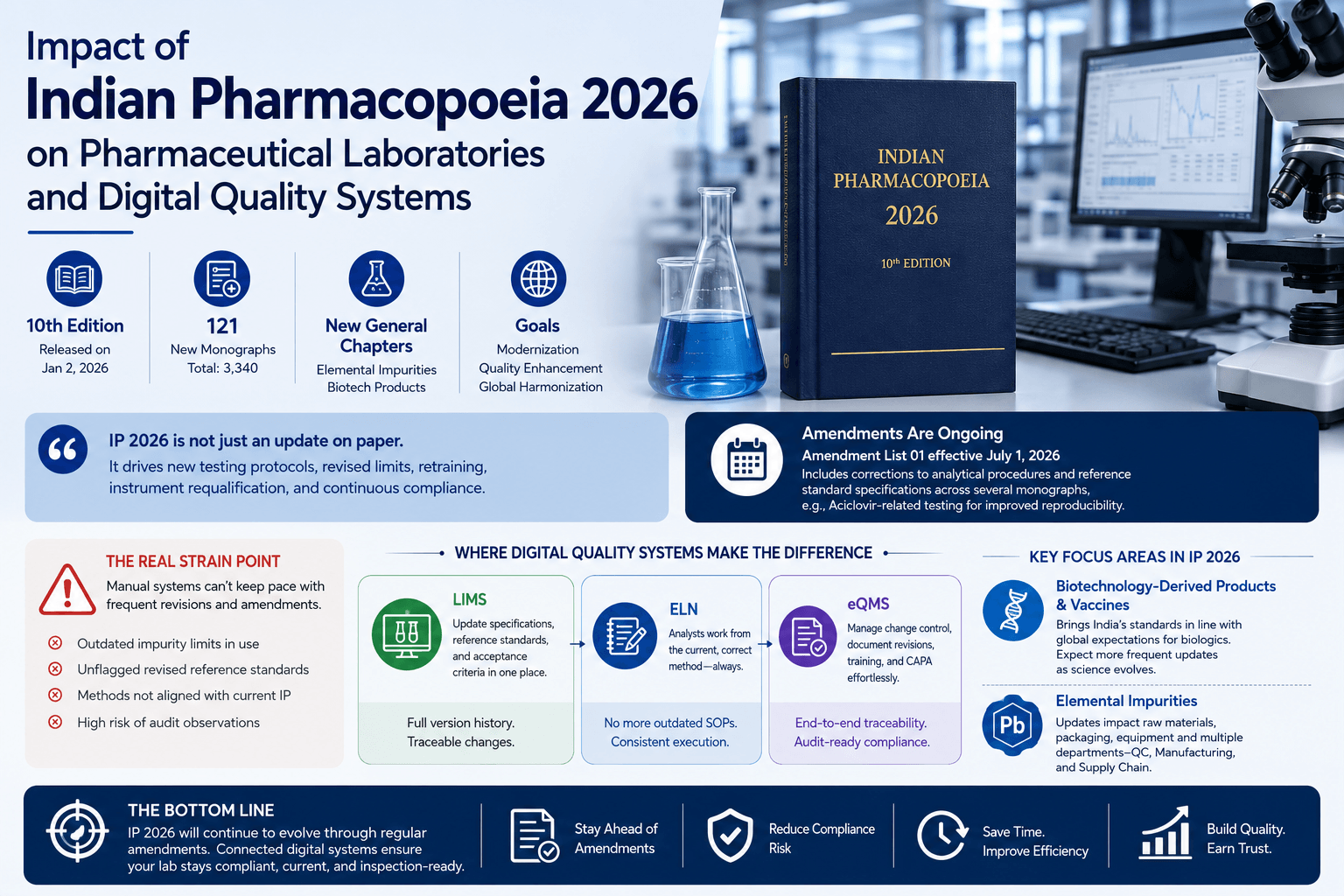
On January 2, 2026, Union Health Minister J.P. Nadda released the 10th edition of the Indian Pharmacopoeia at the Dr. Ambedkar International Centre in New Delhi. For most people outside the industry, that's a footnote. For anyone running a QC lab or managing a quality system in India, it's the kind of update that quietly reshapes daily work for the next several years.
IP 2026 isn't a minor revision. It adds 121 new monographs, bringing the total to 3,340, alongside new general chapters covering areas like elemental impurities and biotechnology-derived products. The stated goals — modernization, quality enhancement, and global harmonization — sound like standard regulatory language until you look at what they actually require labs to change on the ground.
What Changed, and Why It's Not Just Paperwork
Every new or revised monograph in IP 2026 translates into a testing protocol somewhere. New impurity limits, updated reference standard specifications, and revised analytical procedures don't stay on paper — they become method updates, new reagent requirements, retraining needs, and, in many cases, instrument requalification. The Indian Pharmacopoeia Commission has already issued Amendment List 01, effective July 1, 2026, correcting analytical procedures and reference standard specifications across several monographs, including changes to Aciclovir-related testing to improve method reproducibility.
That's a useful preview of what labs should expect going forward: IP updates don't arrive once and sit still. They get amended, clarified, and tightened on a rolling basis, which means a lab's quality system needs to track pharmacopoeial changes continuously rather than treating a new edition as a one-time event.
The Real Strain Point: Manual Systems Can't Keep Pace
Here's where the gap shows up. A lab running paper logbooks, disconnected spreadsheets, or a legacy LIMS that wasn't built for frequent regulatory revision has to manually cross-check every updated monograph against its current test methods, specifications, and reference standards. Multiply that across hundreds of products and dozens of monograph changes, and it's easy to see how something slips — an outdated impurity limit still in use, a reference standard nobody flagged as revised, a method that technically no longer matches the current IP specification.
This is precisely the failure mode that inspectors are trained to catch, and it's also the failure mode that a properly connected digital quality system is built to prevent.
Where Digital Quality Systems Actually Earn Their Keep
A modern LIMS (Laboratory Information Management System) gives QC teams a structured way to update test specifications, reference standard details, and acceptance criteria in one place, with full version history showing exactly what changed and when. When IP 2026 revises an impurity limit or introduces a new general chapter, that change needs to propagate to every affected test method — not get manually re-entered by hand in five different places.
Pair that with an ELN (Electronic Laboratory Notebook), and analysts are working from the current, correct method the moment it's updated, rather than referencing a printed SOP that may already be a version behind. The combination closes the gap between "the pharmacopoeia changed" and "our lab is actually testing to the new standard."
On the compliance side, an eQMS ties it together. Monograph changes typically trigger change control, document revision, training records, and sometimes CAPA if a gap is found in existing practice. Handling that manually across a large product portfolio is where most quality teams lose time — and where a connected eQMS, linked directly to LIMS data, turns a scattered compliance exercise into a traceable, auditable workflow.
Biotechnology and Elemental Impurities: The Harder Cases
Two areas in IP 2026 deserve particular attention. New general chapters addressing biotechnology-derived therapeutic products and vaccines bring India's standards closer to international expectations for biologics — a category that's historically been harder to standardize than small-molecule drugs. Labs working with biologics will likely see more frequent monograph amendments in this space simply because the underlying science moves faster.
Elemental impurities guidance is the other area worth watching closely. These limits touch raw materials, packaging, and manufacturing equipment simultaneously, which means a single elemental impurity update can ripple across multiple departments — QC, manufacturing, and supply chain — all at once. Systems that only manage lab data in isolation, without connecting to manufacturing records, will struggle to track that ripple effect completely.
What This Means Heading Into the Rest of 2026
IP 2026 is going to keep evolving through amendments like the one issued in April 2026 covering biotechnology-derived products and vaccines. Labs that treat the pharmacopoeia as a static reference document, updated once every few years, are setting themselves up to fall behind on something eventually — not through negligence, but simply because manual tracking doesn't scale against a rolling amendment schedule.
The labs that adapt fastest are the ones already running connected digital systems, where a monograph change flows from LIMS to ELN to eQMS without someone manually chasing down every affected document. That's not really about chasing the latest software trend — it's about matching the pace of the regulatory environment itself, which in 2026 is moving faster than most legacy lab systems were ever designed to handle.


