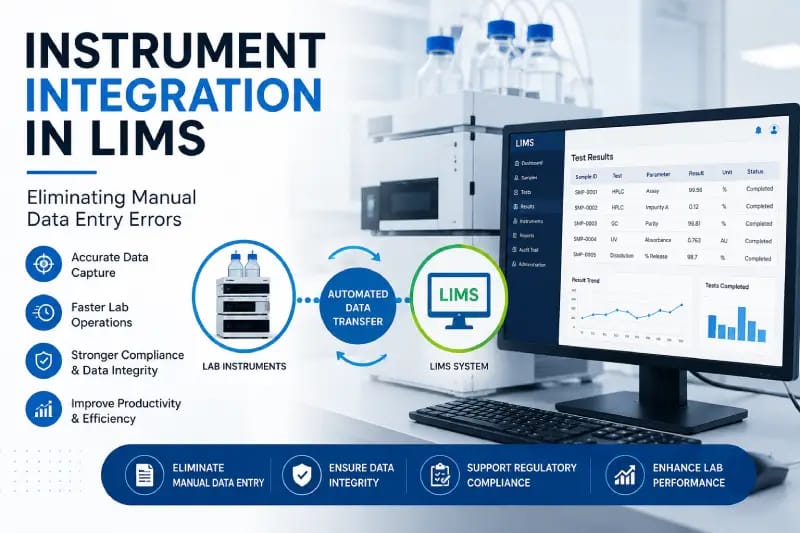
Modern laboratories generate vast amounts of data every day. From analytical instruments and chromatographs to balances and spectrophotometers, laboratory equipment continuously produces critical information that supports quality control, research, and regulatory compliance. However, many laboratories still rely on manual data entry processes, which increase the risk of errors, delays, and compliance challenges.
Instrument integration in a Laboratory Information Management System (LIMS) provides a powerful solution to these issues. By enabling seamless communication between laboratory instruments and the LIMS platform, organizations can improve data accuracy, enhance efficiency, and strengthen compliance across laboratory operations.
The Problem with Manual Data Entry
Manual transcription of instrument results into spreadsheets, paper records, or software systems introduces several risks. Even experienced laboratory personnel can make mistakes while entering large volumes of data. Common issues include:
Typographical errors
Missing or incomplete records
Duplicate entries
Incorrect sample associations
Delayed reporting and approvals
These errors can impact product quality, regulatory compliance, and laboratory productivity. For pharmaceutical manufacturers and regulated laboratories, inaccurate data can result in failed audits, costly investigations, and delayed product releases.
As laboratories continue to embrace digital transformation, eliminating manual data entry has become a key objective for improving operational excellence.
What Is Instrument Integration in LIMS?
Instrument integration refers to the direct connection between laboratory instruments and a Laboratory Information Management System. Instead of manually recording test results, data is automatically transferred from the instrument into the LIMS database.
This integration creates a streamlined workflow where analytical results are captured in real time, reducing human intervention and ensuring data integrity throughout the testing process.
Modern LIMS Software Features support integration with a wide range of laboratory instruments, including:
HPLC systems
Gas chromatographs
UV spectrophotometers
Analytical balances
Dissolution testers
Particle size analyzers
Environmental monitoring equipment
The result is a connected laboratory environment that improves accuracy and efficiency.
Benefits of Instrument Integration in LIMS
Improved Data Accuracy
Automated data transfer significantly reduces transcription errors. Results are captured directly from the instrument, ensuring that laboratory records accurately reflect the original data.
This capability is particularly valuable for organizations that require strict data integrity controls and regulatory compliance.
Faster Laboratory Operations
Instrument integration eliminates the need for repetitive manual entry tasks. Laboratory personnel can focus on testing, analysis, and quality improvement rather than administrative activities.
As part of effective LIMS For Lab Operations Management, automated workflows help laboratories process samples faster and improve turnaround times.
Enhanced Regulatory Compliance
Regulated industries must maintain complete and accurate records. Automated data capture supports audit trails, electronic signatures, and traceable workflows.
Organizations implementing LIMS Compliance Management can strengthen adherence to regulatory requirements such as 21 CFR Part 11, GMP, and data integrity guidelines.
Better Resource Utilization
Laboratories often face pressure to increase productivity without expanding staff. Instrument integration reduces administrative workload and allows scientists and analysts to focus on higher-value activities.
These operational efficiencies contribute to the overall LIMS Software Benefits that organizations seek when modernizing laboratory processes.
Why Instrument Integration Matters for Pharmaceutical Manufacturers
Pharmaceutical manufacturers operate in highly regulated environments where data accuracy is essential. Quality control laboratories must manage large volumes of analytical results while maintaining compliance with global regulations.
A modern LIMS System For Pharma enables automated collection and management of laboratory data, reducing risks associated with manual processes.
Integrated instruments support:
Batch release testing
Stability studies
Method validation
Environmental monitoring
Raw material testing
By eliminating manual data handling, pharmaceutical organizations can improve efficiency while maintaining the highest standards of quality and compliance.
Supporting Life Sciences Data Management
Laboratories in biotechnology, clinical research, and life sciences generate increasingly complex datasets. Managing this information manually is both time-consuming and error-prone.
LIMS For Life Sciences Data Management helps organizations centralize and control laboratory information from multiple instruments and locations. Automated integration ensures that critical data remains accurate, accessible, and secure throughout its lifecycle.
This capability supports research integrity while accelerating scientific decision-making.
Applications Beyond Pharmaceuticals
While pharmaceutical laboratories are among the largest adopters of LIMS, instrument integration also provides significant value across other industries.
For example, LIMS Software For Food And Beverage Labs helps organizations improve product quality, maintain regulatory compliance, and streamline testing processes. Automated instrument connectivity ensures accurate recording of microbiological, chemical, and nutritional testing results while reducing the risk of transcription errors.
Environmental laboratories, chemical manufacturers, and research institutions can also benefit from integrated workflows that improve data consistency and operational efficiency.
Instrument Integration for Small and Medium Laboratories
Many organizations assume that instrument integration is only suitable for large enterprises. In reality, LIMS For Small And Medium Laboratories offers significant advantages regardless of laboratory size.
Smaller laboratories often operate with limited resources and personnel. Automating data capture can help them:
Reduce operational costs
Improve productivity
Minimize human error
Enhance compliance readiness
Scale operations more efficiently
As laboratory workloads increase, integrated systems provide a foundation for sustainable growth.
LIMS Implementation Best Practices for Instrument Integration
Successful integration requires careful planning and execution. Organizations should follow several LIMS Implementation Best Practices to maximize results.
Assess Existing Instrument Infrastructure
Identify which instruments generate critical laboratory data and determine compatibility requirements.
Prioritize High-Impact Workflows
Focus first on instruments involved in high-volume testing or compliance-sensitive processes.
Validate Data Transfer Processes
Ensure that data transferred between instruments and the LIMS remains accurate, complete, and secure.
Train Laboratory Personnel
Users should understand both system functionality and compliance requirements to ensure successful adoption.
Plan for Future Expansion
As laboratory needs evolve, integration strategies should support additional instruments and emerging technologies.
The Importance of a LIMS System Upgrade
Many laboratories continue to operate legacy systems that lack advanced integration capabilities. A LIMS System Upgrade enables organizations to modernize laboratory operations, improve connectivity, and leverage automation technologies that support long-term growth.
Upgraded systems typically provide enhanced security, improved reporting capabilities, cloud deployment options, and broader compatibility with laboratory instruments. These improvements help laboratories maintain compliance while increasing operational efficiency.
Key Considerations When Evaluating LIMS Instrument Integration
When selecting a LIMS platform, laboratories should assess more than just data capture capabilities. A successful integration strategy depends on the system's ability to support existing instruments, maintain data integrity, and scale with future operational requirements.
Key evaluation criteria include:
Compatibility with laboratory instruments and equipment
Support for regulatory compliance and audit trails
Real-time data synchronization capabilities
Secure data transfer and storage mechanisms
Flexible workflow configuration options
Scalability for future laboratory growth
Integration with enterprise systems such as MES, ERP, and QMS
Organizations that prioritize these capabilities can reduce manual intervention, improve laboratory efficiency, and create a more connected digital ecosystem. As laboratories generate increasing volumes of analytical data, seamless instrument integration becomes an essential component of modern laboratory operations and quality management.


