In pharmaceutical and life sciences industries, maintaining product quality and regulatory compliance is critical. Every test result generated in the laboratory must meet predefined specifications and trends. When results fall outside expected limits, organizations must investigate quickly, accurately, and in compliance with regulatory requirements.
This is where Out of Specification (OOS) and Out of Trend (OOT) investigations become important.
Traditional investigation methods that rely on spreadsheets, paper records, emails, and disconnected systems often lead to delays, errors, incomplete documentation, and compliance risks. Modern Laboratory Information Management Systems (LIMS) help organizations streamline and strengthen the entire investigation process.
A modern LIMS not only manages laboratory data but also improves investigation workflows, ensures data integrity, enhances traceability, and supports faster decision-making.
Understanding OOS and OOT in Pharmaceutical Laboratories
What is OOS?
Out of Specification (OOS) refers to test results that fall outside predefined acceptance criteria or specifications. These results indicate that the product, material, or process may not meet quality standards.
Examples include:
Assay results below specification limits
Impurity levels exceeding thresholds
Microbial counts outside acceptable ranges
OOS investigations are mandatory under regulatory guidelines and require detailed root cause analysis and documentation.
What is OOT?
Out of Trend (OOT) refers to results that are within specification limits but show unusual variation or deviation from historical trends.
For example:
A gradual decline in assay values over multiple batches
Unexpected shifts in stability data
Trending microbial growth patterns
OOT results may indicate emerging quality issues before they become actual failures.
Both OOS and OOT investigations are essential for maintaining product quality, patient safety, and regulatory compliance.
Challenges in Traditional Investigation Management
Many organizations still depend on manual processes for handling investigations. This creates several operational and compliance challenges.
Delayed Investigations
Manual data collection and review slow down the investigation process. Teams spend significant time searching for records, compiling reports, and coordinating approvals.
Incomplete Documentation
Paper-based systems increase the risk of missing information, inconsistent records, and documentation gaps.
Poor Data Traceability
Tracking changes, analyst activities, instrument usage, and test history becomes difficult without centralized systems.
Increased Compliance Risks
Regulatory agencies such as the U.S. Food and Drug Administration and World Health Organization expect complete, accurate, and traceable investigation records. Manual systems often struggle to meet these expectations.
Limited Trend Analysis
Without automated analytics, identifying recurring deviations or long-term trends becomes challenging.
Modern LIMS platforms help overcome these limitations through automation, integration, and real-time visibility.
How Modern LIMS Improves OOS and OOT Investigation Management
Centralized Investigation Management
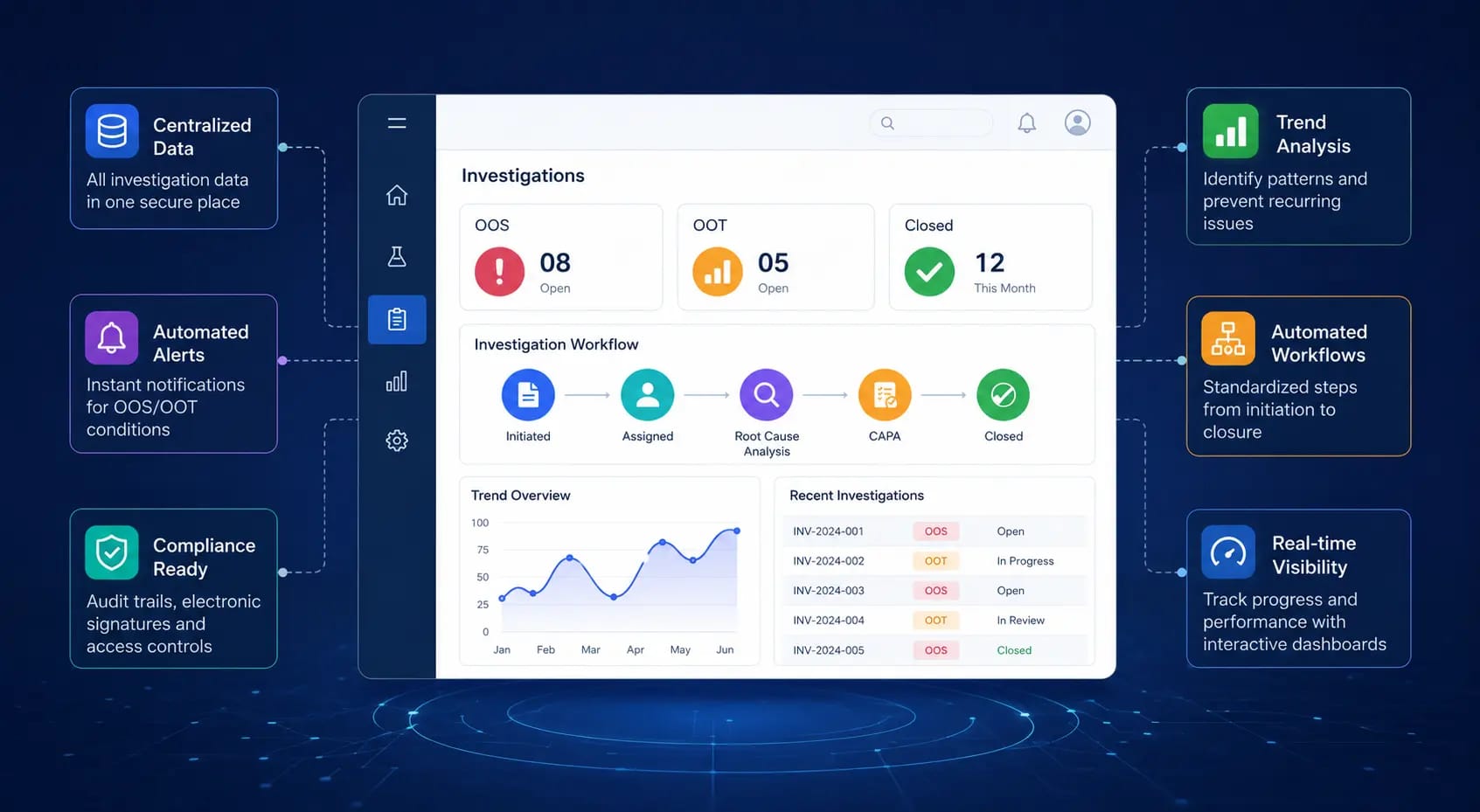
Modern LIMS centralizes all laboratory data, test results, investigation records, and supporting documents in a single platform.
This allows teams to:
Access complete investigation data instantly
Eliminate duplicate records
Improve collaboration across departments
Maintain consistent documentation
Centralized systems also improve audit readiness by ensuring all records are easily retrievable.
Automated OOS and OOT Detection
One of the biggest advantages of modern LIMS is automated identification of abnormal results.
The system can automatically:
Compare results against specifications
Detect trend deviations
Trigger alerts for potential OOS or OOT conditions
Notify quality and laboratory teams immediately
This helps organizations respond faster and reduce the risk of overlooked issues.
Faster Root Cause Analysis
Modern LIMS improves root cause investigations by providing quick access to:
Historical test data
Instrument calibration records
Analyst activities
Environmental monitoring data
Stability studies
Batch records
With all relevant information available in one system, teams can identify root causes more efficiently and accurately.
Improved Data Integrity and Compliance
Data integrity is a major focus in regulated industries. Modern LIMS supports compliance with ALCOA+ principles by ensuring data is:
Accurate
Legible
Contemporaneous
Original
Attributable
Features such as audit trails, electronic signatures, user access controls, and automated workflows help maintain secure and traceable records.
This improves compliance with:
FDA 21 CFR Part 11
EU GMP Annex 11
GxP guidelines
Automated Workflow Management
LIMS platforms standardize investigation workflows and reduce manual intervention.
Organizations can configure workflows for:
Investigation initiation
Assignment of responsibilities
Review and approval processes
CAPA management
Escalation handling
Final closure
Automated workflows ensure investigations follow predefined procedures and timelines.
Better Trend Analysis and Reporting
Modern LIMS includes advanced analytics and reporting capabilities that help identify recurring issues and process variations.
Laboratories can:
Monitor long-term product trends
Detect recurring deviations
Analyze batch performance
Generate statistical reports
Improve process understanding
These insights support continuous quality improvement and proactive risk management.
Real-Time Visibility and Dashboards
Real-time dashboards provide instant visibility into investigation status, pending actions, and laboratory performance.
Management teams can monitor:
Open investigations
Investigation timelines
Root cause categories
CAPA effectiveness
Analyst productivity
This improves operational transparency and helps reduce investigation backlogs.
Integration with Other Quality Systems
Modern LIMS can integrate with other enterprise systems such as:
ERP
Integration enables seamless data exchange and improves end-to-end quality management.
Benefits of Modern LIMS for OOS and OOT Management
Organizations implementing modern LIMS solutions gain several important benefits.
Reduced Investigation Cycle Time
Automation and centralized data significantly reduce the time required to complete investigations.
Improved Regulatory Compliance
Standardized workflows and complete audit trails help organizations meet global regulatory requirements.
Enhanced Data Accuracy
Automated data capture minimizes manual entry errors and improves result reliability.
Better Decision-Making
Real-time access to investigation data enables faster and more informed quality decisions.
Proactive Quality Management
Trend analysis and predictive insights help organizations identify risks before they become critical issues.
Increased Operational Efficiency
Laboratory teams can focus more on scientific analysis instead of administrative tasks.
Why Pharmaceutical Companies Are Moving Toward Modern LIMS
As regulatory expectations continue to evolve, pharmaceutical companies are increasingly adopting digital laboratory solutions to improve compliance and operational efficiency.
Modern LIMS supports:
Digital transformation initiatives
Paperless laboratory operations
Faster product release
Improved inspection readiness
Enhanced quality oversight
Organizations that modernize their laboratory operations gain better control over investigations and reduce overall compliance risk.
How AmpleLogic LIMS Supports Investigation Excellence
AmpleLogic provides advanced LIMS solutions designed specifically for regulated industries such as pharmaceuticals, biotechnology, life sciences, and healthcare.
The platform helps organizations:
Automate OOS and OOT investigation workflows
Improve laboratory efficiency
Ensure regulatory compliance
Maintain data integrity
Enhance traceability and reporting
Streamline quality management processes
With configurable workflows, audit-ready documentation, and real-time visibility, AmpleLogic LIMS enables organizations to manage investigations more effectively while improving overall laboratory performance.
Conclusion
OOS and OOT investigations are critical components of pharmaceutical quality management. Traditional manual investigation processes often create delays, inefficiencies, and compliance risks.
Modern LIMS transforms investigation management by automating workflows, improving data integrity, enabling faster root cause analysis, and providing real-time visibility into laboratory operations.
By adopting a modern LIMS solution, pharmaceutical organizations can strengthen compliance, improve operational efficiency, and build a more proactive quality management system.
As laboratories continue moving toward digital transformation, modern LIMS platforms like those offered by AmpleLogic will play a key role in improving investigation accuracy, speed, and regulatory readiness.


