Walk into any pharmaceutical laboratory today and you'll see sophisticated analytical instruments, automated workflows and teams working under tight regulatory timelines. Yet, in many cases, the information produced by those instruments still travels through disconnected systems before it reaches its final destination. Sample details may sit inside one application, experiment notes inside another, and supporting documents somewhere else entirely.
This fragmented approach doesn't always cause immediate problems. The real challenge appears later—during an investigation, an audit, or when someone needs to trace exactly how a result was generated.
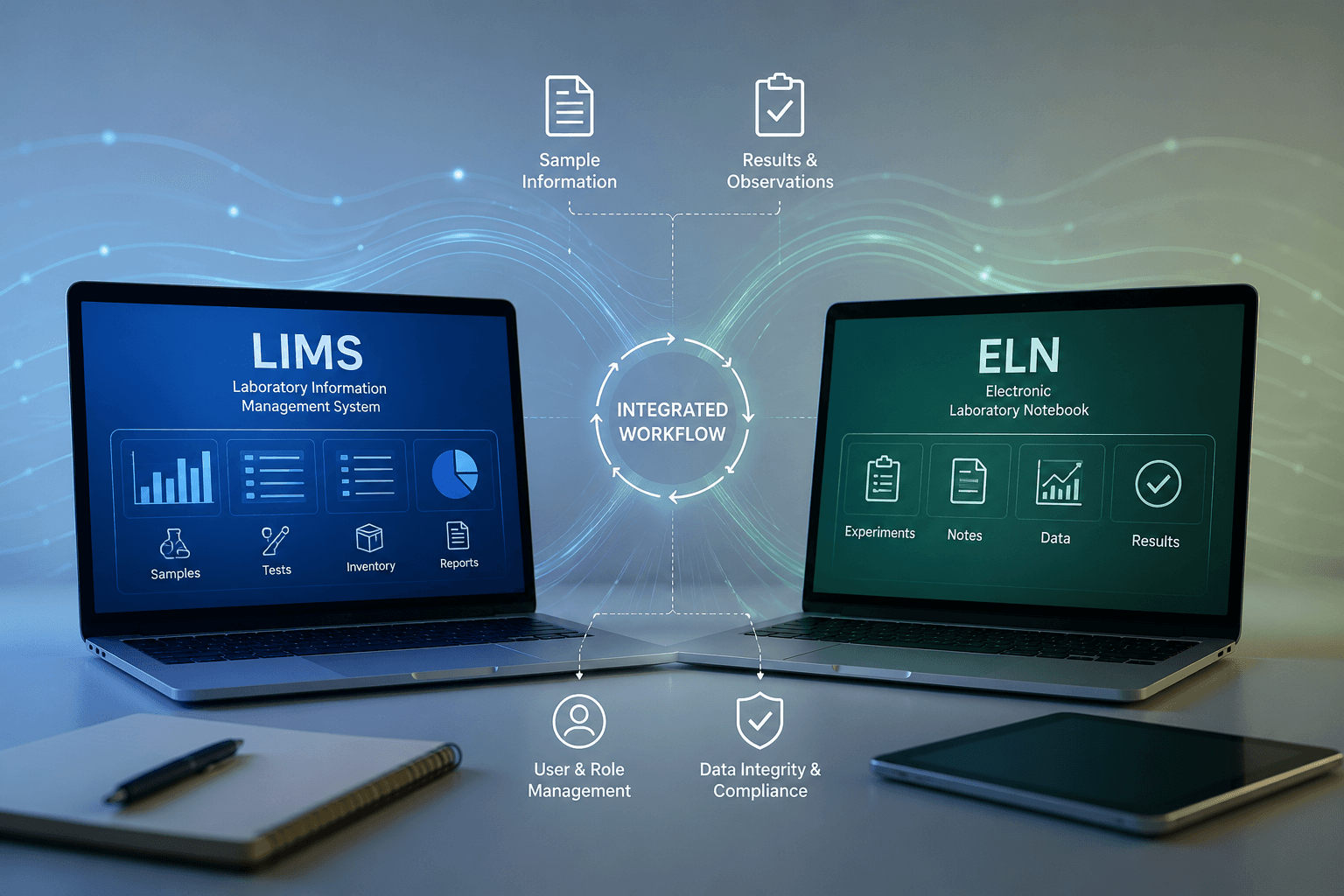
That is one of the biggest reasons pharmaceutical companies are investing in both an Electronic Laboratory Notebook and a Laboratory Information Management System. Each one of these solves a different laboratory challenge. But when worked together, they create a connected environment where data of a sample gets recorded from start to finish. This makes everyday laboratory work simpler, faster and far more reliable.
Different Tools, Different Responsibilities
People often compare an Electronic Laboratory Notebook with a Laboratory Information Management System, but they were never designed to replace one another.
Think about a routine assay in a quality control laboratory.
Before testing begins, the sample has to be received, labelled, assigned to the correct analyst and linked with the right specification. Those operational activities belong to a Laboratory Information Management System.
The testing itself tells another story. An analyst may record observations that never appear in the final certificate of analysis. Instrument screenshots, chromatograms, calculations, unexpected findings and method adjustments all become part of the scientific record. That information belongs inside an Electronic Laboratory Notebook.
One system manages laboratory operations.
The other preserves laboratory knowledge.
Neither replaces the other.
Why Laboratories No Longer Want Separate Systems
Imagine an analyst testing a raw material batch.
The sample arrives and is registered in LIMS Software. After completing the analysis, the analyst documents calculations and observations using ELN Software. Finally, approved results are entered back into the laboratory management system.
Nothing about this process seems unusual until someone notices the same information has been entered more than once.
Duplicate entry creates unnecessary work. More importantly, it creates opportunities for mistakes. A misplaced decimal, an incorrect sample number or a copied result can quickly become an investigation that consumes valuable time.
When the Electronic Laboratory Notebook communicates directly with the Laboratory Information Management System, those repeated steps disappear. Sample information travels automatically, allowing analysts to focus on laboratory work rather than administration.
It is a small operational change that often produces a noticeable improvement in efficiency.
Scientists Should Spend More Time on Science
Laboratory professionals are highly trained specialists. Their expertise lies in generating reliable analytical results—not searching for files or retyping information into multiple applications.
Unfortunately, administrative work tends to grow as laboratories expand.
A reviewer requests additional evidence. Someone searches for an old experiment. An analyst needs to compare today's results with data generated six months earlier. What should take minutes sometimes stretches into hours because information is spread across different locations.
A connected Electronic Laboratory Notebook changes that experience.
Historical experiments become searchable. Supporting documents remain attached to each record. Previous calculations are easy to retrieve, and reviewers no longer need to chase paperwork before approving results.
These improvements rarely attract attention individually, but together they remove many of the small frustrations that slow laboratory teams every day.
Better Data Integrity Starts with Better Workflows
Regulatory guidance often focuses on data integrity, but maintaining high-quality records begins long before an inspector arrives.
Good data is usually the result of good processes.
An integrated Laboratory Information Management System helps ensure that every sample follows the correct workflow. An Electronic Laboratory Notebook captures who performed each activity, when it happened and what supporting evidence was generated along the way.
Because the information is linked automatically, laboratories avoid many of the inconsistencies that appear when data is copied between unrelated systems.
Electronic signatures, audit trails, version histories and user permissions become part of normal laboratory operations rather than additional compliance tasks.
That makes life easier not only during inspections but throughout the entire product lifecycle.
Collaboration Improves When Everyone Sees the Same Information
Most laboratory activities involve more than one person.
An analyst performs the test.
A senior scientist reviews the data.
Quality assurance verifies compliance.
Managers monitor turnaround times and laboratory performance.
If each team works from different records, questions inevitably arise.
Which calculation is the latest version?
Where is the supporting chromatogram?
Has the reviewer already approved this experiment?
Integrated ELN Software and LIMS Software reduce those questions because authorised users are looking at the same connected information.
Instead of requesting documents from colleagues, they simply open the laboratory record.
That may sound like a small convenience, but across hundreds of samples every week it saves a considerable amount of time.
Preparing Laboratories for the Next Five Years
Laboratories are under increasing pressure to deliver results more quickly while maintaining complete regulatory compliance. Sample volumes continue to rise, products are becoming more complex and organisations are expected to make better use of their scientific data.
Managing that growth with paper notebooks or disconnected software becomes increasingly difficult.
Modern laboratories need systems that can adapt without adding unnecessary complexity.
A Laboratory Information Management System provides the operational foundation by organising samples, workflows and approvals. An Electronic Laboratory Notebook captures the scientific reasoning that supports every result. Together, they create a digital laboratory where information remains accurate, searchable and accessible throughout its lifecycle.
That foundation also makes it easier to introduce automation, advanced analytics and AI-driven laboratory insights in the future because the underlying data is already structured and connected.
A Unified Approach Makes the Difference
Many pharmaceutical companies initially purchase software to solve a single problem. Perhaps they want better sample tracking. Others begin by replacing paper notebooks.
Over time, they often realise that solving one challenge without addressing the other leaves gaps in the overall process.
That is why integrated platforms have become increasingly popular across regulated industries.
Solutions such as AmpleLogic's LIMS Software, with integrated Electronic Laboratory Notebook capabilities, allow laboratories to manage samples, experiments, approvals and documentation from one connected environment. Rather than moving information manually between applications, users work with a continuous digital record that supports efficiency, traceability and regulatory compliance.
Conclusion
Digital transformation in the laboratory is no longer about replacing paper with electronic records. The real value comes from connecting people, processes and data so information flows naturally from one stage to the next.
An Electronic Laboratory Notebook is a tool for scientists to keep track of what they do. It helps them write down their work in an organized way. A Laboratory Information Management System is also very useful because it keeps everything that happens in the laboratory in order and easy to follow.
When you use an Electronic Laboratory Notebook and a Laboratory Information Management System together they really help scientists. They cut down on tasks that they have to do over and over. They also make it easier for scientists to work together as a team. This helps make sure that the information they collect is accurate and reliable.. The best part is that laboratories can stay ready for inspections every single day, with an Electronic Laboratory Notebook and a Laboratory Information Management System.
For pharmaceutical organisations looking to modernise laboratory operations, bringing ELN Software and LIMS Software together is more than a technology upgrade. It is a practical step towards building a laboratory that is efficient, compliant and prepared for future growth.


