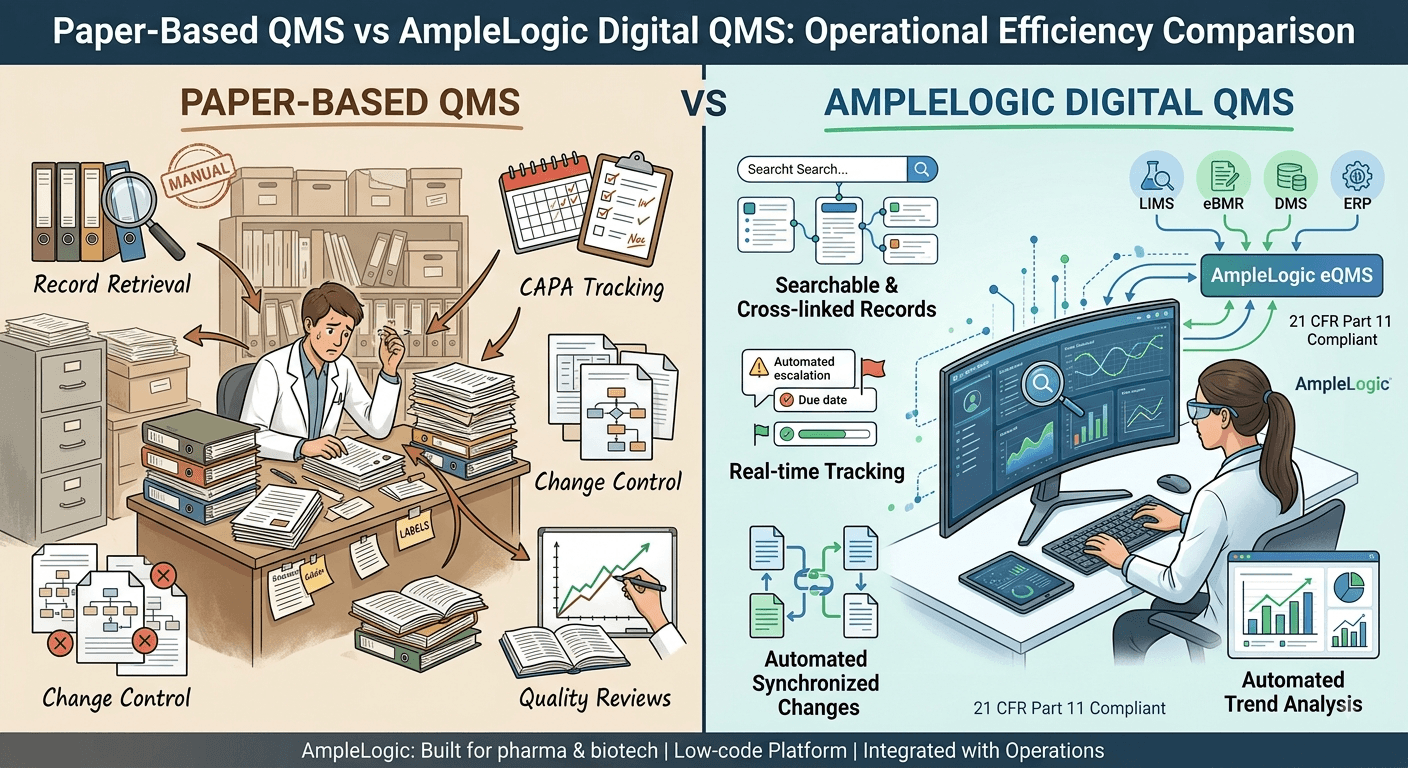
Plenty of pharma and biotech companies still run their quality system largely on paper, and it's not because the teams running them don't care about compliance. Paper-based processes were the standard for decades, and they can technically satisfy GMP requirements. The question worth asking isn't whether paper works. It's whether it holds up as well as a connected digital system does in the moments that actually matter: an inspection, a deviation investigation, a CAPA that needs to move fast.
Retrieving records during an inspection
Paper-based: Finding a specific batch record, training file, or CAPA often means physically locating a binder, and cross-referencing related documents means pulling several binders at once. This is where inspections slow down and where confidence in the system starts to erode.
Digital QMS: Every record is searchable and cross-linked. A CAPA pulls up its related deviation, the affected SOP, and the training records for anyone retrained as a result, in the same view.
Tracking deviations and CAPAs to closure
Paper-based: Status tracking depends on someone manually checking due dates against a log. Escalation, if it happens at all, relies on a person noticing something is overdue.
Digital QMS: Automated escalation and real-time dashboards flag approaching and missed deadlines before they become a finding, and CAPA effectiveness checks are a required workflow step rather than an optional follow-up.
Keeping change control synchronized
Paper-based: A specification change has to be manually traced to every SOP, training module, and batch record it affects, which means real risk of something getting missed.
Digital QMS: Change control workflows automatically trigger the downstream updates, so a change to one document reliably reaches everything connected to it.
Compiling quality reviews and trend analysis
Paper-based: Building a periodic quality review means manually pulling data from multiple logs and rebuilding charts from scratch, often taking weeks.
Digital QMS: Data aggregates continuously from connected systems, and statistical analysis, including process capability and control charts, generates automatically.
Where AmpleLogic's eQMS fits into this comparison
AmpleLogic's electronic quality management system is built specifically around the gaps that show up in the comparison above: deviation management, CAPA, change control, audit management, and OOS/OOT investigations, all connected natively to LIMS, eBMR, DMS, and ERP so quality data doesn't live in a separate silo from the operations it's monitoring. Built on a 21 CFR Part 11 compliant, low-code platform, it's designed to be configured by quality and IT teams directly rather than requiring a developer for every workflow change.
The honest answer
Paper isn't inherently non-compliant, and plenty of companies have passed inspections running on it. But every comparison above comes down to the same pattern: paper depends on someone remembering to check, and digital systems check automatically. As data volumes grow and inspections get more focused on data integrity and traceability, that difference compounds.
If you're weighing the move, the eQMS product page is a good place to see the specific modules and how they'd connect to what you're already running.


