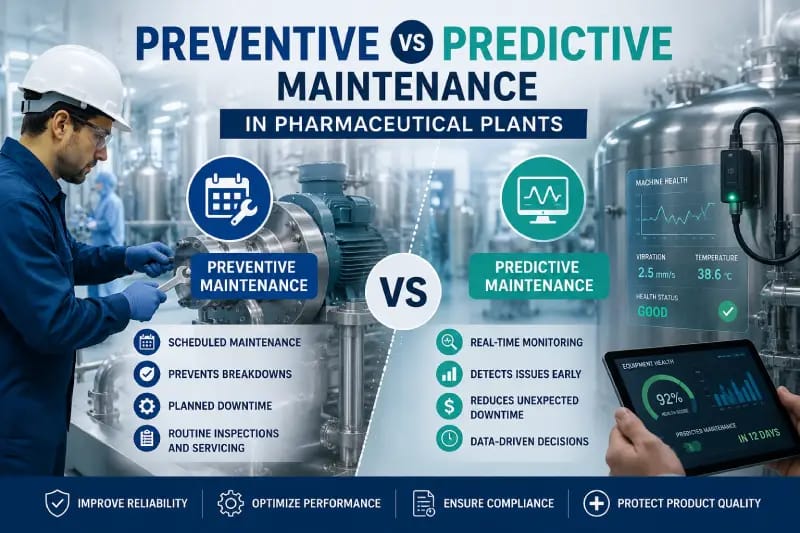
In pharmaceutical manufacturing, equipment reliability is critical for maintaining product quality, regulatory compliance, and operational efficiency. Any unexpected equipment failure can lead to production delays, product loss, compliance risks, and increased maintenance costs. To avoid these issues, pharmaceutical companies rely on maintenance strategies that help keep equipment running smoothly.
Two of the most commonly used approaches are Preventive Maintenance and Predictive Maintenance. While both aim to reduce equipment downtime and improve performance, they differ significantly in how maintenance activities are planned and executed.
Understanding the differences between preventive and predictive maintenance can help pharmaceutical organizations choose the right strategy for their operations and regulatory requirements.
What is Preventive Maintenance?
Preventive Maintenance (PM) is a maintenance strategy where equipment is serviced at predefined intervals regardless of its current condition. These maintenance activities are scheduled based on time, usage hours, production cycles, or manufacturer recommendations.
For example, a pharmaceutical company may schedule calibration of instruments every six months or replace machine components after a specific number of operating hours.
Key Characteristics of Preventive Maintenance
Maintenance is performed according to a fixed schedule.
Activities include inspections, cleaning, lubrication, calibration, and part replacement.
Helps reduce the likelihood of unexpected equipment failures.
Easy to plan and manage through maintenance schedules.
Benefits of Preventive Maintenance
Improves equipment reliability.
Reduces unplanned downtime.
Supports regulatory compliance requirements.
Extends equipment lifespan.
Simplifies maintenance planning and documentation.
Challenges of Preventive Maintenance
Components may be replaced before they actually need replacement.
Maintenance activities can increase labor and spare parts costs.
Scheduled maintenance may require production interruptions.
It does not always prevent sudden failures between maintenance intervals.
What is Predictive Maintenance?
Predictive Maintenance (PdM) is a data-driven maintenance strategy that monitors equipment performance and condition in real time. Instead of following a fixed schedule, maintenance is performed only when data indicates that equipment performance is declining or a failure may occur.
Predictive maintenance uses technologies such as sensors, condition monitoring systems, data analytics, and Industrial Internet of Things (IIoT) devices to assess equipment health.
For example, vibration monitoring on a pharmaceutical mixer can detect abnormal patterns that indicate bearing wear. Maintenance can then be scheduled before a breakdown occurs.
Key Characteristics of Predictive Maintenance
Maintenance decisions are based on actual equipment condition.
Uses real-time monitoring and data analysis.
Identifies potential failures before they happen.
Optimizes maintenance schedules based on equipment health.
Benefits of Predictive Maintenance
Minimizes unexpected equipment failures.
Reduces maintenance costs.
Increases equipment availability.
Improves production efficiency.
Extends asset life by avoiding unnecessary maintenance.
Supports better resource planning.
Challenges of Predictive Maintenance
Requires investment in monitoring technologies and software.
Implementation can be more complex than preventive maintenance.
Requires skilled personnel to analyze maintenance data.
Initial setup costs may be higher.
Preventive Maintenance vs Predictive Maintenance
Both maintenance strategies aim to improve equipment performance, but they differ in several important ways.
Maintenance Scheduling
Preventive maintenance follows a fixed schedule based on time or usage. Predictive maintenance schedules maintenance activities only when equipment data indicates a need.
Data Usage
Preventive maintenance relies on predefined maintenance plans. Predictive maintenance uses real-time data collected from equipment sensors and monitoring systems.
Cost Efficiency
Preventive maintenance may result in unnecessary maintenance activities and part replacements. Predictive maintenance helps reduce unnecessary maintenance by addressing issues only when needed.
Equipment Downtime
Preventive maintenance reduces unexpected failures but may still allow breakdowns between maintenance intervals. Predictive maintenance provides earlier warning signs, helping organizations avoid unplanned downtime.
Resource Utilization
Predictive maintenance allows maintenance teams to focus their efforts where they are most needed, improving labor and resource utilization.
Importance of Maintenance Strategies in Pharmaceutical Plants
Pharmaceutical manufacturing facilities operate under strict regulatory requirements. Equipment must consistently perform as intended to ensure product quality, patient safety, and compliance with Good Manufacturing Practices (GMP).
Poorly maintained equipment can lead to:
Batch failures
Production delays
Product contamination risks
Regulatory observations
Increased operational costs
Both preventive and predictive maintenance play an important role in maintaining compliance and operational excellence. However, as pharmaceutical manufacturing becomes more digitalized, predictive maintenance is gaining popularity due to its ability to provide deeper insights into equipment performance.
How Digital Maintenance Solutions Support Pharmaceutical Operations
Modern pharmaceutical companies are increasingly adopting digital maintenance management systems to streamline maintenance activities.
Advanced maintenance software can help organizations:
Schedule preventive maintenance activities.
Track calibration and maintenance records.
Monitor equipment performance.
Generate maintenance reports for audits.
Improve asset lifecycle management.
Support data-driven maintenance decisions.
Integrated maintenance solutions provide complete visibility into equipment health, helping organizations improve reliability while maintaining compliance with regulatory standards.
Which Maintenance Strategy is Right for Your Pharmaceutical Plant?
The choice between preventive and predictive maintenance depends on factors such as equipment criticality, operational goals, budget, and technology readiness.
Preventive maintenance remains a reliable approach for many pharmaceutical facilities, especially for equipment with predictable maintenance requirements.
Predictive maintenance is ideal for critical assets where unexpected failures can significantly impact production, compliance, or product quality.
In many cases, the most effective approach is a combination of both strategies. Preventive maintenance can be applied to standard equipment, while predictive maintenance can be used for high-value or mission-critical assets.
Preventive and predictive maintenance are both essential strategies for ensuring equipment reliability in pharmaceutical plants. Preventive maintenance provides a structured and compliant approach to routine equipment care, while predictive maintenance leverages real-time data to optimize maintenance activities and reduce downtime.
As pharmaceutical manufacturers continue to embrace digital transformation, predictive maintenance is becoming an important tool for improving operational efficiency, reducing costs, and maintaining compliance. By implementing the right maintenance strategy and leveraging modern maintenance management solutions, pharmaceutical organizations can achieve greater equipment performance, higher productivity, and long-term business success.


