Manufacturing a drug that meets specification once isn't the hard part. Doing it consistently, batch after batch, year after year, while regulators watch every deviation — that's where most quality teams feel the pressure. This is exactly why process performance monitoring pharma companies depend on has shifted from a once-a-year validation exercise into something continuous, data-driven, and far less forgiving of manual gaps.
Continued Process Verification (CPV) sits at the center of this shift. It's the ongoing assurance that a manufacturing process stays in a validated state throughout its commercial life, not just during the initial three-batch qualification. Regulators including the FDA and EMA expect it. Auditors ask for it by name. And yet, a surprising number of pharma manufacturers still track it through spreadsheets, disconnected LIMS pulls, and manual trend charts built the night before an inspection.
Why Manual Monitoring Falls Short
Spreadsheet-based process monitoring might work for a single product line with a handful of critical quality attributes. It falls apart quickly once you're managing:
Multiple products across different manufacturing sites
Dozens of critical process parameters (CPPs) and critical quality attributes (CQAs)
Statistical process control limits that need constant recalculation
Cross-functional teams who all need visibility into the same data
When monitoring lives in disconnected files, trends get missed, out-of-trend results surface too late, and audit trails become a scramble rather than a given.
How Process Performance Monitoring in Pharma Changes the Picture with Amplelogic CPV
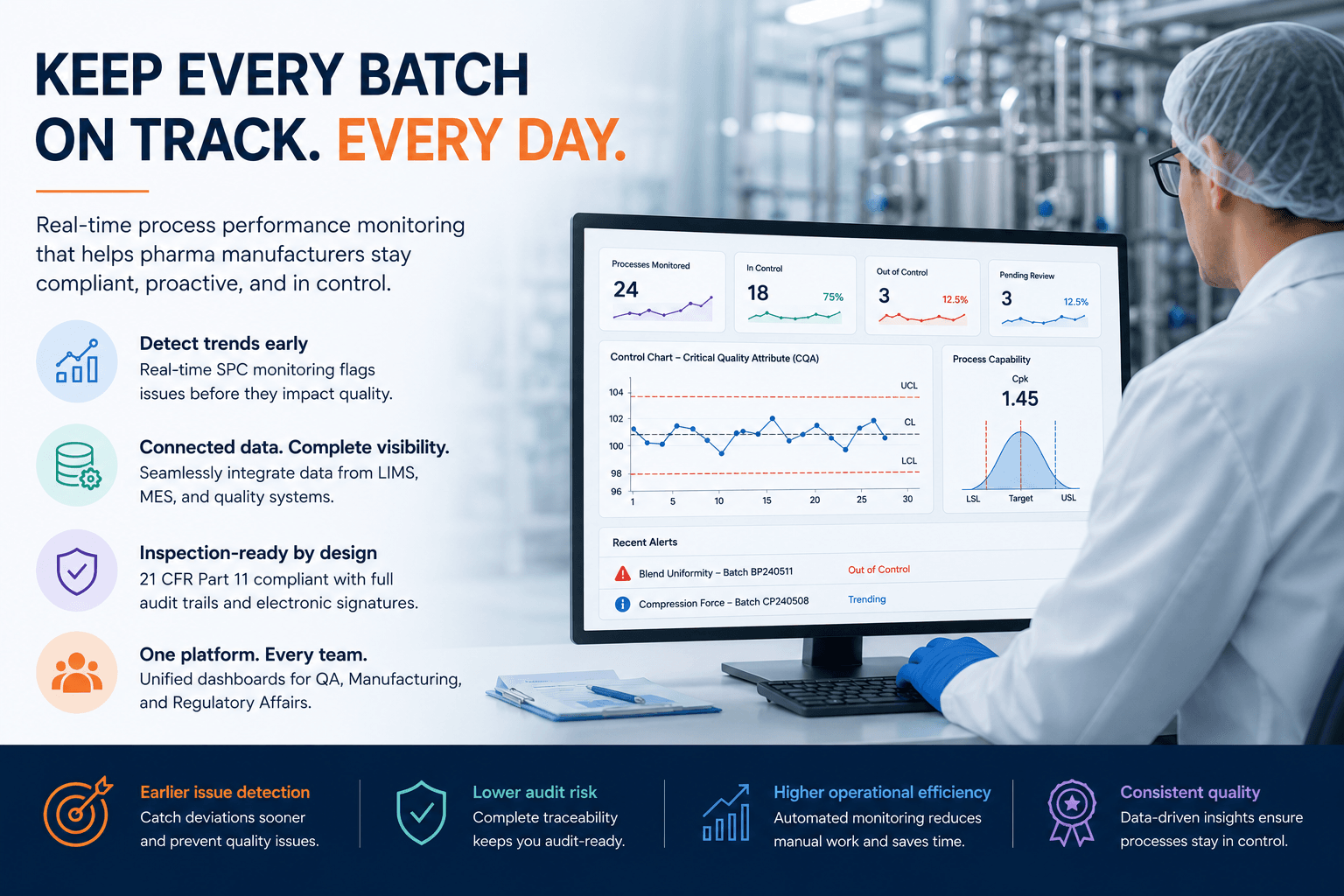
AmpleLogic's CPV application was built specifically for this gap. It pulls process and qualityA data automatically, applies statistical tools like control charts and capability indices, and flags trends before they become deviations.
A few things set it apart for teams focused on process performance monitoring pharma operations require:
Automated data integration from LIMS, MES, and other quality systems, cutting out manual data entry errors
Real-time trend analysis using SPC methods, so out-of-trend signals get caught early instead of during a retrospective review
Configurable dashboards that give QA, manufacturing, and regulatory affairs the same real-time view without needing separate reports
21 CFR Part 11 compliant audit trails, so every change, review, and approval is timestamped and traceable
GAMP 5 aligned architecture, built to support validated environments without extra customization overhead
Built for the Realities of GxP Manufacturing
What makes CPV genuinely useful isn't just the dashboards — it's how it fits into existing quality systems. AmpleLogic's platform connects with CAPA and deviation modules, so when a trend does cross a threshold, the investigation workflow starts automatically rather than depending on someone noticing a chart days later. Electronic signatures and role-based access keep the system inspection-ready without additional manual documentation.
For quality teams preparing for an FDA or EMA audit, this matters more than it might seem. Inspectors increasingly ask not just "do you monitor your processes" but "show me how you knew this trend was developing before it became an OOS result." A connected CPV system answers that question with data, not explanation.
Where This Fits in a Broader Quality Strategy
Process performance monitoring doesn't work in isolation. It's most effective when it's part of a connected quality ecosystem — tied to your Document Management System for SOP version control, your LIMS for testing data, and your CAPA system for closing the loop when something drifts. AmpleLogic's platform is designed with this connectivity in mind, so CPV isn't a standalone tool bolted onto existing systems but a natural extension of them.
The Bottom Line
Continued Process Verification isn't optional anymore, and manual tracking methods aren't sustainable at scale. Pharma manufacturers that invest in automated process performance monitoring reduce audit risk, catch quality issues earlier, and free up QA teams from chasing spreadsheets. AmpleLogic's CPV application brings this together in a validated, GxP-ready platform that grows with your manufacturing footprint.
If your team is still piecing together trend data manually, it might be time to see what a connected CPV system looks like in practice.


