A batch can be ready for release and still sit in the queue.
The manufacturing team has finished its part. The samples are in QC. The methods are approved. The analysts know what needs to be tested. And yet, the result isn't moving as quickly as everyone expected.
Sometimes the instrument needed for the next test is already booked. Sometimes the only qualified analyst is handling another priority. A stability sample reaches its testing window. An urgent release sample suddenly jumps to the front of the queue. The QC planner then has to work out what can move, what cannot, and what the change means for everything else.
This is becoming one of the less obvious problems in pharmaceutical quality control.
The laboratory may have enough analysts and instruments on paper. What it doesn't necessarily have is enough usable capacity.
That's where a QC management system starts to mean something more than software for managing laboratory records. It becomes a way of coordinating the people, instruments, samples, priorities, and timelines that determine whether QC work actually gets completed on time.
The QC Bottleneck Isn't Always in the Laboratory
When a batch release is delayed, attention usually goes to the testing itself.
Was the method too slow? Was there an instrument issue? Did the sample fail? Was additional testing required?
Those questions matter, but there's another one worth asking:
Was the testing planned properly in the first place?
A laboratory can lose considerable capacity without losing a single instrument or employee.
An analyst spends an hour rearranging assignments. An HPLC remains unused because the next compatible test wasn't ready. Similar samples are run separately, creating unnecessary setup time. An urgent test forces the planner to manually reshuffle half a day's schedule.
None of these events looks like a major failure.
Together, they create a backlog.
AmpleLogic identifies inefficient analyst and instrument utilization, manual scheduling, fragmented workflows, underutilized instruments, and limited visibility into laboratory workload and capacity as key QC planning challenges.
The question for a QC manager therefore isn't simply:
"How many resources do we have?"
It's:
"How much testing can we realistically complete with the resources available today?"
That is a very different question.
Why Spreadsheets Stop Being Enough
Spreadsheets are often perfectly reasonable when a laboratory is small.
They're familiar. They're flexible. A QC planner can change a cell, move a test, add an analyst, and share the schedule with the team.
The trouble starts when the spreadsheet becomes the place where several different decisions are being connected manually.
One file contains the testing plan. Another tracks instruments. Someone knows which analysts are qualified for particular methods. An urgent request arrives through email. Another person has the latest change on their desktop.
Everything depends on people keeping everything synchronized.
Until something changes.
An analyst becomes unavailable.
An instrument goes down.
A batch-release test needs to move forward.
A stability pull becomes due.
Now someone has to rebuild the plan while remembering all the dependencies that were never visible in one place.
A modern QC management system brings those relationships together so planning isn't dependent on one person's spreadsheet knowledge.
What Should a QC Management System Actually Manage?
The term "QC management system" can sound broader than it really is.
For a pharmaceutical laboratory, it shouldn't simply mean another system for recording test results.
The more useful question is whether it can manage the work that has to happen before those results exist.
That means connecting:
Samples with priorities so time-sensitive testing doesn't get buried in routine work
Tests with qualified analysts rather than assigning work based only on availability
Analysts with their workload so one person isn't overloaded while another has capacity
Tests with instruments so scheduling reflects actual equipment availability
Testing with turnaround times so deadlines can be managed before they become overdue
Similar samples with campaigns so compatible work can be grouped efficiently
Laboratory workload with capacity so planners can see where the next bottleneck is likely to appear
This is where QC planning becomes an operational discipline rather than a calendar exercise.
AmpleLogic's QC Planning & Scheduling solution combines workload forecasting, batch-release planning, sample prioritization, capacity planning, automated scheduling, resource allocation, campaign-based execution, and real-time laboratory visibility.
Analyst Availability Isn't Enough
Here's a situation most QC planners will recognize.
A test requires a particular analytical method. Two analysts are qualified. One is available tomorrow morning; the other is already assigned to stability testing.
On paper, there is an available analyst.
But the instrument required for the test is booked until the afternoon.
So the test cannot actually happen tomorrow morning.
This is why resource planning needs to look at more than one variable.
A useful QC management system should consider analyst qualification, workload, availability, instrument availability, and testing priorities together.
AmpleLogic's scheduling engine is designed to assign tests to qualified analysts and available instruments while supporting workload balancing and conflict detection.
The difference is subtle but important.
The question stops being:
"Who is free?"
It becomes:
"Who is qualified, available, and able to complete this test with the right equipment within the required timeline?"
That's the question a QC planner actually needs answered.
Batch Release Makes Scheduling a Business Problem
Not every QC test carries the same operational consequence.
A routine test and a batch-release test might both require an hour of instrument time. But delaying one could have a very different effect on manufacturing and release timelines.
This is why priority-based scheduling matters.
A modern QC management system should allow the laboratory to identify time-sensitive work and adjust the schedule accordingly. Batch-release testing, stability checks, and other deadline-driven activities cannot always be treated as another item in a first-come, first-served queue.
AmpleLogic supports priority-based scheduling for time-sensitive testing, including batch release and stability checks, along with turnaround-time monitoring and escalation when samples approach defined deadlines.
The benefit isn't simply a cleaner schedule.
It's knowing which delay matters most before it becomes a business problem.
Campaign-Based Testing Can Recover Lost Capacity
There's another source of inefficiency that isn't always obvious.
Imagine several samples requiring similar analytical work. If every sample is treated as an individual job, the laboratory may repeatedly prepare an instrument, change methods, and perform setup activities.
Now group compatible samples into an analytical campaign.
The instrument can handle similar work together, reducing avoidable setup and changeover time.
For a high-volume QC laboratory, those small savings can accumulate quickly.
AmpleLogic's platform supports sample campaigning by grouping similar samples according to factors such as product, method, or turnaround-time requirements. The objective is to reduce instrument setup time and improve testing throughput.
It is a good example of why QC scheduling shouldn't stop at deciding when a test happens.
It should also consider how the work can be organized efficiently.
What Happens When the Plan Changes?
No laboratory schedule survives an entire day untouched.
An instrument becomes unavailable.
An urgent sample arrives.
An analyst's workload changes.
A test takes longer than expected.
The problem with manual planning isn't that change happens. Change is inevitable.
The problem is how much effort is required to understand the consequences.
With a disconnected process, the answer can involve phone calls, messages, emails, and several spreadsheet updates.
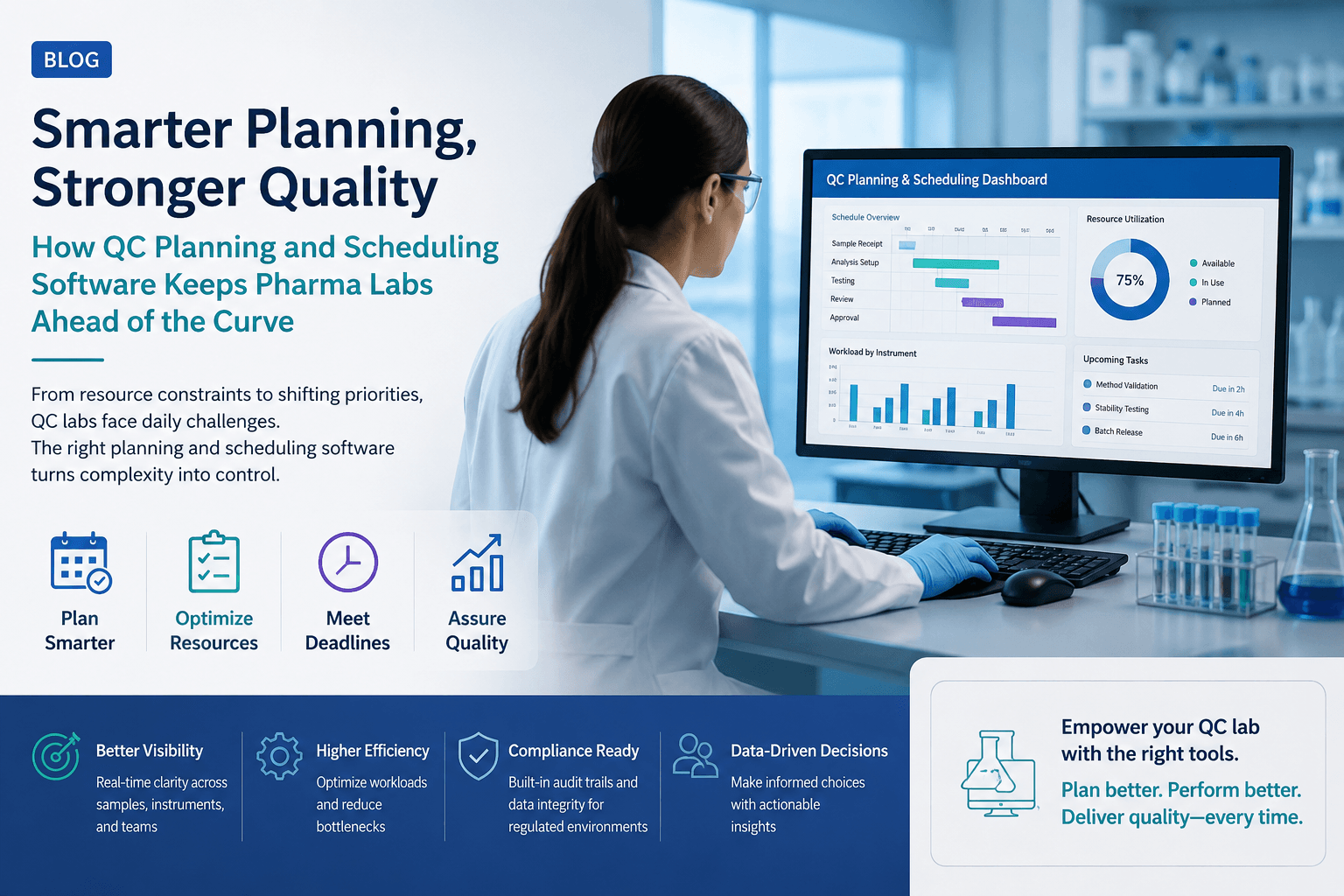
With a connected QC planning environment, the planner can see active tests, pending work, analyst workload, equipment status, and approaching deadlines from a central view.
AmpleLogic provides real-time dashboards for test progress, analyst productivity, instrument utilization, workload distribution, and laboratory capacity.
That changes the conversation.
Instead of asking:
"Why is this test late?"
the QC manager can ask:
"Where is capacity being consumed, and what can we change before it affects the next deadline?"
That's a much more useful conversation.
QC Efficiency Still Has to Be Traceable
Efficiency alone isn't enough in a regulated laboratory.
A QC team needs to be able to explain what happened.
Who was assigned to the test? Was the analyst qualified? Which instrument was planned? What priority did the sample have? Was the schedule changed? Did the test approach its TAT? What happened when the original resource became unavailable?
These aren't questions a laboratory should have to reconstruct from memory.
A QC management system should make the planning and execution history visible as part of the controlled workflow.
AmpleLogic's platform supports TAT reporting, OOS reporting, analyst productivity metrics, equipment utilization insights, and audit-ready documentation. It also supports integration with AmpleLogic LIMS for an end-to-end sample lifecycle.
That connection is important because QC planning shouldn't exist in isolation from the rest of the laboratory.
The closer the link between sample registration, scheduling, execution, and reporting, the less manual coordination is required between systems.
When Has a QC Lab Outgrown Manual Planning?
There isn't a specific number of samples that suddenly means a laboratory needs a QC management system.
The warning signs are operational.
A laboratory may have outgrown its current planning approach when:
QC planners spend significant time rebuilding schedules.
Analysts are frequently reassigned as priorities change.
Instruments are available but aren't consistently utilized.
Urgent testing repeatedly disrupts planned work.
Batch-release tests are difficult to prioritize.
TAT problems are discovered only when deadlines are close.
Separate spreadsheets are used for analysts, instruments, samples, and schedules.
Managers don't have a real-time view of laboratory capacity.
Audit preparation requires manually reconstructing what happened.
At that point, adding another spreadsheet rarely solves the underlying problem.
The laboratory needs a better way to understand the relationship between workload, resources, priorities, and time.
Where AmpleLogic Fits
AmpleLogic approaches QC planning as an operational problem rather than simply a scheduling problem.
Its QC Planning & Scheduling solution combines workload forecasting, batch-release planning, sample prioritization, automated scheduling, analyst and instrument allocation, campaign-based execution, laboratory capacity planning, TAT monitoring, conflict detection, and real-time visibility.
The platform also supports integration with AmpleLogic LIMS, allowing planning and scheduling to connect with the wider sample lifecycle rather than operating as another isolated application.
AmpleLogic reports outcomes including 20% faster turnaround time, 25% more samples per shift, and 90% faster audit closure on its product page. These are company-reported figures rather than independent industry benchmarks, so they should be considered directional rather than guaranteed results.
The more important point is the problem the system is designed to address.
A laboratory cannot make effective use of capacity it cannot see.
When QC teams can see upcoming workload, qualified analysts, instrument availability, testing priorities, active work, and approaching deadlines in one place, they have a much stronger basis for deciding what should happen next.
The Bigger Shift in Pharmaceutical QC
For years, laboratory efficiency conversations have focused on analytical instruments, automation, and faster testing methods.
Those things still matter.
But there's another constraint becoming harder to ignore: coordination.
A laboratory can have highly qualified analysts, expensive instruments, approved methods, and a capable LIMS—and still lose valuable time because those resources aren't being planned together.
That's why the next stage of QC digitalization isn't simply about putting more laboratory records into software.
It's about making the laboratory itself easier to plan.
A well-designed QC management system gives QC teams a clearer view of what is coming, what is happening now, where capacity is being consumed, which resources are available, and which tests need attention first.
And when those decisions can be made earlier, batch release doesn't have to become the point where everyone discovers that QC has already fallen behind.
The goal isn't to make QC teams work faster. It's to help them use the capacity they already have more intelligently.
See how AmpleLogic can help
If your QC team is still coordinating testing through spreadsheets, email, and disconnected resource schedules, it may be time to look at a more connected approach.
Explore the AmpleLogic QC Planning & Scheduling solution to see how intelligent planning, automated scheduling, resource optimization, campaign-based testing, and real-time laboratory visibility can fit into your QC operation.


