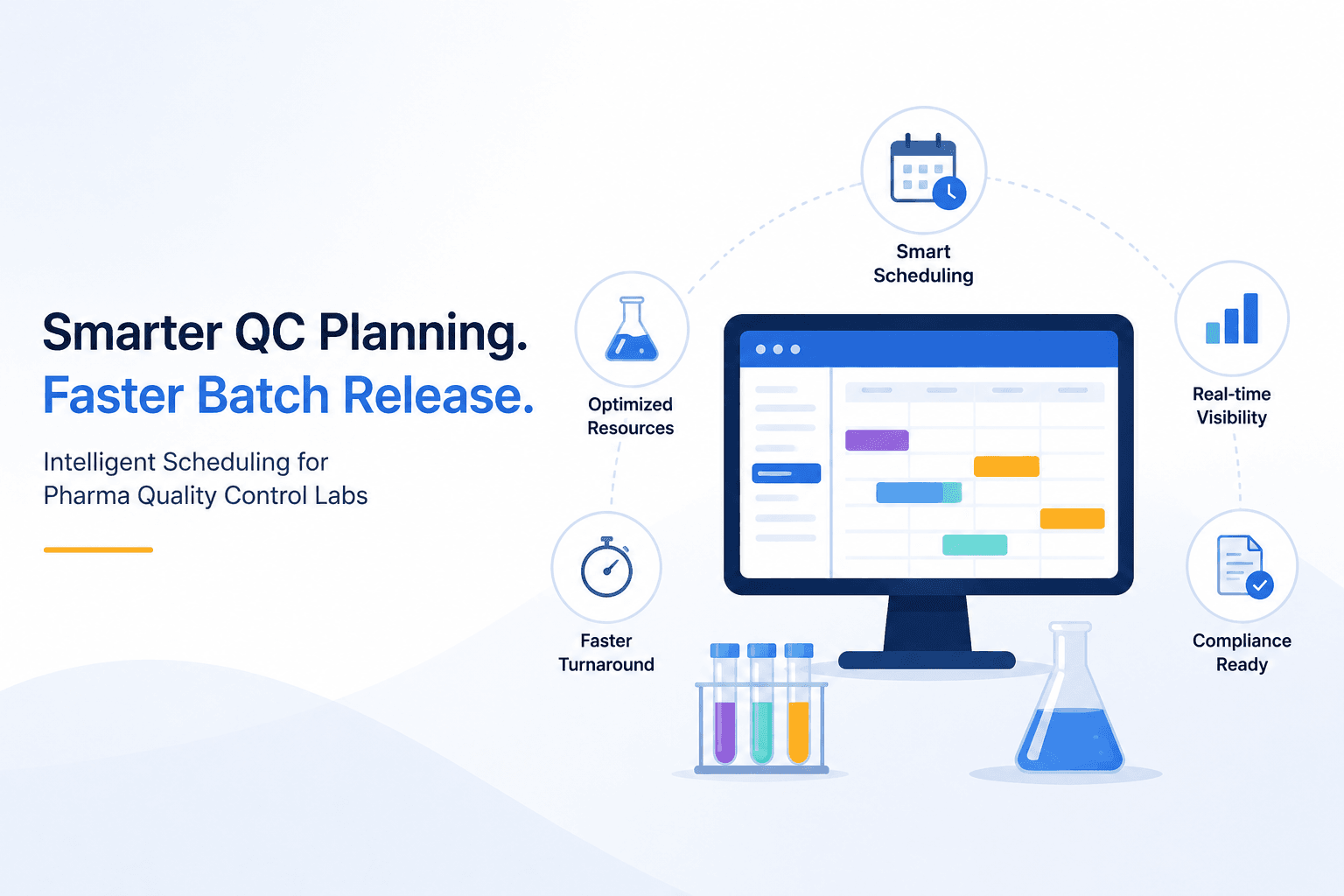
Walk into most pharma quality control labs and you'll still find the same bottleneck: a whiteboard, a spreadsheet, or three different tools trying to tell the same story about who's testing what, on which instrument, by when. A QC management system exists to fix exactly this problem, and the labs that get it right aren't just avoiding delays. They're compressing batch release timelines by weeks.
Here's the uncomfortable truth about manual QC scheduling: it doesn't fail all at once. It fails a little bit every day, in ways that are easy to shrug off individually. An analyst gets double-booked. An instrument sits idle while a queue builds up next door. A stability pull gets logged an hour late. None of these look like a crisis on their own. Added up over a quarter, they're the difference between hitting your release dates and explaining to a client why you didn't.
What Actually Breaks in Manual QC Planning
Most labs run into the same handful of issues, regardless of size:
Resources — analysts, instruments, reagents — get allocated based on who remembers what's free, not on real data.
Testing cycles stall because scheduling happens after the fact instead of ahead of it.
Workflows fragment across LIMS, spreadsheets, and paper logs, so nobody has one source of truth.
Instruments go underused simply because nobody grouped similar samples into a single run.
There's no real-time view of lab capacity, so managers plan blind.
None of this is a people problem. It's a tooling problem, and it's exactly what modern quality control planning software is built to solve.
What a Modern QC Planning Platform Actually Does
Than treating scheduling as an afterthought we build it into the workflow right from the moment a sample arrives. AmpleLogics QC Planning and Scheduling module shows how this works in life:
1. Test Requests and Sample Registration
Test requests and sample registration happen automatically through LIMS integration or ERP batch triggers, with priority levels assigned at intake instead of guessed at later.
2. Intelligent Scheduling
Intelligent scheduling matches tests to qualified analysts and available instruments, flagging conflicts before they become delays.
3. Campaign-Based Execution
Campaign-based execution groups similar samples by product, method, or turnaround time, cutting down instrument changeover and pushing more tests through each shift.
4. Real-Time Dashboards
Real-time dashboards give lab managers live visibility into workload, instrument status, and approaching deadlines — instead of finding out about a bottleneck after it's already cost time.
5. Automated Reporting
Automated reporting generates TAT reports, OOS documentation, and audit-ready records without someone assembling them by hand at month-end.
The result, in practice: faster batch release, better instrument utilization, and a lab that can prove its compliance posture on demand instead of scrambling before an audit.
Why This Matters More Than Ever for Pharma QC Teams
Regulatory scrutiny on data integrity isn't loosening up, and neither are client expectations around turnaround time. Labs running on manual coordination are competing against labs running on automated, campaign-based scheduling — and the gap between the two shows up directly in release cycle times. A system that can forecast workload, balance analyst assignments by qualification, and resolve scheduling conflicts automatically isn't a nice-to-have anymore. It's becoming the baseline.
Real world use cases show this. Batch release testing that took a lot of time like days can now be done faster when priority-based scheduling and TAT tracking are part of the work process.
Big labs that process than a hundred samples every day use sample campaigning to make sure they do not waste time changing instruments.
This way batch release testing is easier to manage.
Big labs, with locations can see everything in one place like analyst qualifications and instrument availability instead of treating each place separately. This makes batch release testing and priority-based scheduling more efficient.
Choosing the Right QC Management System
If you're evaluating options, a few questions cut through the marketing noise fast:
Does it integrate natively with your existing LIMS, or does it create another data silo?
Can it handle urgent, unplanned testing without breaking the rest of the schedule?
Does it generate audit-ready documentation on demand, or does someone still have to compile it manually?
Is scheduling calendar-based and visual, or buried in menus nobody opens?
A QC lab that answers "yes, automatically" to those questions is running on infrastructure built for where pharma quality control is headed, not where it's been. If your lab is still coordinating QC work over email and spreadsheets, it's worth seeing what a purpose-built quality control planning software platform looks like in an actual demo — the difference tends to show up in the very first week.


