Walk into a busy pharmaceutical quality control laboratory on any given Monday morning and you'll notice something interesting. Analysts aren't just testing samples—they're constantly juggling priorities. A stability sample arrives unexpectedly. A release batch suddenly becomes urgent. An instrument goes offline for calibration. Someone updates a production schedule, and now the entire testing plan has to change.
Most laboratories have experienced this at some point.
The challenge isn't the testing itself. It's planning everything around it.
For years, many pharmaceutical companies managed these activities using spreadsheets, emails, and whiteboards. They worked—until workloads increased. As manufacturing expanded and regulatory expectations became more demanding, manual planning started creating more questions than answers. Who is available to perform the next test? Which instrument can be used? Why is this sample still waiting? Has the testing priority changed?
These are exactly the kinds of problems that Quality Control Planning Software is designed to solve.
When Planning Becomes the Bottleneck
Quality control teams today are expected to do more with the same resources. Production schedules are tighter, product portfolios are growing, and laboratories handle thousands of testing activities every month.
Planning these activities manually often creates hidden inefficiencies that aren't immediately visible. One analyst may be overloaded while another has spare capacity. Instruments remain reserved longer than necessary. Samples wait simply because no one has complete visibility into laboratory workloads.
None of these issues may seem significant individually. Together, however, they can delay batch release, increase laboratory costs, and create unnecessary pressure during inspections.
Digital planning changes that picture entirely.
What Makes Quality Control Planning Software Different?
Unlike a spreadsheet, dedicated Quality Control Planning Software doesn't simply record information—it helps laboratories organize work intelligently.
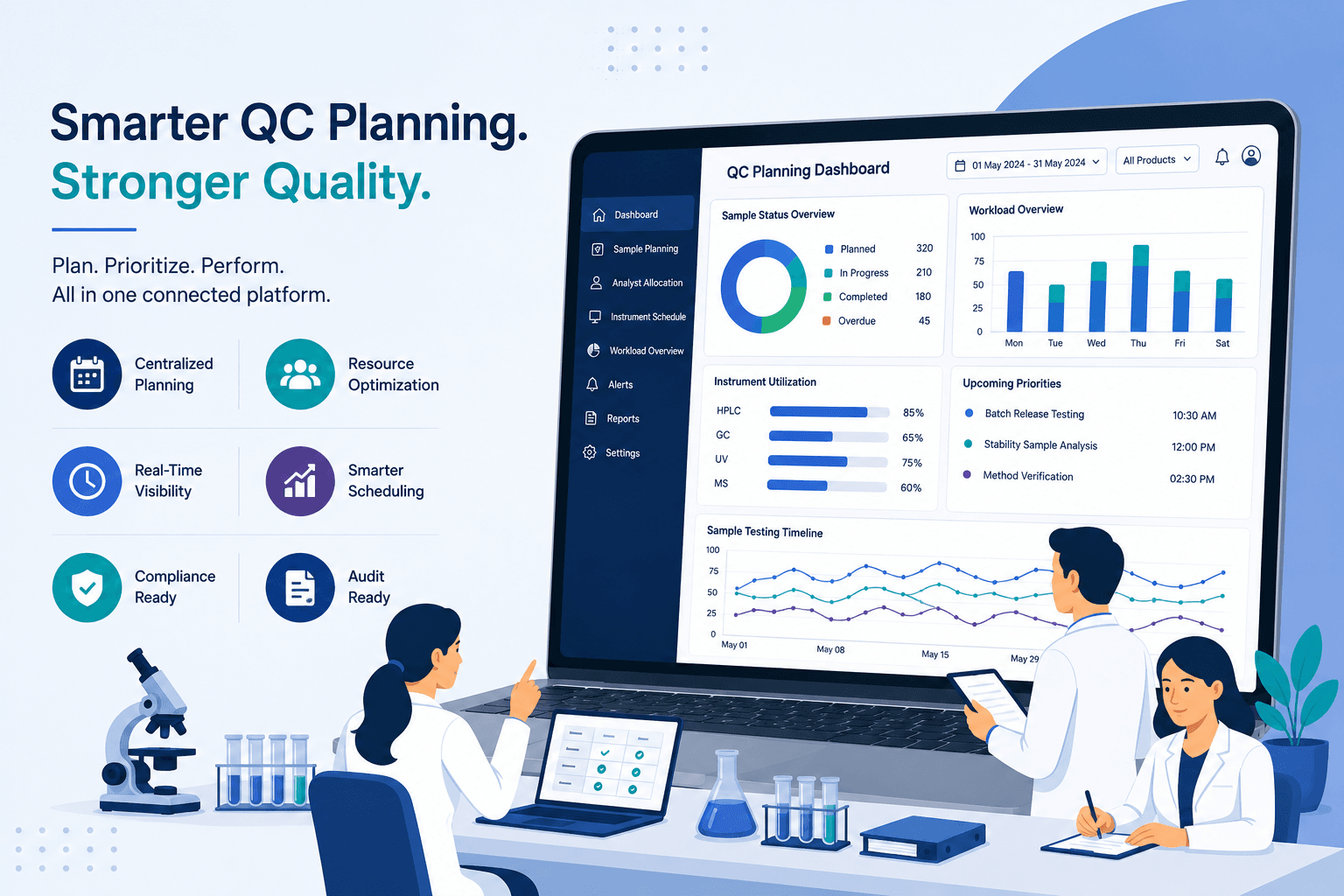
Instead of searching through multiple files or chasing updates over email, laboratory managers can view testing schedules, analyst availability, sample priorities, and equipment status from one centralized workspace.
That visibility makes planning more proactive than reactive.
When production priorities change, schedules can be adjusted without rebuilding the entire testing calendar. Teams know exactly where work is pending and where additional capacity exists.
For laboratories handling dozens—or even hundreds—of daily activities, that level of visibility becomes invaluable.
Why Pharmaceutical Companies Are Moving Toward Digital Planning
Regulated industries have always relied on documentation, but documentation alone doesn't improve efficiency.
Today's laboratories need information that supports decisions in real time.
Imagine receiving ten new release samples before lunch while two analysts are already working on stability studies. In a manual system, redistributing work usually involves phone calls, spreadsheets, and multiple emails.
With digital planning, managers immediately understand workload distribution, available resources, testing deadlines, and instrument schedules before assigning additional work.
The result isn't simply faster planning.
It is smarter planning.
How AmpleLogic Supports Smarter QC Operations
AmpleLogic developed its Quality Control Planning Software specifically for pharmaceutical and life sciences organizations where compliance and operational efficiency must work together.
Rather than managing laboratory schedules across disconnected spreadsheets, the platform provides a single environment where testing activities can be planned, monitored, and adjusted as priorities change.
Laboratory managers gain visibility into analyst workloads, pending samples, equipment utilization, and testing timelines without switching between multiple systems.
This helps reduce scheduling conflicts while improving overall laboratory coordination.
The software also allows organizations to prioritize critical activities such as release testing, stability studies, and routine quality control work according to business needs. Instead of reacting to delays after they occur, teams can identify potential bottlenecks early and make informed scheduling decisions.
For organizations preparing for inspections, having every planning activity digitally recorded also improves traceability and simplifies audit preparation.
Better Planning Creates Better Laboratory Performance
One of the biggest misconceptions about laboratory planning is that it's purely an administrative task.
In reality, planning influences almost every quality metric.
Balanced workloads reduce analyst fatigue. Better scheduling minimizes instrument downtime. Faster sample allocation shortens turnaround times. Clear visibility prevents duplicate work and missed deadlines.
Over time, these operational improvements contribute to more consistent laboratory performance without increasing headcount.
This is one reason many pharmaceutical organizations now view planning software as an operational investment rather than simply another digital tool.
Looking Beyond Daily Scheduling
Quality Control Planning Software also creates opportunities for continuous improvement.
When planning data is available in one system, managers can identify recurring delays, understand resource utilization trends, and make more informed decisions about staffing or laboratory capacity.
Instead of relying on assumptions, they can use actual operational data to improve future planning.
That shift—from reactive management to data-driven decision-making—is becoming increasingly important as pharmaceutical manufacturing grows more complex.
Why AmpleLogic QC Planning Software Stands Out
Every pharmaceutical laboratory operates differently, but the need for visibility, coordination, and compliance remains the same.
AmpleLogic's Quality Control Planning Software helps organizations replace fragmented planning methods with a connected digital workflow that supports both operational efficiency and regulatory expectations.
From scheduling laboratory activities and balancing analyst workloads to improving resource utilization and maintaining complete planning records, the platform gives quality teams greater control over everyday operations.
Rather than spending valuable time coordinating spreadsheets or following up through email, laboratories can focus on what matters most—delivering reliable analytical results that support safe and timely product release.
Final Thoughts
Laboratory testing will always remain at the heart of pharmaceutical quality. But behind every successful test lies an effective planning process.
As workloads continue to grow and regulatory expectations evolve, relying on manual scheduling becomes increasingly difficult to sustain.
Organizations that invest in Quality Control Planning Software are not simply digitizing their laboratory operations. They are building a more organized, efficient, and inspection-ready quality control environment.
For pharmaceutical companies looking to modernize QC operations, AmpleLogic provides a practical solution that brings planning, visibility, and compliance together in one connected platform.


