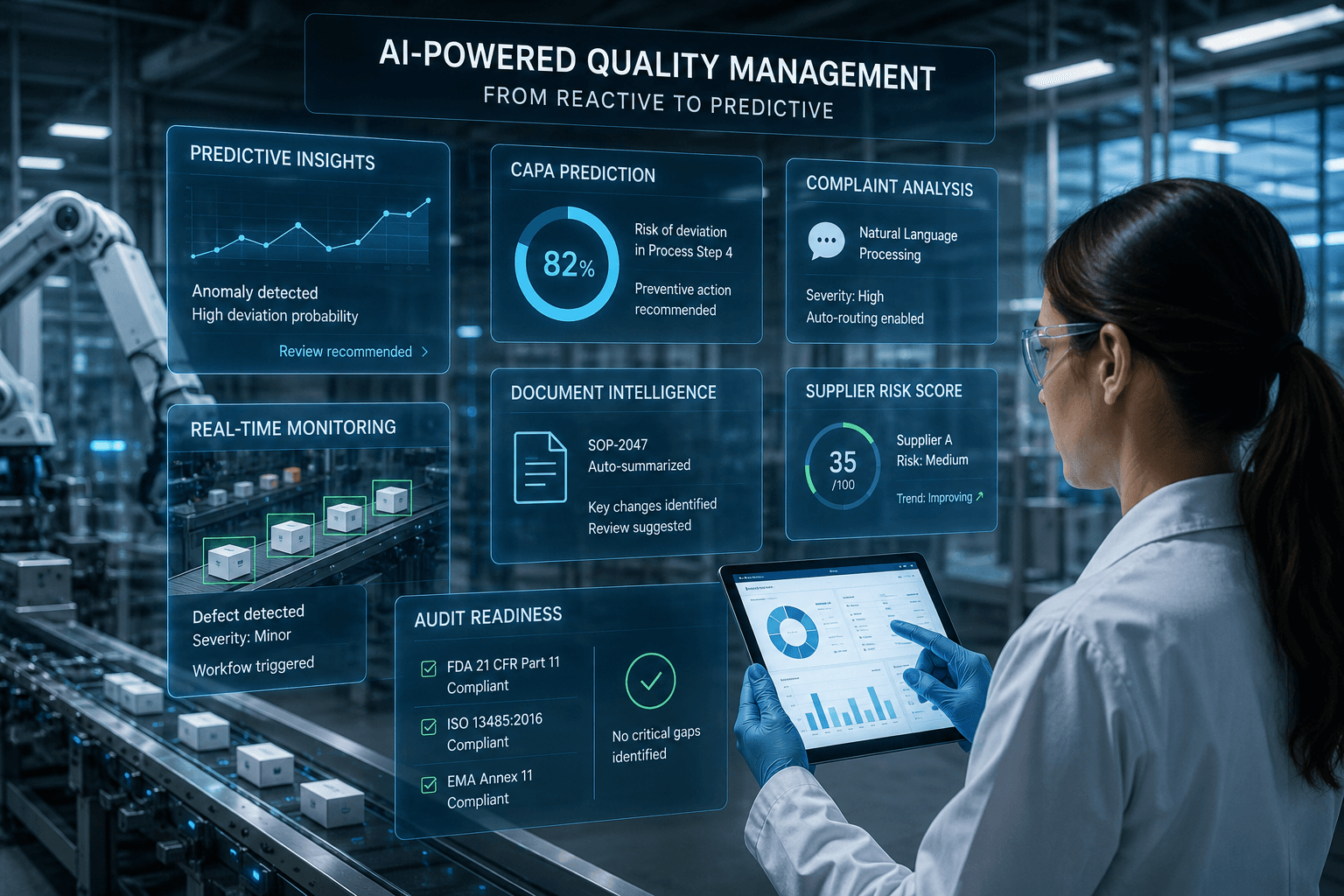
For years, quality management in regulated industries has run on the same playbook: log the deviation, investigate after the fact, file the paperwork, hope you catch the pattern before it repeats. It worked, more or less. But "more or less" isn't good enough anymore, not when regulators expect real-time visibility and manufacturing environments grow more complex by the quarter.
That's the gap AI is closing. Quality management is no longer just a compliance checkbox sitting at the end of a production line, it's becoming a genuine strategic asset. Pharma companies, medical device manufacturers, and life sciences organizations across the board are moving away from paper-trail digitization and toward something smarter: systems that don't just record problems but anticipate them.
This piece walks through what's actually changing in electronic quality management systems (eQMS), which workflows are ripe for automation right now, and what to look for if you're evaluating a platform built for where the industry is headed not where it's been.
Old eQMS vs. AI-Powered eQMS: The Real Difference
Here's the simplest way to think about it: the old model reacts, the new model anticipates.
A traditional eQMS is essentially a very organized filing cabinet. Someone has to manually log a deviation, someone has to investigate it, and someone has to route the paperwork for sign-off. Every step depends on a human noticing something first.
An AI-powered quality platform flips that sequence. It's constantly reading data as it comes in watching for anomalies, cross-referencing historical patterns, and surfacing recommendations before a small issue becomes a documented failure. Auditors don't have to find the gap. The system already flagged it.
Where AI Is Actually Showing Up in eQMS Today
This isn't one sweeping upgrade; it's a handful of distinct capabilities working together.
Predictive CAPA. Corrective and Preventive Action processes have always eaten up enormous amounts of quality team time. AI changes the sequence: instead of opening a CAPA after a failure occurs, the system studies equipment logs, environmental data, and historical trends to flag where a non-conformance is likely to happen, so teams can intervene before it does.
Faster root cause analysis. The old "5 Whys" whiteboard session still has its place, but AI-driven analysis tools can now comb through years of audit records and batch data in minutes, surfacing correlations a human investigator might take days to spot.
Natural language processing for unstructured data. Complaints, emails, handwritten notes, this kind of data used to sit untouched because nobody had time to parse it manually. NLP tools now read it automatically, pulling out severity indicators and routing adverse events to the right regulatory contact without anyone lifting a finger.
Generative AI for documentation. Drafting SOPs and summarizing lengthy audit reports is tedious, repetitive work. Generative AI can produce a solid first draft, which means quality professionals spend their time reviewing and refining instead of starting from a blank page.
Computer vision on the shop floor. Cameras paired with machine learning can catch microscopic defects as products move down the line, then automatically categorize severity and trigger the right workflow, no manual inspection bottleneck required.
What to Automate First
Knowing AI can help is one thing. Knowing where to point it first is what actually moves the needle. A few high-friction areas consistently deliver the fastest returns:
Document control and routing — intelligent routing based on workload and expertise, automatic version tracking, and alerts when regulatory changes require an SOP update.
Supplier quality workflows — continuous monitoring of supplier performance and risk scoring, with automatic audit triggers when a supplier's quality trend starts slipping.
Audit readiness — ongoing, automated cross-referencing of current processes against the latest FDA, ISO, or EMA requirements, so compliance gaps surface in real time instead of during the actual audit.
Choosing a Platform That's Actually Future-Ready
Not every "AI-powered" eQMS on the market is built the same way. A few criteria matter more than the sales deck will tell you:
Built for regulated industries, not retrofitted for them. Generic software struggles with frameworks like 21 CFR Part 11 and Annex 11. Look for a platform designed around these requirements from the ground up.
Real integration, not just a dashboard. AI is only as good as the data it can see. A platform that connects cleanly with your ERP, LIMS, and MES will produce sharper, more useful predictions than one operating in isolation.
Explainability. In a regulated environment, "the algorithm said so" doesn't fly with auditors. The system needs to show its work a clear trail of how it arrived at a given recommendation.
Usability. The most sophisticated AI in the world is worthless if your team avoids using it because the interface is a headache.
Provable ROI. Ask vendors for real case studies. A strong platform should pay for itself through reduced scrap, faster time-to-market, and lower administrative overhead — not just promise it will.
Rolling It Out Without Disrupting Everything
Implementation matters as much as selection. A phased approach tends to work best:
Clean your data first. AI is only as reliable as the historical data it's trained on.
Pilot one workflow. Pick a specific pain point, complaint handling, supplier risk scoring, whatever hurts most rather than attempting a full overhaul at once.
Keep a human in the loop. Let quality managers review and approve AI recommendations early on, then gradually expand autonomy as trust builds.
Keep monitoring. Regulatory expectations shift, and AI models need regular tuning to stay aligned with them.
The Bigger Shift
Quality departments used to be seen as the compliance police, the team that shows up after something's already gone wrong. That framing is fading fast. With predictive analytics catching deviations before they happen, computer vision catching defects in real time, and document control running on autopilot, quality teams are becoming a genuine driver of operational resilience rather than a downstream checkpoint.
The goal was never just to digitize paperwork. It's to build a quality function sharp enough to keep pace with how complex modern manufacturing and regulatory environments have become — so your team can spend less time chasing problems and more time delivering products that are actually safe.


