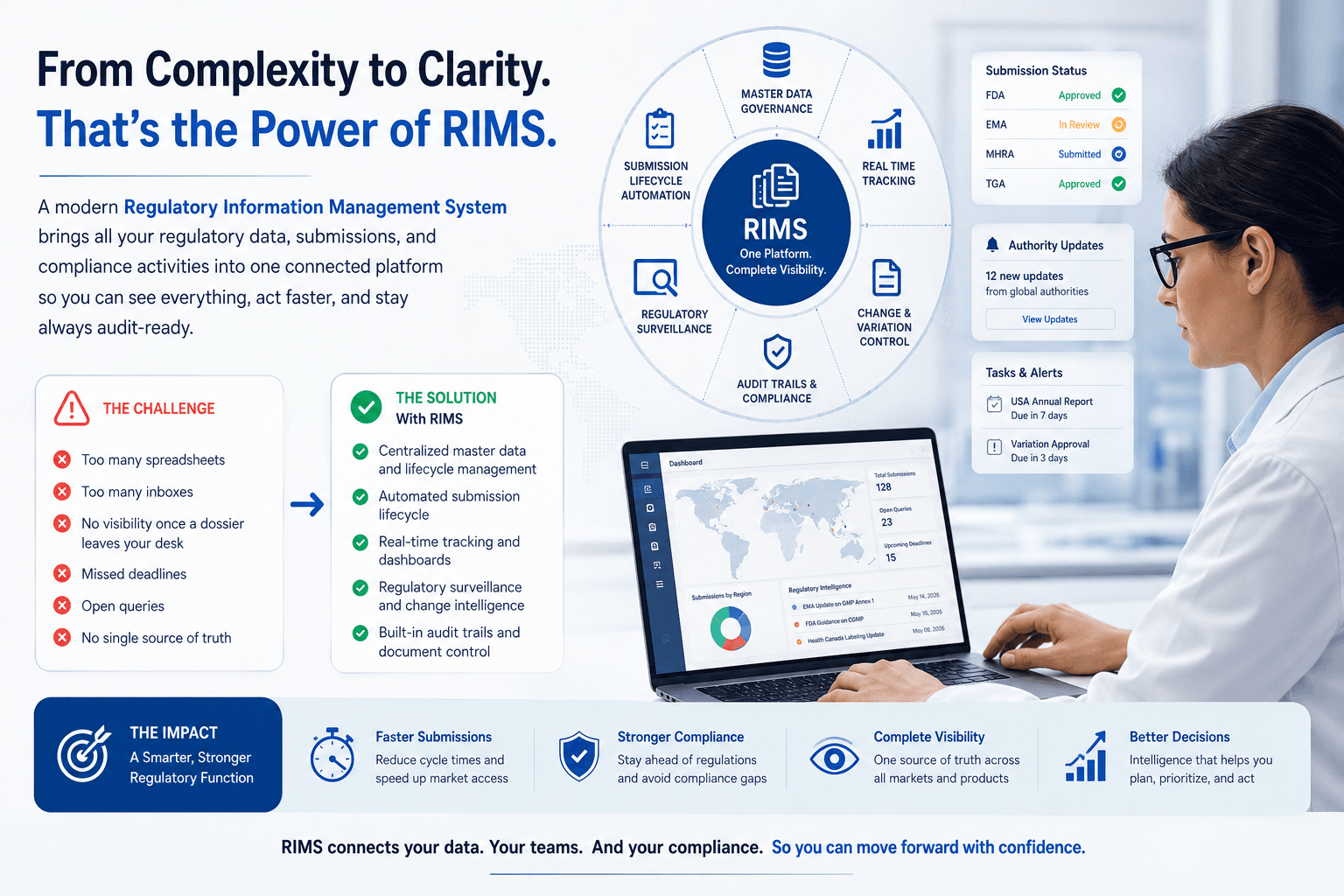
Ask any regulatory affairs lead how their week is going, and you'll likely hear some version of the same complaint: too many spreadsheets, too many inboxes, and not enough visibility into what's actually happening with a dossier once it leaves their desk. That's the quiet crisis sitting underneath most pharma regulatory operations today and it's exactly the gap a modern regulatory information management system is built to close.
For years, regulatory teams got by on a patchwork of shared drives, email chains, and legacy tools that were never designed for the scale of today's global submissions. That patchwork worked, more or less, when a company filed in a handful of markets. It stops working the moment you're tracking product registrations across 50, 80, or 120+ countries, each with its own authority, timeline, and format requirements.
The Real Cost of Fragmented Regulatory Data
A regulatory data management solution isn't a nice-to-have anymore, it's risk management. When submission data lives in disconnected systems, three things happen predictably: deadlines get missed, queries sit unanswered longer than they should, and nobody has a single source of truth when an inspector asks for a status update.
This is where a purpose-built regulatory compliance management system earns its keep. Rather than treating regulatory data as a filing exercise, it treats it as a living, connected record one that ties master data, submission status, and compliance obligations together instead of scattering them across five different tools.
The shift from legacy record-keeping to an intelligent Regulatory Information Management System mirrors a broader trend across pharma: moving from documentation for its own sake to documentation that actively supports decision-making. A good regulatory document management software doesn't just store your eCTD, ACTD, or NeeS submissions it makes them searchable, versioned, and instantly retrievable when you need them most.
What Modern RIMS Software Actually Does
At its core, RIMS software exists to answer a handful of deceptively simple questions at any given moment: Where does every submission stand? What's approaching its deadline? Which authority queries are still open? A well-built regulatory information management software platform answers all three without anyone needing to open a spreadsheet.
That typically comes down to a few connected capabilities:
Master data governance — centralized product registration and lifecycle tracking across every authority you deal with, so nobody's reconciling three different versions of "the truth."
Submission lifecycle automation — planning, preparing, publishing, and validating submissions with fewer manual handoffs.
Real-time tracking — live dashboards instead of end-of-month status reports nobody trusts.
Change and variation control — full audit trails when something in a dossier shifts, which it always eventually does.
None of this replaces regulatory expertise. It just removes the friction between having that expertise and being able to act on it quickly.
Surveillance Is the Part Everyone Underestimates
Submission tracking gets most of the attention, but a regulatory surveillance management system is arguably just as important and far more neglected. Regulations don't stand still. FDA, EMA, MHRA, CDSCO, and dozens of other authorities update requirements constantly, and a team relying on manual monitoring is, by definition, always a step behind.
A capable regulatory surveillance software platform flips that dynamic. Instead of regulatory affairs staff hunting for updates across dozens of authority websites, a regulatory compliance surveillance system surfaces relevant changes as they happen, tied directly to the products and markets they actually affect.
Pair that with regulatory change management software, and you get something regulatory teams have wanted for a long time: the ability to see a rule change coming and map its impact before it becomes a compliance gap. This is the essence of a true regulatory intelligence system not just storing information, but actively interpreting what it means for your portfolio.
Tracking, Trust, and the Audit Trail Problem
Every regulatory professional has lived through an audit where finding the right version of a document took longer than it should have. Regulatory tracking software exists precisely to eliminate that scramble. When submission history, correspondence, and version control live in one system, an audit stops being an emergency and becomes a formality.
This is also where a compliance surveillance management solution and a regulatory requirements tracking software overlap both are, at heart, about closing the gap between "we filed something once" and "we can prove, at any moment, exactly where things stand and why." Regulators don't just want compliance; they want evidence of active, ongoing oversight. That's a hard thing to fake with spreadsheets and a much easier thing to demonstrate with a connected platform.
Why This Matters More in 2026 Than It Did Five Years Ago
Global regulatory complexity hasn't just grown it's compounded. New markets, evolving eCTD standards, tightening timelines, and rising expectations around traceability mean the old tools are increasingly a liability rather than a workaround. Companies still running regulatory operations on shared drives and email threads aren't just slower; they're carrying real submission and inspection risk they may not fully see until it surfaces.
The organizations pulling ahead are the ones treating regulatory information management as infrastructure, not paperwork connecting it to quality, manufacturing, and lab systems so that a change in one place is reflected everywhere it needs to be, automatically.
That's ultimately the promise of a modern regulatory information management system: not just fewer missed deadlines, but a regulatory function that can finally see its own work clearly, market by market, submission by submission.


