Regulatory affairs teams evaluating a Regulatory Information Management System have a genuinely hard job: most vendors describe their platforms in similar language, and the real differences only show up once you're deep into an implementation. Independent analyst recognition exists precisely to cut through that, offering a comparison built on structured evaluation criteria rather than vendor marketing.
What the recognition reflects
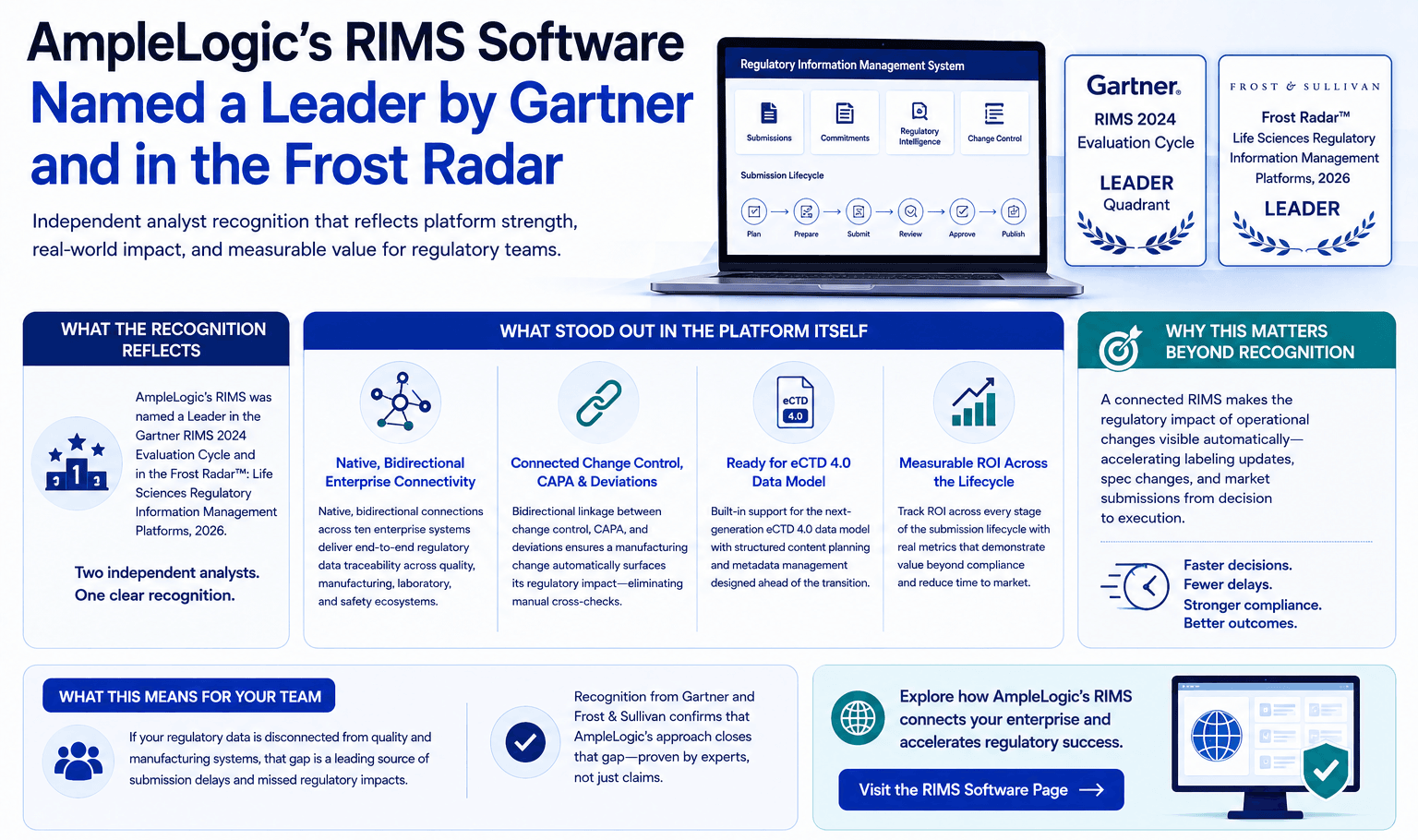
AmpleLogic's RIMS was placed in the Leader Quadrant in the Gartner RIMS 2024 Evaluation Cycle, and more recently earned a Leader position in the Frost Radar™: Life Sciences Regulatory Information Management Platforms, 2026 report from Frost & Sullivan. Two separate analyst firms reaching similar conclusions, in different evaluation cycles, is a stronger signal than either recognition would be on its own.
What stood out in the platform itself
A few specific capabilities tend to differentiate a RIMS in these evaluations, and they're the same ones AmpleLogic's RIMS software is built around:
Native, bidirectional connections across ten enterprise systems, giving end-to-end regulatory data traceability across quality, manufacturing, laboratory, and safety ecosystems rather than a regulatory database that sits apart from the rest of the operation
Bidirectional linkage between change control, CAPA, and deviations, so a manufacturing change automatically surfaces its regulatory impact instead of requiring a manual cross-check
Readiness for the next-generation eCTD 4.0 data model, with structured content planning and metadata management built in ahead of the transition rather than bolted on afterward
Measurable ROI tracked across every stage of the submission lifecycle, giving regulatory leadership a way to demonstrate the platform's value in terms beyond compliance alone
Why this matters beyond the recognition itself
An analyst placement is a useful shortcut in a vendor evaluation, but the more useful question for a regulatory team is what the underlying capabilities mean day to day. A RIMS that's genuinely connected to your quality and manufacturing systems changes how quickly a labeling update, a specification change, or a new market submission can move from decision to execution, because the regulatory impact of operational changes is visible automatically instead of requiring someone to manually check.
What this means for teams evaluating a RIMS
If your regulatory information currently lives in a system that's disconnected from quality and manufacturing data, that disconnect is usually the first place submission delays and missed regulatory impacts originate. Recognition from two independent analyst firms is a signal that AmpleLogic's approach to closing that gap holds up under outside scrutiny, not just internal claims.
You can explore the specific integration and eCTD 4.0 readiness details on the RIMS software page.


