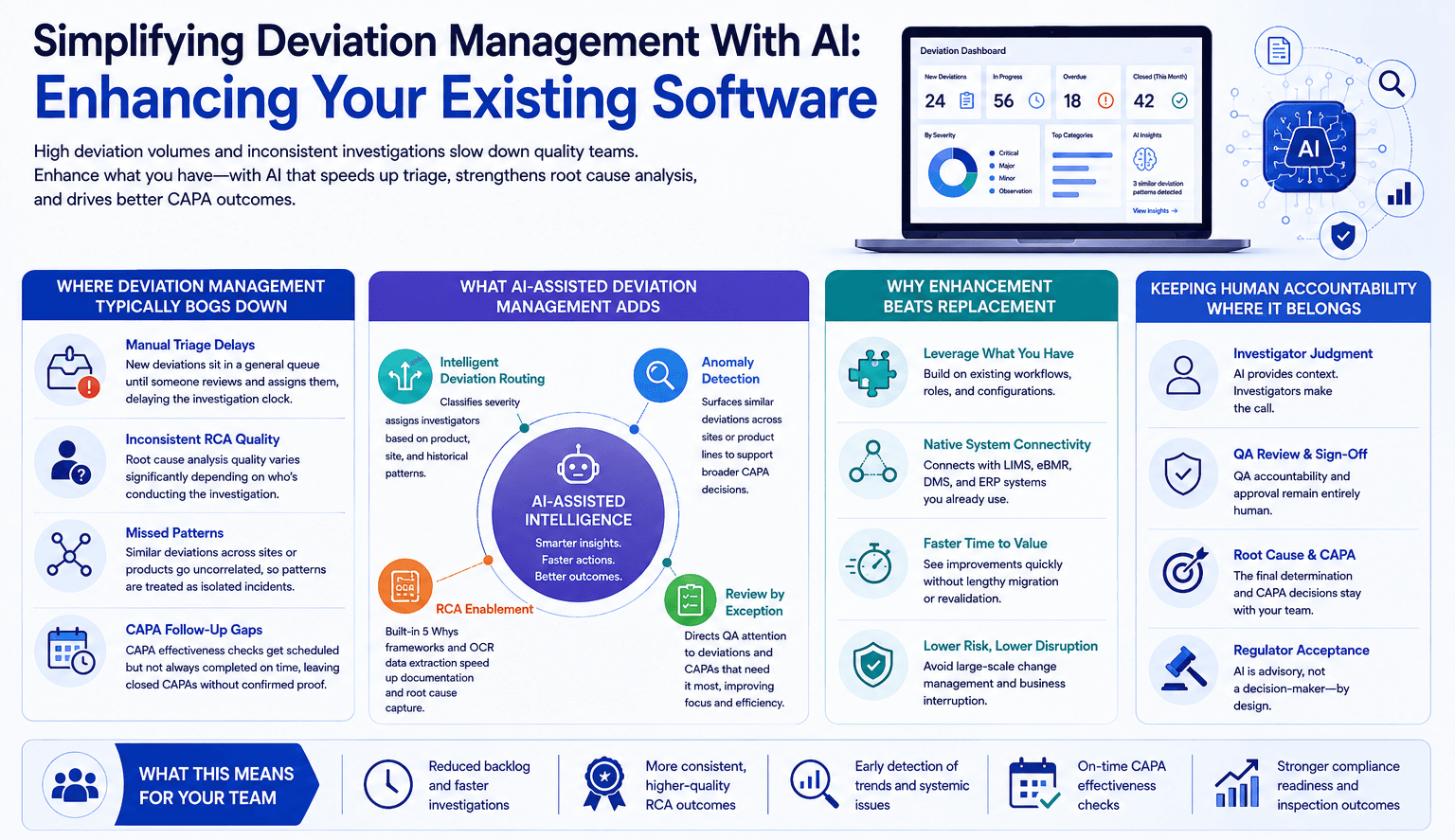
Deviation management is one of the more painful workflows in a pharma quality system, not because the process is unclear, but because the volume is high and every deviation still needs a consistent, defensible investigation. Teams often assume the only way to improve it is a full platform replacement. In most cases, the more realistic path is enhancing the deviation workflow you already have with AI-assisted routing and analysis, rather than starting over.
Where deviation management typically bogs down
A few friction points show up across most manufacturing and lab environments:
New deviations sit in a general queue until someone manually reviews and assigns them, which delays the investigation clock without adding any value
Root cause analysis quality varies significantly depending on who's conducting the investigation and how much time they have
Similar deviations across sites or products go uncorrelated, so a pattern that should trigger a broader CAPA gets treated as several isolated incidents
CAPA effectiveness checks get scheduled but not always completed on time, leaving closed CAPAs without confirmed evidence they worked
What AI-assisted deviation management adds
Within AmpleLogic's eQMS, AI is applied specifically to the parts of deviation management that benefit most from pattern recognition and consistency:
Intelligent deviation routing classifies severity and assigns investigators based on product, site, and historical patterns, so the queue sorts itself instead of waiting for manual triage
Anomaly detection surfaces similar deviations across sites or product lines that a human reviewer might not connect on their own, supporting broader CAPA decisions when a pattern is emerging
Built-in 5 Whys frameworks and OCR data extraction speed up documentation and root cause capture without changing the investigator's actual analysis
Automated review-by-exception directs QA attention to deviations and CAPAs that need it most, rather than treating every record with equal scrutiny
Why enhancement beats replacement for most teams
A full QMS replacement is a significant validation and change management undertaking, and it's rarely justified purely to improve deviation handling. Because AmpleLogic's platform connects natively with existing LIMS, eBMR, DMS, and ERP systems, the AI-assisted deviation workflow can be layered onto data you're already generating, without requiring a wholesale system migration to see the benefit.
Keeping human accountability where it belongs
It's worth being direct about what doesn't change: the investigator's judgment, the QA reviewer's sign-off, and the accountability for the final root cause and CAPA remain entirely human. AI insights here are advisory, speeding up triage and surfacing patterns, not making the quality decision. That distinction is part of what keeps this kind of enhancement acceptable to regulators, and it's a deliberate design choice rather than a limitation.
What this means for your team
If deviation backlog and inconsistent investigation quality are recurring problems, the fix doesn't have to start with a system overhaul. The eQMS product page outlines how deviation management, CAPA, and the AI-assisted workflows around them connect with the systems you're already running.


