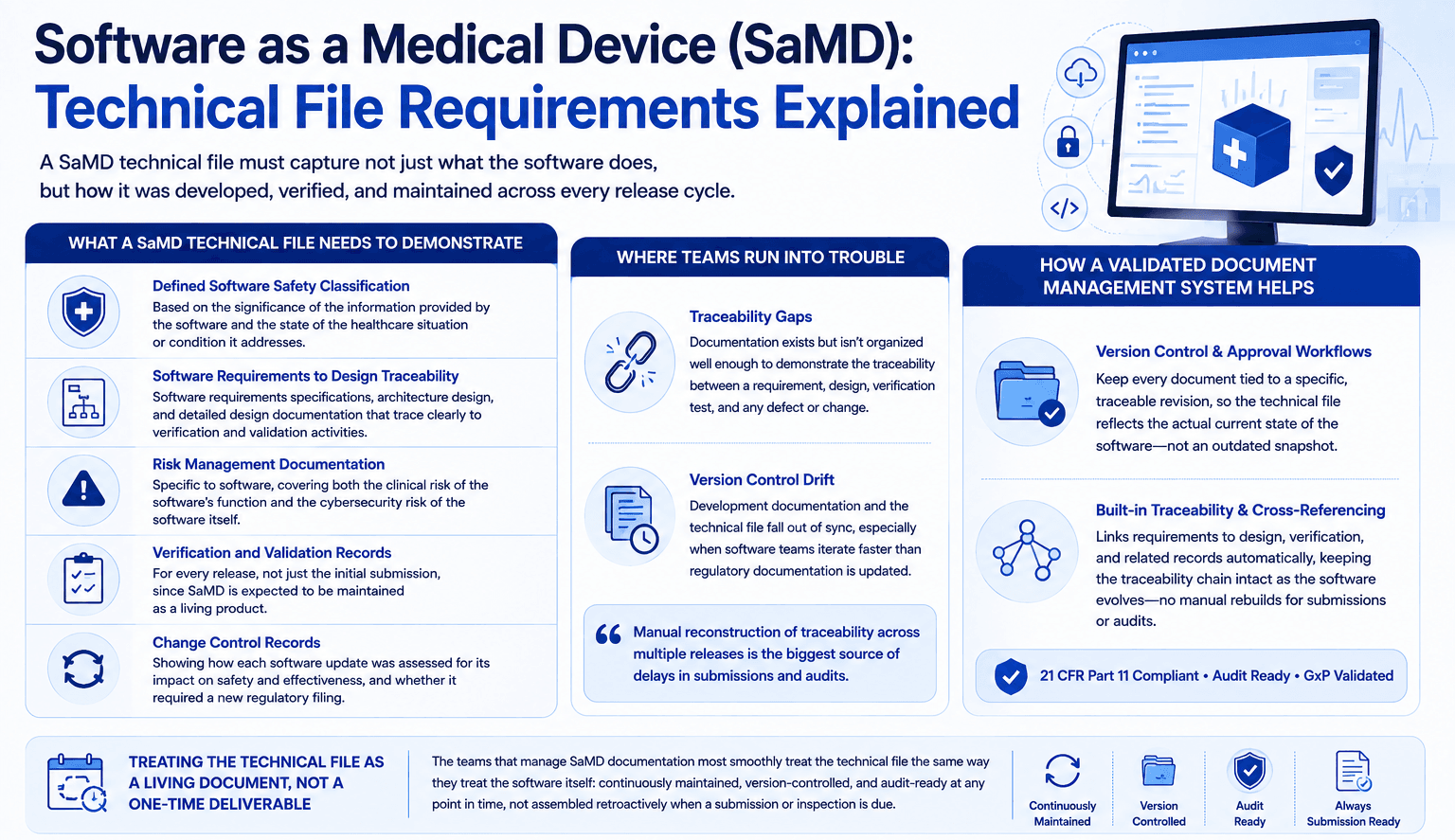
Software as a Medical Device sits in an unusual regulatory position: the product changes faster than the documentation processes originally built for hardware devices were designed to handle. A SaMD technical file has to capture not just what the software does, but how it was developed, verified, and maintained across a release cycle that might be measured in weeks rather than years. That difference is where a lot of teams underestimate what's actually required.
What a SaMD technical file needs to demonstrate
Beyond the general device description and intended use, a SaMD file typically needs to show:
A defined software safety classification based on the significance of the information provided by the software and the state of the healthcare situation or condition it addresses
Software requirements specifications, architecture design, and detailed design documentation that trace clearly to verification and validation activities
Risk management documentation specific to software, covering both the clinical risk of the software's function and the cybersecurity risk of the software itself
Verification and validation records for every release, not just the initial submission, since SaMD is expected to be maintained as a living product
Change control records showing how each software update was assessed for its impact on safety and effectiveness, and whether it required a new regulatory filing
Where teams run into trouble
The most common gap isn't missing documentation. It's documentation that exists but isn't organized well enough to demonstrate the traceability regulators expect between a requirement, its design implementation, its verification test, and any defect or change linked to it. When that traceability has to be manually reconstructed at submission time, across possibly dozens of software releases, it becomes the single biggest source of delay.
A second common gap is version control drift between development documentation and what's actually referenced in the technical file, particularly when software teams are iterating faster than the regulatory documentation is being updated to match.
How a validated document management system helps
A document management system built for regulated industries addresses both problems directly. Version control and approval workflows keep every document tied to a specific, traceable revision, so the technical file reflects the actual current state of the software rather than a snapshot from months earlier. Cross-referencing between related documents, requirements to design to verification, keeps the traceability chain intact automatically as the software evolves, rather than requiring it to be rebuilt by hand for each submission or audit.
Treating the technical file as a living document, not a one-time deliverable
The teams that manage SaMD documentation most smoothly tend to treat the technical file the same way they treat the software itself: continuously maintained, version-controlled, and audit-ready at any point in time, not assembled retroactively when a submission or inspection is due. That shift in approach is what actually closes the gap between fast-moving software development and the documentation rigor regulators require.
If document traceability across releases is where your SaMD documentation process is struggling, the document management system page covers how version control and cross-referencing work in a 21 CFR Part 11 compliant environment.


