In the pharmaceutical and life sciences industry, stability studies play an important role to determine how long a product maintains its quality, safety, and efficiency throughout its shelf life. These studies are essential for regulatory submissions, product approvals, and ongoing quality assurance. Managing stability programs manually can get really complicated. This happens when you have to keep track of a lot of things like products, batches, storage conditions and testing requirements.
Many organisations still use spreadsheets and paper records to manage stability studies. This causes a problem because stability studies are hard to keep track of and the information is scattered over the place. While these methods may seem manageable initially, they often lead to scheduling errors, missed sampling points, delayed reporting, and compliance risks.
This is where modern stability testing software becomes really important. It helps by automating the stability schedule and putting all the study activities in one place on a platform that has been validated. This means organizations can do things efficiently make sure they are complying with the rules and make decisions faster.
What Is Stability Schedule Management?
Stability schedule management is the process of planning, executing, monitoring, and tracking pharmaceutical stability studies throughout their lifecycle. It ensures that every product batch is stored under the appropriate environmental conditions and tested at predefined intervals according to an approved stability test protocol.
A well-managed stability program helps organizations:
* Determine accurate product shelf life
* Monitor product quality over time
* Support regulatory submissions
* Ensure compliance with ICH, FDA, and GMP requirements
* Maintain complete traceability throughout the study
Managing a stability schedule is really important. It needs all these different parts to work together like the protocols and the storage chambers and the labs where they do the analysis and the teams that make sure everything is good quality. If you do not have some kind of automation it is very hard to keep track of everything that is going on with the stability schedule and all these different parts.
Common Challenges in Manual Stability Management
Some pharma companies still follow manual systems when it comes to planning and doing stability studies. This can cause problems with how they work. If they are following the rules. Companies that make medicine still use these methods, for stability study planning and stability study execution.
1. Manual Scheduling and Tracking
Managing pull dates through spreadsheets and calendars increases the risk of missed sampling points, scheduling conflicts, and delayed testing activities. As study volumes grow, maintaining visibility becomes even more difficult.
2. Inconsistent Stability Test Protocols
When protocols are created manually across different departments or sites, inconsistencies can occur in study designs, acceptance criteria, and testing requirements. These variations may lead to regulatory observations and audit findings.
3. Lack of a Centralized Stability Schedule Calendar
Without a unified stability schedule calendar, teams struggle to view upcoming sample pulls, chamber allocations, analyst workloads, and overlapping studies in one place. This often results in poor resource utilization and planning inefficiencies.
4. Disconnected Environmental Monitoring
Temperature and humidity data are frequently managed separately from stability study records. This disconnect creates traceability gaps and delays the identification of chamber excursions that may impact study integrity.
5. Delayed Trend Analysis and Reporting
Collecting and consolidating data manually for trend analysis can take days or even weeks. These delays affect shelf-life determination, regulatory submissions, and product launch timelines.
6. Increased Compliance Risks
Using multiple disconnected systems for stability program management creates data integrity concerns and makes regulatory inspections more challenging.
How Stability Testing Software Transforms the Process
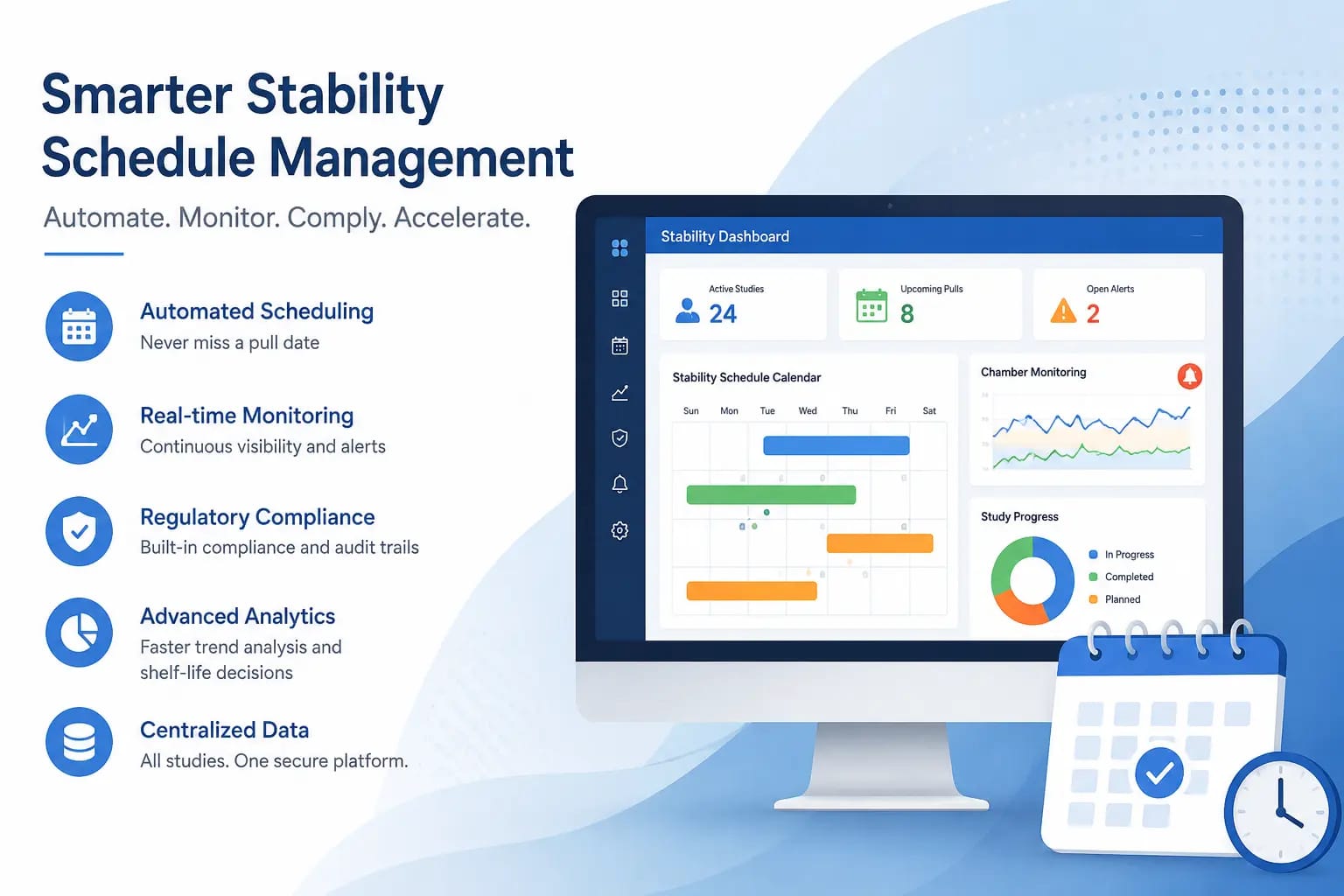
Modern stability testing software centralizes every aspect of stability management within a single validated environment. Instead of relying on manual coordination, organizations can automate workflows from protocol creation through final reporting.
Automated Stability Test Protocol Creation
The software enables users to create standardized, ICH Q1A-compliant stability test protocols using configurable templates. Study conditions, sampling intervals, acceptance criteria, and packaging configurations can all be defined consistently across products and sites.
Intelligent Stability Schedule Calendar
An automated stability schedule calendar generates pull dates, chamber assignments, analyst allocations, and testing schedules in real time. Built-in notifications and reminders help ensure that no critical activity is missed.
Real-Time Chamber Monitoring
Integrated environmental monitoring continuously tracks chamber temperature and humidity conditions. Automated alerts notify teams immediately when excursions occur, allowing faster investigation and corrective action.
Integrated Test Execution
Analytical testing can be performed directly within the laboratory workflow. Instrument integration, automated calculations, and electronic data capture improve accuracy while maintaining complete sample-to-result traceability.
Advanced Trend Analysis
Modern solutions leverage advanced analytics to evaluate stability data, identify trends, detect potential out-of-specification conditions, and support scientific shelf-life determination. This enables faster and more reliable decision-making.
Automated Regulatory Reporting
Regulatory-ready reports can be generated automatically using approved study data. This significantly reduces manual effort while improving consistency and compliance with industry requirements.
Building a Centralized Stability Data Hub
One of the biggest advantages of stability testing software is the ability to create a centralized data hub that connects all study-related information.
A unified platform provides:
Real-time visibility into active and completed studies
Centralized stability schedule management
Interactive trend analytics and degradation modeling
Automated notifications for upcoming pulls and deviations
Complete audit trails supporting ALCOA+ principles
Seamless integration with LIMS, QMS, ERP, and laboratory instruments
By bringing all stability information together, organizations gain better control over their programs while reducing administrative burden.
Manual vs Automated Stability Management
The difference between manual and automated approaches is significant.
Manual processes often involve spreadsheet-based scheduling, inconsistent protocol documentation, delayed reporting, and reactive compliance management. In contrast, automated stability testing software delivers standardized workflows, real-time visibility, predictive analytics, and continuous audit readiness.
Organizations can benefit from:
Reduced administrative workload
Improved study accuracy
Faster shelf-life determination
Better resource utilization
Enhanced data integrity
Increased regulatory confidence
Supporting Global Regulatory Compliance
Stability studies must meet strict regulatory expectations throughout their lifecycle. A robust stability testing software solution helps organisations maintain compliance with major global regulations and guidelines, including:
FDA 21 CFR Part 11
FDA 21 CFR Part 211.166
EU GMP Annex 11
GAMP 5
ICH Q1A (R2)
ICH Q1B–Q1E
ICH Q5C
ALCOA+ Data Integrity Principles
WHO Technical Report Series
MHRA Requirements
By embedding compliance controls directly into workflows, organizations can simplify inspections and reduce regulatory risk.
Today pharmaceutical and life sciences companies continue to expand their product portfolios. Because of this manual stability management processes are becoming increasingly difficult to sustain due to missed pull dates, fragmented data, delayed reporting, and compliance challenges. These can significantly impact operational efficiency and product timelines.
Modern stability testing software provides a smarter approach by automating stability schedule management, standardizing stability test protocols, centralizing data, and enabling faster shelf-life determination. With integrated workflows, real-time monitoring, and regulatory-ready reporting, organizations can transform stability studies from a complex administrative process into a strategic advantage.
Companies which need greater efficiency, compliance, and visibility, automated stability schedule management is no longer a future goal; it is a business necessity.


