Pharmaceutical QC labs have been moving toward paperless operation for a long time, but the pace has picked up meaningfully in the last few years, largely because LIMS platforms have gotten genuinely better at handling the parts of lab work that used to require manual transcription and judgment. The direction of travel is clear. What's worth understanding is specifically what's changing and why it matters beyond simply eliminating paper.
Why paper still lingers in QC labs
Even labs that have digitized sample management often still have paper touchpoints: instrument printouts manually transcribed into a LIMS, handwritten notebook entries for observations that don't fit a structured field, or logbooks for equipment usage kept separately from the testing records themselves. Each of these is a place where data integrity risk creeps in, since manual transcription is a well-documented source of both simple errors and more serious findings around data manipulation.
What AI-driven LIMS actually automates
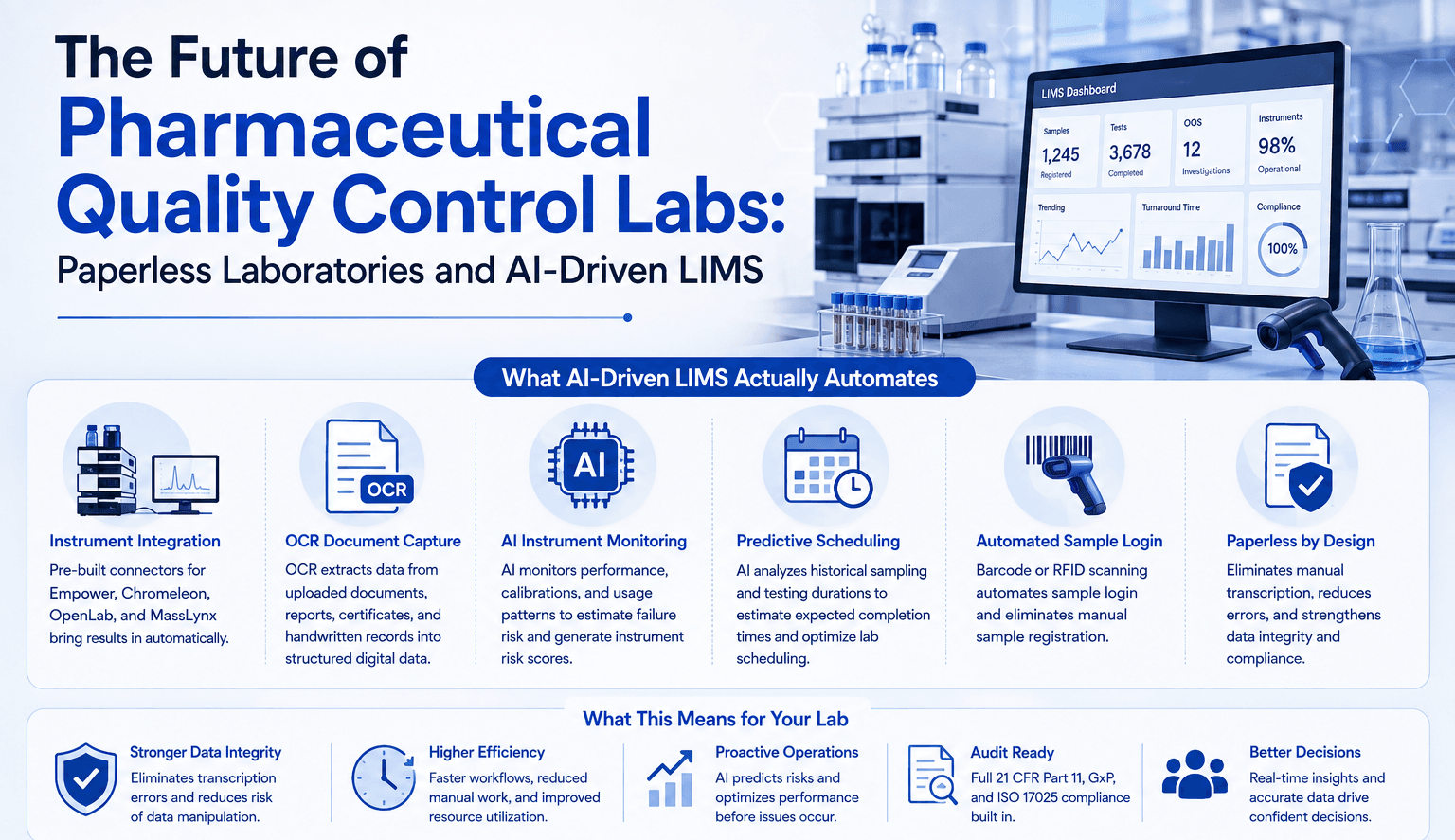
AmpleLogic's LIMS applies AI specifically to the points where manual work has historically been unavoidable:
Pre-built connectors for Empower, Chromeleon, OpenLab, and MassLynx bring instrument results in automatically, removing the transcription step entirely
OCR automatically extracts data from uploaded documents, including scanned reports, certificates, and handwritten records, converting them into structured digital data
AI continuously monitors instrument performance, calibration records, and usage patterns to estimate failure risk and generate instrument risk scores before a breakdown affects testing
Predictive scheduling analyzes historical sampling and testing durations to estimate expected completion times, improving both lab scheduling and workforce planning
Automated sample login with barcode or RFID scanning replaces manual sample registration entirely
What this means for data integrity, not just convenience
The paperless lab conversation often gets framed around efficiency, and the time savings are real. But the more significant shift is what it does for data integrity. When results move from instrument to record without a transcription step, the most common source of laboratory data integrity findings simply stops being possible. That's a more durable improvement than speed alone, and it's usually the argument that resonates most with quality leadership evaluating the investment.
Where the lab of the near future is headed
The direction is toward labs where the LIMS isn't just a record-keeping system but an active participant in lab operations: flagging an instrument likely to need maintenance before it fails, predicting how long a batch of testing will take before it's even scheduled, and surfacing OOS investigations through structured workflows the moment a result falls outside specification. Full 21 CFR Part 11, GxP, and ISO 17025 compliance remains the foundation underneath all of it, since none of this AI-driven automation is worth much if it can't hold up during an inspection.
Getting there without disrupting current testing
Most labs move toward this incrementally, starting with instrument integration to eliminate transcription, then layering in predictive scheduling and OCR-based document capture as the initial integration proves out.
To see how the AI-driven capabilities connect with your current instrument fleet, the LIMS product page covers integration options and compliance coverage in detail.


