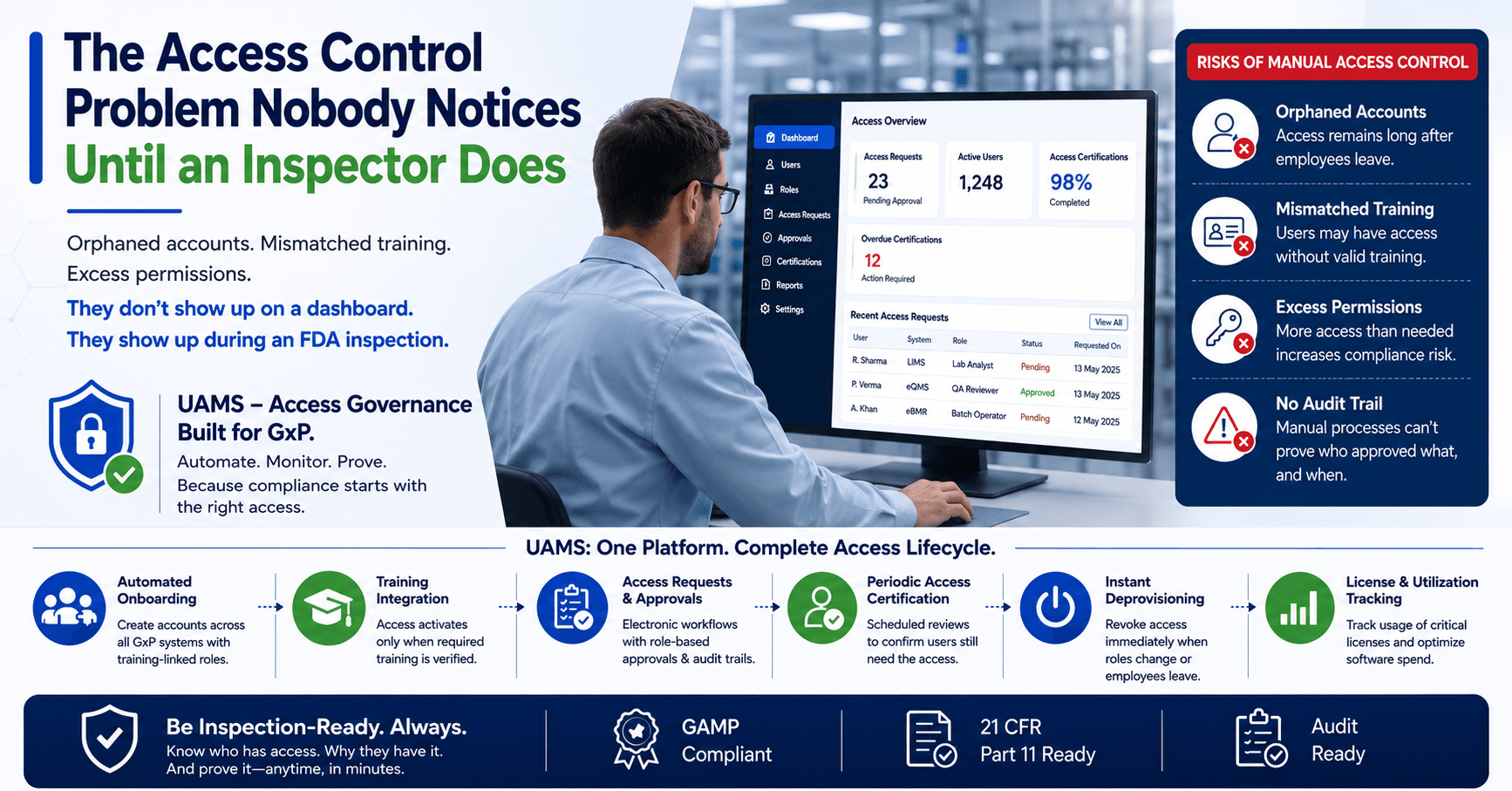
Walk into most pharma IT departments and ask how access to LIMS, eQMS, or the batch record system gets granted, and you'll usually hear a version of: "IT sets it up when someone starts, and QA reviews it... eventually." That "eventually" is where the risk lives. Orphaned accounts, mismatched training records, and permissions nobody remembers granting don't show up on a dashboard they show up during an FDA inspection, usually at the worst possible moment. This is exactly the gap a proper access management software platform is built to close.
Why Manual Access Control Doesn't Scale in GxP Environments
Every validated system LIMS, eQMS, eBMR, DMS needs its own access logic, and that logic has to line up with training records, role changes, and departures in real time. Do that manually across a handful of systems and it's tedious. Do it across ten or more GxP applications, multiple plants, and hundreds of users, and it becomes a genuine compliance liability.
That's the case for an electronic access management solution: not convenience, but defensibility. When access requests move through paper forms and email chains, there's no audit trail, no consistent approval logic, and no easy way to prove six months later that a given permission was granted correctly and revoked on time.
A GAMP compliant access management system solves this by baking the logic in from the start. Roles, approvals, and training verification aren't bolted on after the fact; they're part of how the system is validated to work. That distinction matters more than it sounds like it should, because it's the difference between "we think our access controls are fine" and "we can prove it."
Role-Based Access, Done the Way Regulated Industries Actually Need It
Generic IT access tools weren't built with cGMP in mind. A role-based access control software designed for life sciences has to do more than assign permissions by job title; it has to tie those permissions to training status, segregation-of-duties rules, and least-privilege principles that hold up under FDA or MHRA scrutiny.
Think about what actually goes wrong in practice: a lab analyst approving their own test results, a QA reviewer who also has production operator rights, an operator using an HPLC system despite an expired qualification. None of these shows up as errors until someone's specifically looking for them, which is usually an auditor, not an internal team. A well-designed UAMS software platform catches these conflicts automatically, before they become findings.
What Good User Access Control Software Actually Looks Like
The best user access control software for pharma handles the entire identity lifecycle, not just the moment someone logs in. That means:
Automated onboarding — accounts created across every GxP system the moment HR triggers a new hire, with training-linked roles that only activate once qualifications are verified.
Periodic access certification — scheduled reviews where supervisors and QA actually attest to whether someone still needs the access they have, instead of rubber-stamping a list.
Instant deprovisioning — no lingering accounts in LIMS or batch record systems after someone leaves or changes roles.
License and utilisation tracking — visibility into who's actually using Empower, Chromeleon, or SAP seats, so licensing costs stop growing on autopilot.
A user access control system built around these principles doesn't just reduce IT tickets though it usually does, often significantly. It closes the gap between "access was granted at some point" and "access is currently correct, verified, and traceable."
The Real Value of a User Access Management System
Strip away the feature list, and a User Access Management System exists to answer one uncomfortable question honestly: if an inspector asked right now who has access to what, and why, could you answer in minutes instead of days? For most pharma organisations still running access control through spreadsheets and email approvals, the honest answer is no.
That's really the shift underway across life sciences IT, from access management as an administrative chore to access governance as active risk management. Segregation-of-duties violations, orphaned accounts, and training-access mismatches aren't hypothetical audit findings; they're the kind of thing that turns a routine inspection into a 483 observation.
Getting ahead of that doesn't require a bigger IT team. It requires a system that treats identity, training, and access as one connected record instead of three separate problems, automating the parts that are tedious and error-prone by hand, and leaving the judgment calls (who should have access, and why) to the people actually qualified to make them.


