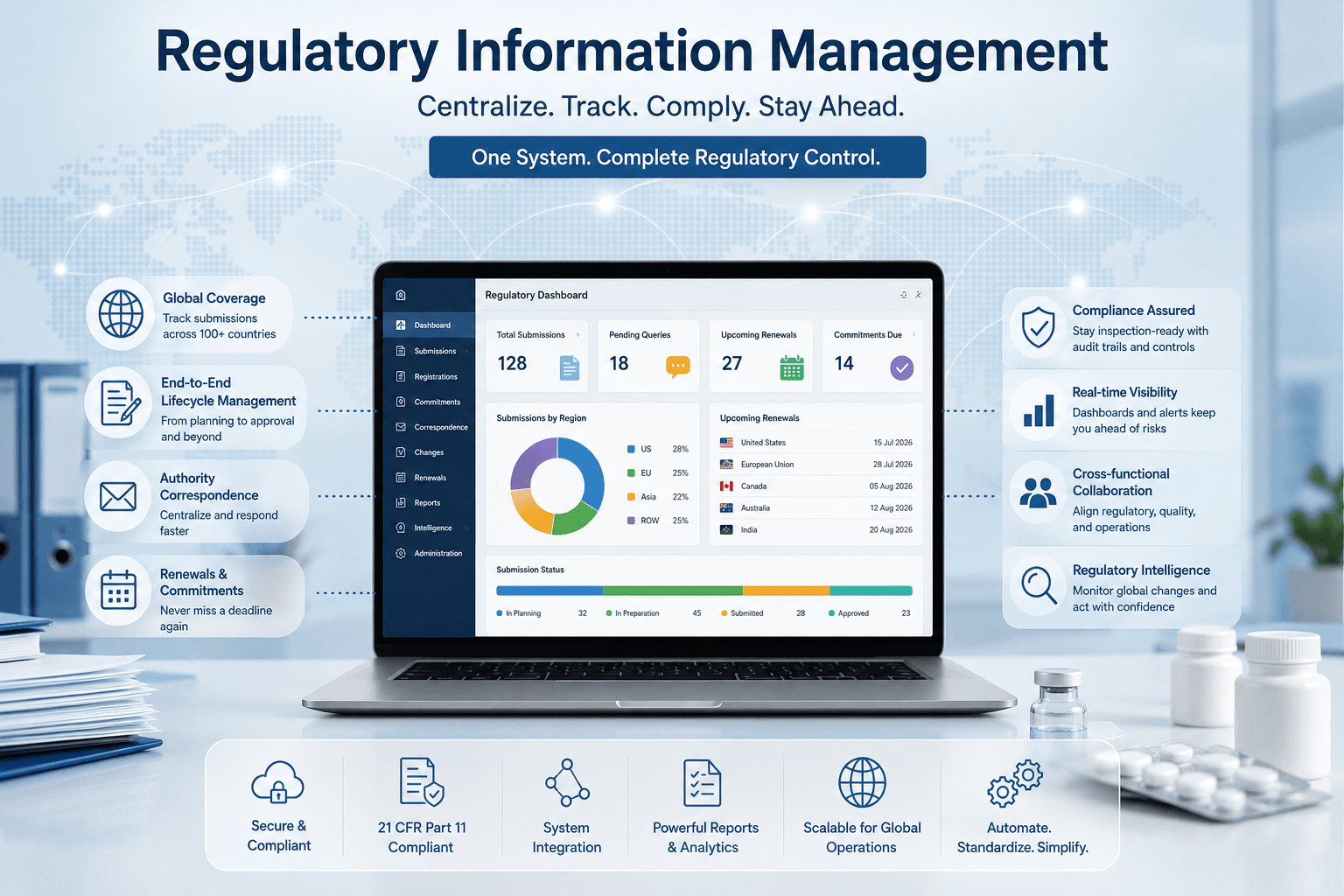
Ask any regulatory affairs head how their team tracks global submissions, and you'll usually get the same answer: a patchwork of spreadsheets, shared drives, and email threads held together by institutional memory. It works, until it doesn't. A missed renewal date, a lost query response, or a version mix-up during an FDA inspection can cost a company far more than the price of better software. This is exactly the gap a Regulatory Information Management System is built to close.
For pharmaceutical, biotech, and medical device companies operating across dozens of markets, regulatory data isn't a side function anymore it's the backbone of market access. When that data lives in silos, delays and compliance risk follow. A modern Regulatory Information Management System brings product registrations, submission timelines, authority correspondence, and compliance commitments into one place, so nothing falls through the cracks.
The Problem With Manual Regulatory Tracking
Regulatory affairs teams are dealing with more complexity than they were even five years ago. Submission formats vary by region eCTD, ACTD, NeeS, and paper-based dossiers all coexist depending on where a product is registered. Authorities like the FDA, EMA, MHRA, CDSCO, TGA, WHO, and Health Canada each have their own timelines, formats, and expectations. Multiply that across a portfolio of products and 50-100 countries, and manual tracking stops being a viable option.
A few recurring pain points show up again and again in regulatory operations:
Constantly shifting regulations. Global authorities update requirements frequently, and keeping pace by hand is nearly impossible without a regulatory intelligence system feeding real-time changes into daily workflows.
Scattered data. Registration details, correspondence, and dossiers spread across inboxes and folders create blind spots that only a proper regulatory data management solution can close.
Limited visibility. Without live dashboards, nobody has a clear view of submission status, pending queries, or upcoming renewal deadlines until it's almost too late.
Manual, error-prone coordination. Email-driven handoffs between regulatory, quality, and manufacturing teams increase the odds of a missed deadline or an inconsistent filing.
Disconnected systems. When your QMS, DMS, LIMS, and ERP don't talk to each other, regulatory teams end up re-entering the same data multiple times, and errors compound.
These aren't hypothetical risks. They show up as delayed launches, avoidable FDA483 observations, and audit findings that could have been prevented with better traceability.
What a Regulatory Information Management System Actually Does
At its core, a Regulatory Information Management System (RIMS) centralizes everything related to a product's regulatory life: registrations, submissions, approvals, variations, renewals, and correspondence with health authorities. But the better platforms go beyond simple record-keeping. They function as a regulatory compliance management system that actively monitors deadlines, flags risks, and keeps teams aligned across geographies.
A well-designed RIMS software platform typically covers:
Master data management — a single source of truth for product registrations and market authorizations across every country a company operates in.
Submission lifecycle management — structured workflows for planning, preparing, publishing, and validating submissions, whether they follow eCTD, ACTD, or NeeS formats.
Tracking and intelligence — real-time visibility into submission status, authority queries, target action dates, and renewal timelines, all in one dashboard instead of a dozen spreadsheets.
Change control — documented, auditable workflows for variations and post-approval changes, which matters enormously during an inspection.
Cross-functional collaboration — shared visibility for regulatory, quality, manufacturing, and external partners like CDMOs, so nobody is working from an outdated file.
Analytics and reporting — dashboards and reports that turn raw submission data into something leadership can actually act on.
Together, these functions turn what used to be a purely administrative task into a proactive, data-driven discipline which is really the difference between old-style Regulatory Submission Management Systems and a true, AI-enabled pharma regulatory information system.
Regulatory Document Management Is Only Half the Picture
A lot of companies assume that solid document control is enough. Version history, electronic signatures, and a searchable repository certainly matter, and any credible regulatory document management software needs to deliver on those basics with full audit trails and 21 CFR Part 11-compliant controls. But documents alone don't tell you whether a renewal is due in three weeks or whether a query response is sitting unanswered in someone's inbox.
That's why the strongest platforms pair document control with active tracking. A good regulatory tracking software module doesn't just store the dossier it tells you where that dossier stands in the submission lifecycle, what's pending, and what's coming due. Combined, document management and tracking form the operational core of any serious regulatory information management software.
Why Regulatory Surveillance Deserves Its Own Conversation
Submission tracking is only one part of staying compliant. The other half is watching the regulatory landscape itself new guidance documents, updated requirements, and shifting authority expectations that can affect products already on the market. This is where a regulatory surveillance management system earns its keep.
Instead of regulatory affairs staff manually scanning agency websites and industry newsletters, a regulatory surveillance software platform continuously monitors updates from the FDA, EMA, MHRA, and 100-plus regional authorities, then routes relevant changes to the right internal stakeholders. Paired with a broader regulatory compliance surveillance system, teams get early warning of changes that could affect labeling, manufacturing, or ongoing submissions before those changes turn into findings.
This proactive layer is what separates a merely functional platform from a genuinely intelligent one. A capable regulatory change management software module doesn't just log that a rule changed somewhere; it connects that change back to the specific products and markets it affects, so teams can act instead of reacting after the fact.
Turning Data Into Decisions With Regulatory Requirements Tracking
Every regulated product carries a running list of commitments: post-approval commitments, periodic safety updates, renewal cycles, labeling updates, and authority-specific obligations that vary by market. Keeping track of all of it by hand is where most compliance gaps quietly form.
A dedicated regulatory requirements tracking software module keeps every obligation tied to its due date, owner, and current status, with automated alerts well before anything lapses. Combined with dashboard-level reporting, this becomes a compliance surveillance management solution that gives regulatory leadership an honest, real-time picture of where the organization stands — not a quarterly snapshot assembled under deadline pressure.
The Business Case: Why This Matters Beyond Compliance
It's tempting to think of regulatory information management as a defensive function — something that exists purely to avoid problems. In practice, the business case is much stronger than that.
Faster submission preparation means faster market entry. Fewer manual errors mean fewer costly resubmissions. Real-time visibility means leadership can make portfolio decisions with current data instead of outdated reports. And when regulators or auditors show up, having a system that produces audit-ready documentation in minutes rather than weeks changes the entire tone of that visit.
Companies that have moved from spreadsheet-based tracking to a proper RIMS software platform typically report meaningfully faster submission cycles, sharp reductions in manual data entry hours, and near-elimination of missed deadlines — the kind of operational shift that compounds across a large product portfolio and a global footprint.
What to Look for in a Regulatory Information Management Platform
Not every platform marketed as a RIMS software solution delivers the same depth. When evaluating options, a few things are worth scrutinizing closely:
Global authority coverage. Does it support FDA, EMA, MHRA, CDSCO, TGA, WHO, Health Canada, and other authorities relevant to your markets, with country-specific lifecycle tracking?
Format flexibility. Can it handle eCTD, ACTD, NeeS, and paper-based submissions without forcing manual workarounds?
Integration depth. Does it connect natively with your eQMS, DMS, LIMS, and ERP systems, or will you end up re-keying data anyway?
Audit trail integrity. Does it meet 21 CFR Part 11 and EU Annex 11 requirements with genuine electronic signature controls?
Intelligence, not just storage. Does the platform proactively flag risks and regulatory changes, or does it simply hold documents until someone goes looking?
Deployment speed. Can it go live in weeks with validated templates, or are you looking at a multi-year implementation?
Getting this right is what separates a platform that genuinely functions as a pharma regulatory information system from one that's just a glorified file cabinet with a login screen.
Global regulatory complexity isn't slowing down, and neither are the expectations from health authorities around traceability, transparency, and speed. Companies still relying on spreadsheets and email chains aren't just working harder than they need to they're carrying risk that a properly implemented Regulatory Information Management System would quietly absorb. Whether the priority is faster submissions, fewer missed renewals, or simply sleeping better before an inspection, the right regulatory compliance management system pays for itself well before the first audit ever begins.


