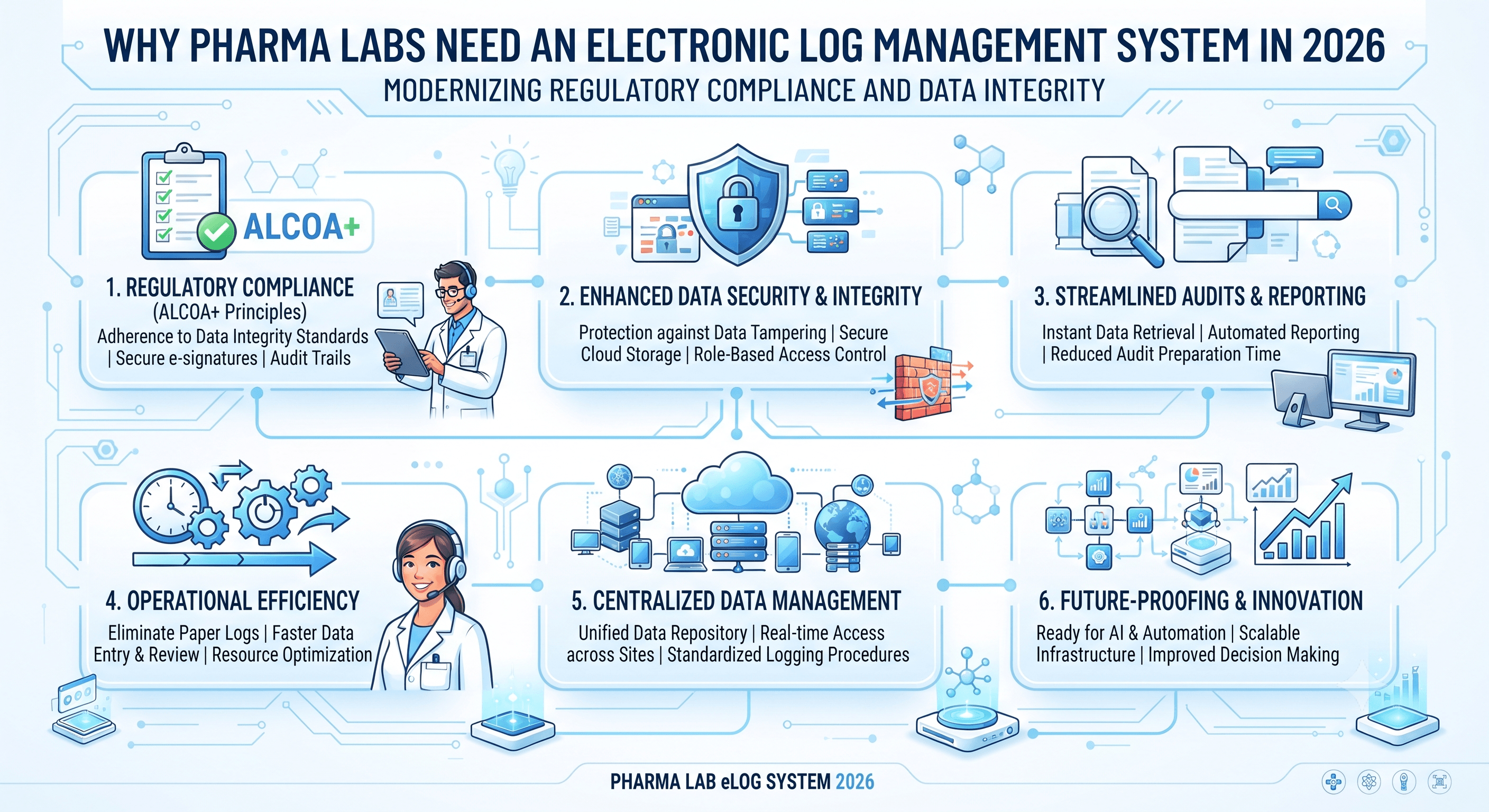
And that mismatch is where the trouble starts. Inspections have gotten stricter, data integrity rules under 21 CFR Part 11 and EU Annex 11 keep getting tighter, and paper just isn't holding up anymore. Below are the real problems pharma labs are dealing with right now, and why so many of them are finally switching to an electronic logbook system.
1. Data Integrity Gaps That Auditors Always Find
Paper logs are easy enough to backdate, overwrite, or quietly "fix" later on. Most of the time nobody's actually trying to falsify anything, it's just a missed entry or a correction without initials, but that's still enough to earn an observation the moment an FDA or MHRA inspector looks at it. ALCOA+ expects records to be attributable, legible, contemporaneous, original, and accurate, and paper falls short on nearly all of those, contemporaneous especially, since entries usually get filled in at the end of a shift instead of the moment something actually happens. This is precisely the gap an eLogbook compliance software is designed to close.
2. The Blind Spot Between MES and Real Operations
MES systems are genuinely good at one thing: structured, pass or fail transactions. What they're not built for is the messier, human side of plant operations. Things like:
A visual observation made while cleaning equipment
A note explaining the context behind an HVAC deviation
Shift handover details that carry knowledge no dropdown field can hold
A calibration check someone actually walked over and verified by hand
MES is great at enforcing process logic, but it was never flexible enough to capture the judgment calls operators make on a normal day. That gap in documentation is exactly what inspectors tend to zero in on, and paper logbooks were never really built to close it either.
3. Legacy Equipment That Refuses to Talk to Modern Systems
Most pharma plants run a strange mix of things, old PLCs, standalone instruments, newer SCADA systems, often all crammed onto the same floor. Building a custom hardware interface for every old machine costs time and money most teams just don't have lying around. And revalidating a control system only to add connectivity? That's a project people keep pushing to next quarter, every quarter.
So the workaround becomes manual. Someone walks up, reads the number off the display, writes it into a notebook by hand. That's exactly where transcription errors creep in, right at the one point where accuracy actually matters.
4. Indirect Systems Like HVAC and Purified Water Getting Ignored
Direct production equipment usually gets documented reasonably well. Indirect systems, HVAC, boilers, chillers, purified water loops, often don't get the same attention because they fall outside the MES scope entirely. Yet these systems affect environmental monitoring, cleanroom classification, and ultimately product quality. When they're tracked on paper or in disconnected spreadsheets, trending problems over time becomes nearly impossible without a proper electronic log management system pulling everything into one place.
5. Shift Handovers That Lose Information
Ask any QA manager about their biggest recurring headache and shift handovers will come up quickly. Verbal handovers plus a scribbled note rarely capture the full context of an ongoing deviation or an unusual equipment behavior. By the time the next shift picks it up, details are missing, and that gap can turn a minor issue into a full-blown investigation later.
6. Slow, Manual Deviation and CAPA Documentation
When something goes wrong, whether it's an out-of-condition environmental reading or an equipment malfunction, the clock starts ticking. Paper based systems slow down every step: locating the right logbook, writing the observation, routing it for review, and eventually linking it to a CAPA. Every manual handoff adds delay and risk of miscommunication.
7. No Real Visibility for QA and Plant Leadership
Perhaps the most frustrating challenge is visibility. QA heads and plant managers often only find out about a recurring equipment issue or a documentation lapse during a monthly review, or worse, during an audit. Paper logbooks sitting in different departments make it nearly impossible to get a real time view of what's happening across the facility.
How Digital Logbooks Are Changing This
That's basically the gap electronic logbook software was built for in the first place. It's not trying to replace MES, a solid eLogbook just sits next to it, catching the unstructured, observational stuff automated systems tend to miss entirely. Non-intrusive integration with PLCs, SCADA, and standalone instruments means old equipment can get digitized at last, no touching validated control logic, no expensive revalidation cycle to deal with.
Real-time capture. Built-in e-signatures. An audit trail nobody can quietly go back and edit. All of it lines up with the exact ALCOA+ gaps auditors keep pointing out, inspection after inspection. Drag-and-drop logbook builders and AI-assisted template conversion help as well, so labs stop burning months just configuring things manually before a digital log even goes live. And the stuff that used to fall through the cracks, calibration checks, shift transitions, environmental monitoring, warehouse handling, it all ends up in one connected electronic log management system with actual traceability. Finally.
The Bottom Line
Pharma laboratories are not struggling because they lack technology. They're struggling because their documentation practices haven't caught up with how modern manufacturing actually works. Paper logbooks were fine when processes were simpler and inspections were less rigorous. Neither of those is true anymore.
Labs that move to an electronic logbook system, backed by genuine eLogbook compliance software, are not just checking a compliance box. They're closing the visibility gap between what MES tracks and what actually happens on the floor, and that difference shows up clearly the next time an inspector walks through the door.


