Design of Experiments
Support experimental design optimization, critical quality attribute identification, process parameter analysis and risk-based development strategies within the ELN.
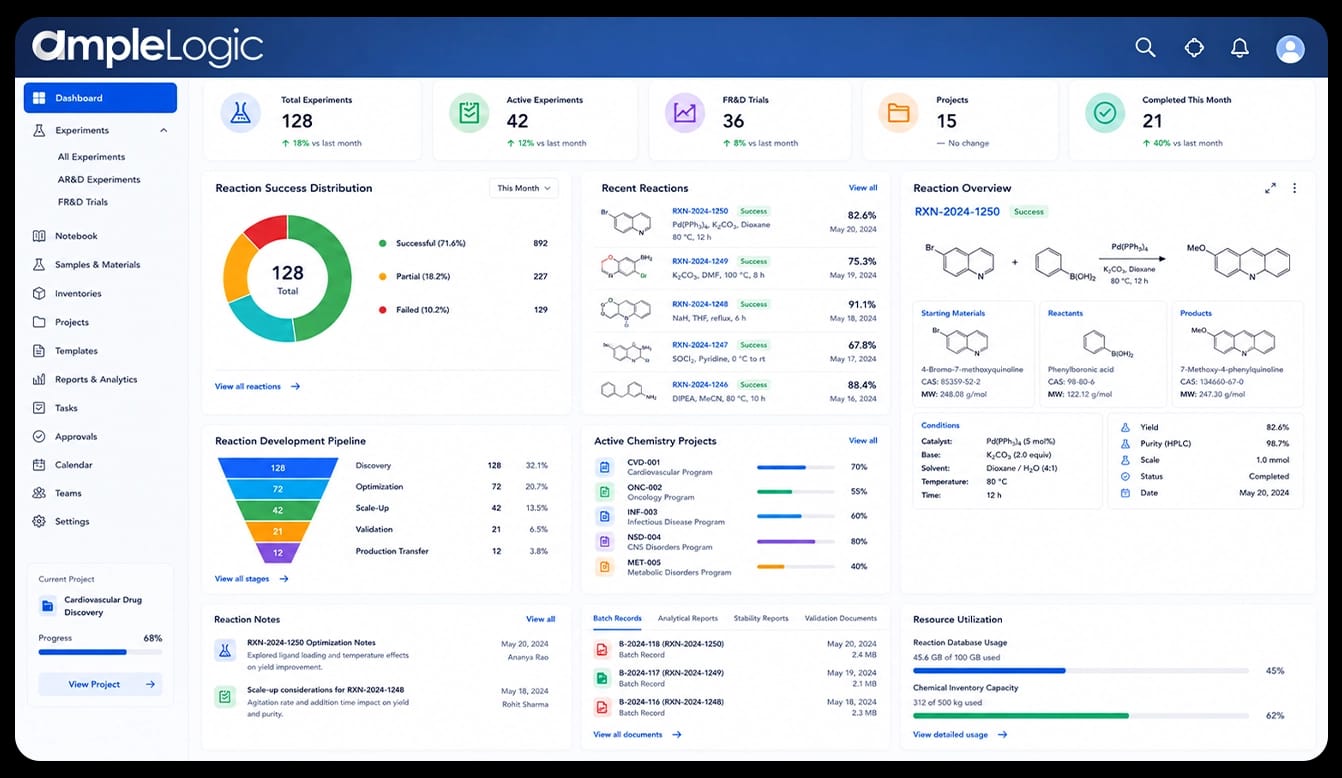
Build structured experimental design into scientific development
Unstructured trial-and-error experimentation consumes time and leaves critical parameter relationships poorly understood. Development teams need a more deliberate way to design studies.
AmpleLogic Electronic Laboratory Notebook supports Design of Experiments with experimental design optimization, critical quality attribute identification, process parameter analysis, risk-based development strategies and comparison across experiment series to optimize conditions.
That helps scientists design more informative studies and connect design intent to experiment execution and later statistical interpretation.
Explore AmpleLogic Electronic Laboratory NotebookWhat Design of Experiments enables
Practical capabilities research teams use to manage scientific work in the ELN.
Experimental Design Optimization
Structure experimental designs so scientists evaluate factors and responses more systematically.
Critical Quality Attribute Identification
Support identification of critical quality attributes as part of development planning.
Process Parameter Analysis
Analyze process parameters to understand how experimental conditions influence outcomes.
Risk-Based Development Strategies
Apply risk-based thinking when planning experimental strategies and study priorities.
Compare Experiment Series
Compare a series of experiments to optimize experimental conditions across related studies.
How this capability fits the research lifecycle
From create and review through approval, distribution, use, revision and archival — adapted for this page.
Step 01
Define study objective
Clarify the scientific question, responses and development goals for the DoE effort.
Step 02
Structure the design
Organize factors, parameters and experimental design strategy before execution.
Step 03
Execute experiments
Carry designed studies into experiment management for controlled execution.
Step 04
Compare conditions
Review experiment series to identify improved experimental conditions.
Step 05
Analyze and decide
Use statistical analysis and scientific review to refine development direction.
Outcomes researchers and laboratory teams can expect
Benefits focused on this ELN capability.
More informative studies
Structured designs help teams extract stronger scientific learning from each experiment set.
Clearer parameter understanding
Process parameter analysis supports better insight into what drives outcomes.
Risk-aware development
Risk-based strategies help teams focus experimental effort where uncertainty matters most.
Faster optimization cycles
Comparing experiment series helps refine conditions without losing design context.
Built to support regulated scientific research and data integrity
Controls and practices most relevant to this ELN capability.
Controlled design records
Retain DoE planning context within governed ELN scientific workflows.
Traceable design-to-execution link
Connect experimental design intent to executed experiment records.
Role-based access
Limit design and review actions to authorized scientific roles.
DoE connected to experiment execution and analysis
Design of Experiments works with experiment management, statistical analysis and AI-assisted scientific support to improve development learning loops.
Design then execute
Move structured designs into experiment management for consistent study delivery.
Analyze design outcomes
Feed DoE results into statistical analysis for scientific interpretation.
See how AmpleLogic can transform your scientific research workflows
Move from fragmented notebooks and disconnected research tools to a more connected, traceable and collaborative electronic laboratory notebook.
Speak with our ELN specialists about your current research workflows, laboratory systems and data integrity requirements.
Unsere globalen Büros
Wir sind dort, wo Sie uns brauchen. Global verbunden, lokal geliefert.
Indien

Melange Tower, 2nd Floor, Wing-C, Patrika Nagar, HITEC City, Madhapur, Hyderabad - 500081, Telangana, India
Vereinigte Staaten (Dallas)

17330 Preston Road Suite 200D, Dallas, TX, 75252
Kanada (North York, Toronto)

5255 Yonge Street Suite 201, North York, ON, M2N 6P4
Australien (Melbourne)

Level 14, 330 Collins Street, Melbourne, VIC, 3000
Südkorea (Daegu)

Daegu Trade Centre, 8/F. 489, Dongdaegu-ro, Daegu, 41256
Irland (Dublin)

Block 1, Blanchardstown Corporate Park Ballycoolen Road, Dublin, D15 AKK1
Singapur

1 Scotts Road, #24-10 Shaw Centre, Singapore, Singapore, 228208
Bleiben Sie in den Biowissenschaften an der Spitze
Erhalten Sie die neuesten Produktaktualisierungen, Compliance-News und Brancheneinblicke in Ihren Posteingang.