Pharmaceutical manufacturing compliance is often treated as overhead: the paperwork layered on top of production rather than something built into it. That framing is exactly why paper-based batch records still slow so many operations down. Every handwritten entry, every sequential sign-off, every manual reconciliation against a specification is a place where compliance and throughput pull against each other. Automating that layer doesn't just speed things up. It removes the reason for the trade-off in the first place.
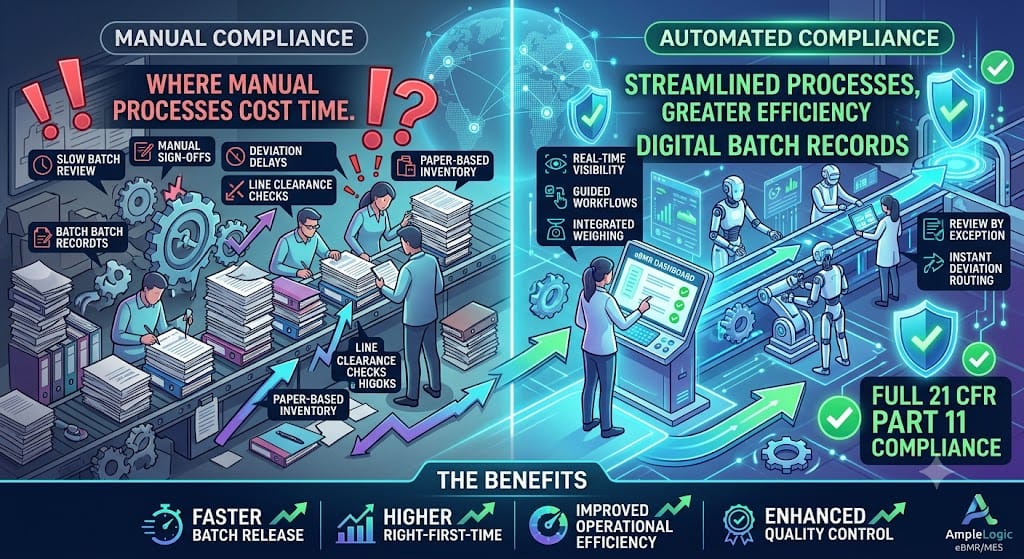
Where manual compliance processes cost the most time
A few points in a typical batch cycle account for most of the delay:
Batch record review, where every entry has to be manually checked against the master batch record before release
Material dispensing, where weight and identity verification happen on paper and get re-checked by a second person
Deviation handling, where an in-process exception stops the line while someone tracks down the right form and the right approver
Line clearance, which often depends on someone physically confirming the previous batch's materials and documentation are gone
None of these steps are unnecessary. They exist because the regulatory expectation is real. The inefficiency comes from doing them manually.
What an automated eBMR/MES actually removes
AmpleLogic's eBMR/MES platform digitizes the batch record from master recipe through execution, quality checks, and release, on a single GMP data layer:
Electronic work instructions and process checkpoints guide operators step by step, so a step can't be skipped or recorded out of sequence
Weighing scale integration with barcode verification confirms material identity and quantity automatically, instead of relying on a second manual check
Exception handling routes deviations to the right workflow immediately, rather than pausing the line while someone locates a paper form
Review by exception lets quality managers focus their attention on batches that actually triggered a deviation, instead of reviewing every batch record from the first page to the last
Real-time production dashboards and equipment integration give live visibility into status, so a line clearance check is a system query instead of a walk-through
The efficiency and compliance numbers move together
In deployments at large-scale manufacturers, this kind of automation has driven meaningful gains: batch release times cut significantly, higher right-first-time batch rates, and measurable improvement in overall operational efficiency, all while maintaining full 21 CFR Part 11 compliance. Those results aren't a coincidence. Review by exception alone is both a compliance improvement, since it puts scrutiny where it's actually needed, and an efficiency gain, since it stops quality teams from re-reviewing records that had no issues.
Getting started without a disruptive overhaul
The path to automated compliance doesn't require replacing every system at once. Most manufacturers start with the batch record and exception handling workflows, since that's where the manual burden is heaviest, and expand into equipment integration and dashboarding as the initial rollout proves out.
To see how this fits your current shop floor systems, the eBMR/MES page walks through integration with ERP, LIMS, and equipment already in place on your lines.


