A batch record tells you what happened during a specific production run. It doesn't tell you what else that equipment was used for last week, whether it was cleaned between two different products, or what an operator noticed during a routine check that didn't rise to the level of a formal deviation. That's what a sequential equipment logbook is for, and it's one of the most consistently underestimated documents in a life sciences quality system.
What a sequential logbook captures that other records don't
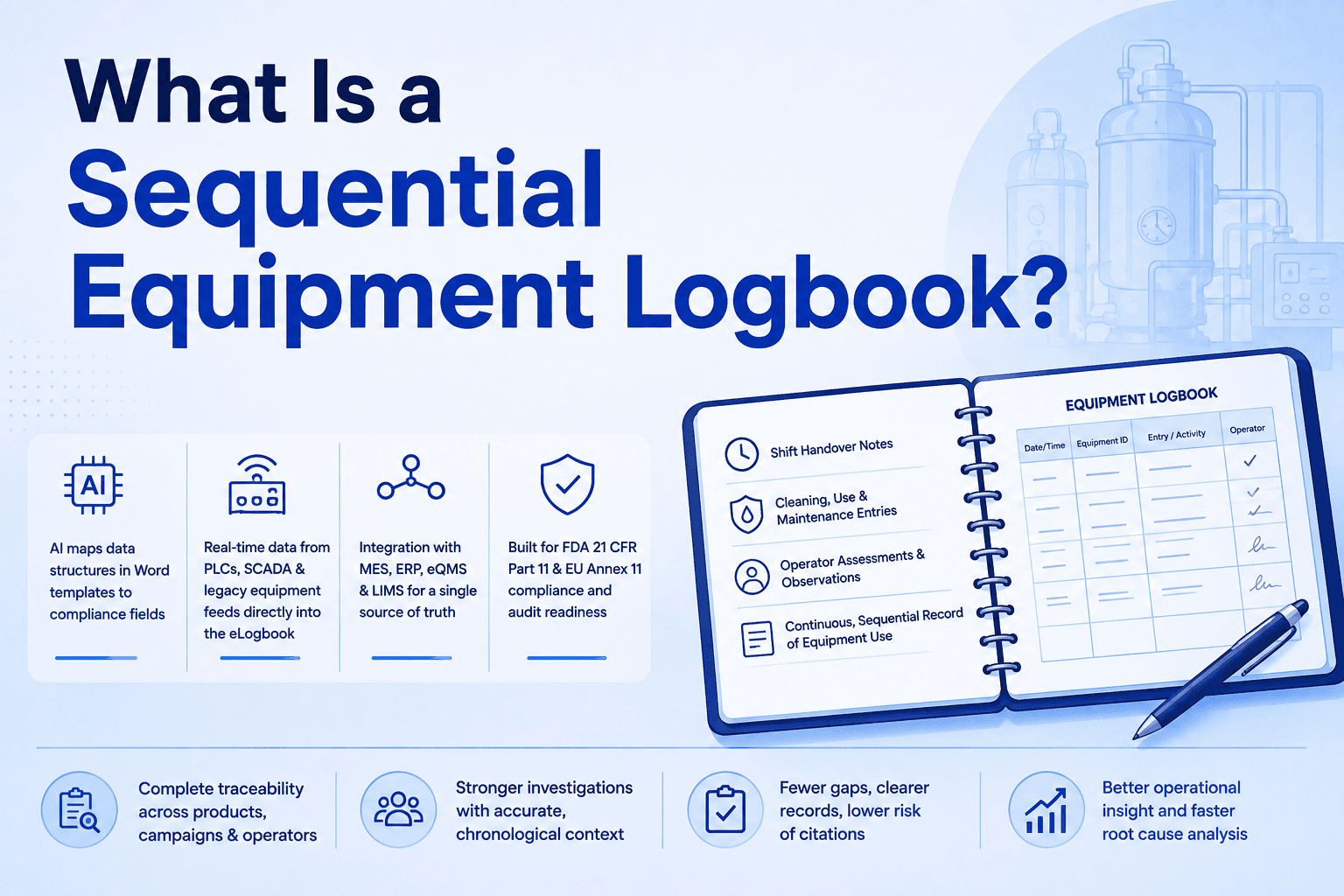
Manufacturing execution systems are built around transactional, structured data: pass or fail, in-spec or out-of-spec, complete or incomplete. That's exactly right for the decisions those systems are meant to support, but it leaves gaps. A sequential equipment logbook captures the unstructured, chronological context that MES logic isn't designed for:
Shift handover notes and observations that don't fit a binary pass/fail field
Cleaning, use, and maintenance entries for equipment that may not have dedicated MES coverage, like HVAC or purified water systems
Operator assessments and situational judgments, the kind of human context that matters during an investigation but doesn't map to a structured transaction
A continuous, sequential record of equipment use across multiple products and campaigns, which is exactly what an inspector asks for when tracing potential cross-contamination risk
Why inspectors care specifically about sequential logbooks
When an investigation needs to establish exactly what a piece of equipment was used for, in what order, and by whom, a sequential logbook is often the fastest and most direct evidence available. Gaps, illegible entries, or missing sequential continuity in these logs are a recurring citation, precisely because they undercut the traceability that the rest of the quality system depends on.
What changes with a digital logbook
AmpleLogic's eLogbook system converts standard Word templates into fully compliant, version-tracked electronic records, so existing logbook formats don't need to be redesigned from scratch to go digital. A few specific capabilities close the gaps paper logbooks tend to have:
AI automatically identifies data structures in uploaded Word templates and maps compliance fields without manual configuration, so converting a paper form takes far less setup time than it sounds
Raw data from PLCs, SCADA, and standalone legacy equipment feeds directly into the eLogbook, capturing real-time readings and alarms that a paper log would only capture if someone remembered to write them down
Integration with MES, ERP, eQMS, and LIMS gives a single source of truth for operational reporting, rather than a logbook sitting apart from the rest of the equipment's records
Generated eLogbooks inherently meet FDA 21 CFR Part 11 and EU Annex 11 standards, delivering audit readiness without a separate compliance configuration step
Why this matters beyond the audit trail
The practical value of a well-maintained equipment logbook shows up during investigations, not just inspections. When a deviation needs root cause analysis, having a complete, sequential, and legible record of everything that happened around a piece of equipment often shortens the investigation significantly, because the context that would otherwise require interviewing multiple operators from memory is already documented.
If your equipment logbooks are still paper-based or scattered across department-specific templates, the eLogbook product page shows how existing templates convert into compliant digital records without a full redesign.


