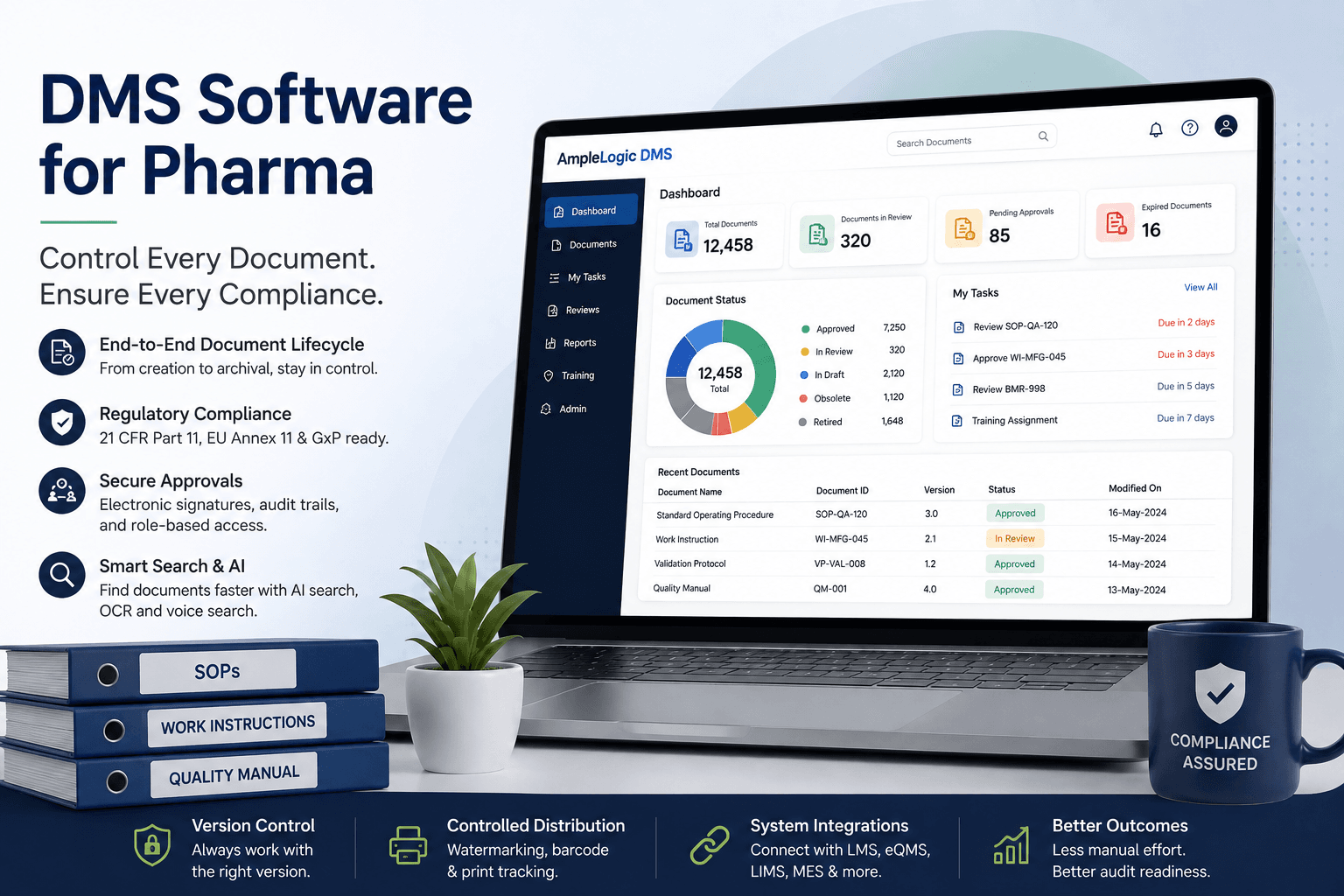
Ask a document control team what happens when an SOP changes, and the answer usually involves more than clicking "save." Someone has to review the revision, someone else has to approve it, the right employees need to be notified, training may need to be assigned, and any printed copies sitting on the shop floor have to be accounted for. Miss one step and an apparently simple document change can turn into a compliance problem.
That's where DMS software starts to earn its place.
For pharmaceutical companies, document management isn't really about storing PDFs and Word files. It's about controlling what people can create, review, approve, access, print, and use across a regulated operation. A useful DMS should make that chain visible and traceable, rather than simply moving the filing cabinet from the office into the cloud.
The Real Problem Isn't the Number of Documents
Pharma companies deal with an enormous amount of documentation: SOPs, specifications, manufacturing procedures, validation documents, laboratory methods, quality records, change controls, technical documents, and regulatory records. The volume itself isn't necessarily the problem.
The difficult part is knowing whether everyone is working from the right document.
A shared drive can tell you where a file was saved. An email can tell you that someone approved something. Neither necessarily gives a quality team the complete picture of what happened between draft and release.
That's why a capable DMS should handle:
Document authoring and controlled editing
Multi-level review and approval workflows
Electronic signatures and audit trails
Version control and document comparison
Superseding and obsolete document management
Controlled distribution and print tracking
Role-based access and permissions
Search and retrieval across large document repositories
AmpleLogic's DMS Software is designed around this complete document lifecycle, taking documents from draft and review through approval, release, superseding, and archival.
Version Control Is Where Things Get Serious
There's a reason version control gets so much attention in pharmaceutical document management.
Imagine an SOP has been revised. The new version is approved, but an older printed copy is still sitting near a production area. The digital system shows the current document. The physical copy tells a different story.
That gap is where document control becomes a quality concern.
AmpleLogic approaches this with version locking, superseding controls, obsolete document handling, and controlled-copy tracking. Printed documents can also carry watermarks and unique barcodes, with printing and retrieval activity recorded for traceability.
It's a practical feature, but an important one. Digital transformation doesn't automatically make paper disappear from a pharmaceutical facility. Sometimes the better approach is to control the connection between the digital record and the physical copy.
Compliance Has to Be Built Into the Workflow
A DMS that simply stores documents isn't particularly useful to a regulated organization.
The system needs controls around electronic records, signatures, access, approvals, and audit history. AmpleLogic positions its DMS as ready for FDA 21 CFR Part 11, with controls mapped to EU Annex 11 and GxP requirements.
That matters because compliance shouldn't be something the quality team checks after a workflow is completed. It needs to be part of the workflow itself.
When a document is reviewed, approved, released, revised, or retired, the system should leave a clear trail behind it. That makes the record easier to understand months later, when nobody remembers who approved what or why a particular revision was introduced.
Where AI Is Actually Useful
AI gets attached to almost every enterprise software category these days. In DMS, though, there are a few applications that make practical sense.
AmpleLogic uses AI-powered OCR to make scanned documents searchable, along with intelligent and voice-activated search capabilities. The platform also supports document comparison and e-discovery to help teams locate and review information more efficiently.
The value here isn't replacing a quality professional's judgment. It's reducing the time spent finding information.
If an auditor asks for a particular document or a team needs to compare two revisions, being able to locate the relevant information quickly is far more useful than another flashy AI feature that doesn't solve a real workflow problem.
A DMS Shouldn't Become Another Silo
This is another area worth considering before selecting DMS software.
Documents rarely exist in isolation. An SOP revision can trigger training in an LMS. A change control can affect a document in an eQMS. A laboratory method may need to connect with LIMS. Manufacturing teams may need access through MES or eBMR processes.
AmpleLogic's DMS supports integrations with systems including LMS, eQMS, RIMS, LIMS, eLog Book, Cleaning Validation, eBMR/MES, calibration management, SAP, and user management systems.
That connected approach matters because the goal isn't simply to digitize documents. It's to maintain traceability across the processes that depend on them.
Does DMS Software Actually Deliver a Business Return?
AmpleLogic reports a projected 25% reduction in audit findings, 30% improvement in document release time, and 50% reduction in manual effort. These are company-reported figures rather than independently verified benchmarks, so they should be treated as directional rather than guaranteed outcomes.
Still, the logic behind the investment is straightforward. If teams spend less time chasing approvals, reconciling versions, retrieving documents, and tracking physical copies, that time can go back into quality and operational work.
The Bottom Line
Good DMS software shouldn't make document control feel more complicated. It should make the complicated parts visible, controlled, and easier to manage.
For pharma companies, that means more than document storage. It means version control, compliant approvals, controlled distribution, audit trails, searchable records, and connections to the systems that sit around quality and manufacturing.
AmpleLogic's DMS brings those capabilities together in a platform built specifically for regulated life sciences operations. If your current document process still depends heavily on shared folders, email approvals, and manual tracking, it may be worth looking at what a purpose-built DMS can change.


