Ask a document control specialist what happens when an SOP gets revised, and the answer usually sounds straightforward. The document is updated, reviewed, approved, released, and the previous version is superseded.
The problem starts when that same document exists somewhere else.
A copy may have been downloaded to a laptop for editing. Another version could be sitting in a shared folder. Someone may have emailed the older file to a colleague. None of those copies necessarily appear in the official document history, but they can still find their way into day-to-day work.
This is one of the less obvious problems a Quality Document Management System needs to solve.
In pharma, document control isn't simply about keeping files in one place. It's about maintaining confidence that the document being used, reviewed, or approved is the document the organization actually controls.
The Problem With "Download, Edit, Upload"
It's a workflow that looks harmless.
A user downloads an SOP from the document system, opens it in Word, makes a few changes, saves the file locally, and uploads the revised version when finished.
But what happens to the copy sitting on the user's computer?
That's where the control gap begins.
The organization may have a controlled version inside the DMS, but an uncontrolled copy now exists outside it. If that copy is emailed, renamed, stored in another folder, or accidentally used as the basis for another revision, the document's history becomes harder to establish.
For quality teams, the questions aren't theoretical:
Which version was actually edited?
Were all changes made to the approved source?
Who had access to the local copy?
Could the file have been altered outside the controlled workflow?
Is there another copy still being used somewhere?
Can the organization demonstrate the complete history during an inspection?
A quality document management system should reduce these questions, not create more of them.
Why Keeping the Document Inside the DMS Matters
This is where AmpleLogic takes a different approach.
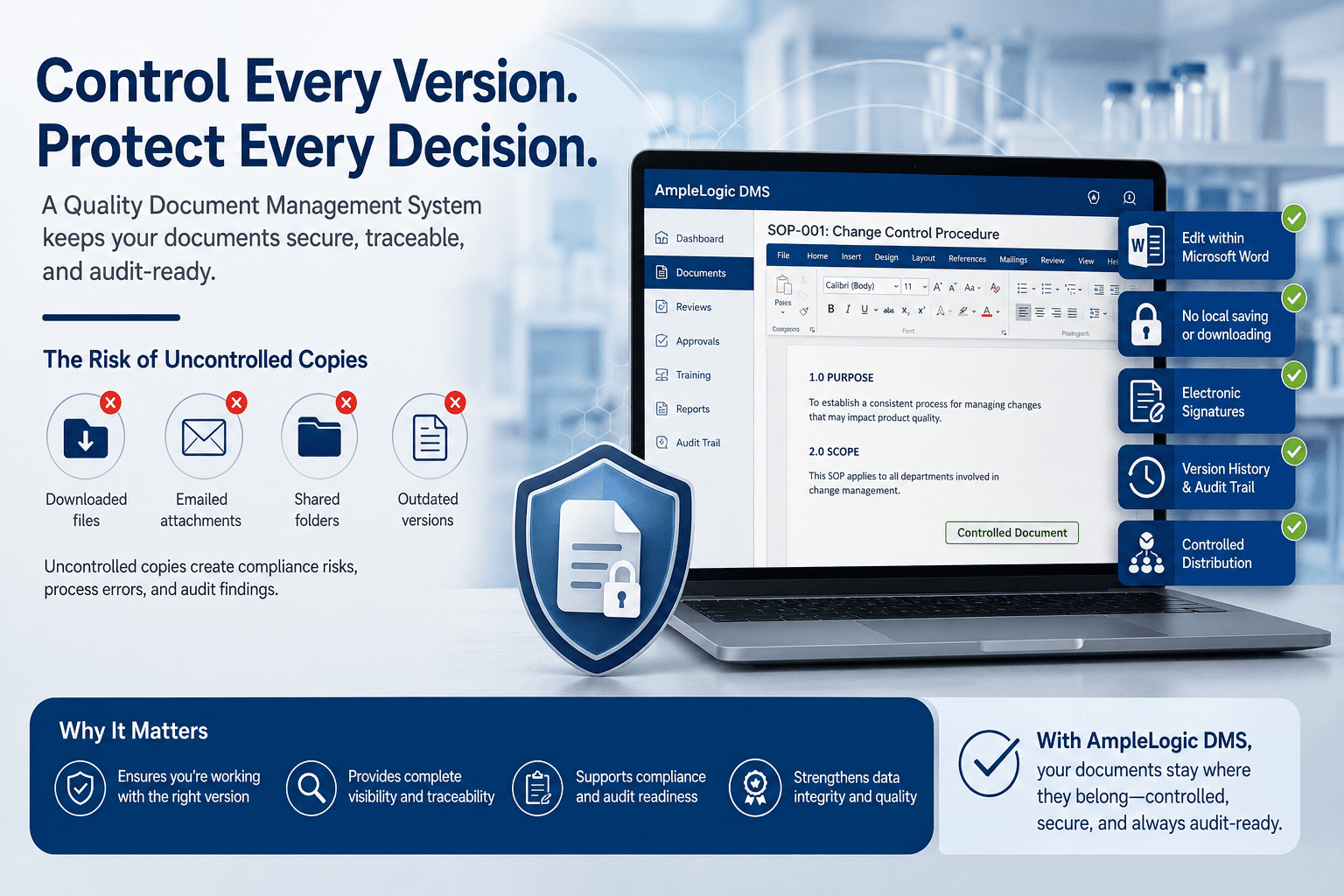
With AmpleLogic DMS Software, users can create and edit documents directly through Microsoft Word while the file remains within the application. Local saving and downloading are restricted, and editing access is limited to authorized users. The activity is also captured through audit trails.
That changes the workflow in a fairly important way.
The user doesn't need to take the document out of the controlled environment just to make an edit.
They can work on the document, make the required changes, and continue through the review and approval process within the DMS.
For a regulated organization, that removes one of the easiest ways an uncontrolled copy can enter the document lifecycle.
It's More Than a Security Feature
It would be easy to describe this simply as a security control. There's more to it than that.
Think about what happens during document revision.
A quality team needs to know what changed, who made the change, which version came before it, and whether the revised document went through the required review and approval steps.
AmpleLogic's DMS combines controlled authoring with version comparison. Users can compare internal versions of the same document, with changes highlighted through Microsoft Word comparison, while the version history and audit trail preserve visibility into the revisions.
That gives document control teams something much more useful than a folder full of files: context.
You don't just know that a new SOP exists. You can trace how it got there.
Where This Becomes Important During an Audit
Auditors aren't interested only in seeing the current SOP.
They may want to understand the history behind it.
Who approved it? When was it revised? What changed? Was the previous version properly superseded? Were users working with the correct document?
A well-designed Quality Document Management System should make those answers relatively easy to establish.
AmpleLogic's DMS manages document lifecycle stages from drafting and review through approval, release, superseding, and archival. It also supports electronic signatures, audit trails, version management, and controlled document distribution.
The distinction matters because compliance isn't demonstrated by having a PDF with the right title. It is demonstrated by showing that the organization has control over the document throughout its lifecycle.
The Shop Floor Creates Another Challenge
There is another side to document control that often gets overlooked.
Even after a document is approved digitally, physical copies may still exist on the production floor. An obsolete SOP sitting in a binder can be just as problematic as an outdated digital file.
AmpleLogic addresses this through controlled print issuance, watermarks, barcode generation, distribution tracking, and point-of-use verification. The system can track issued physical copies and verify their approval status and version through barcode scanning.
So the control doesn't stop when a document leaves the screen.
That's important for organizations that haven't completely eliminated paper from their operations.
What Should You Expect From a Quality Document Management System?
The basics are familiar: version control, electronic signatures, audit trails, approval workflows, permissions, and document lifecycle management.
But a pharma organization should also ask a more practical question:
What happens when someone wants to edit a controlled document?
If the answer is "download it, edit it locally, and upload it again," there is an opportunity to strengthen the process.
A more controlled approach keeps the document inside the application, restricts uncontrolled local copies, records user activity, and carries the document through its defined workflow.
That is the kind of detail that can make a difference when document control moves from being an administrative function to a genuine GMP control.
The biggest document management risks aren't always dramatic. Sometimes they're hidden in ordinary actions: downloading a file, saving a copy, emailing an attachment, or continuing to work from an old version.
A Quality Document Management System should make those actions easier to control.
AmpleLogic's approach of allowing users to edit documents within the application while restricting local saving and downloading addresses one of those often-overlooked gaps. Combined with version comparison, audit trails, electronic signatures, controlled distribution, and document lifecycle controls, it creates a more traceable environment for regulated documentation.
For pharma companies still relying on shared drives, email attachments, and locally saved working copies, that's probably a good place to start asking a different question:
Do we really control our documents, or do we simply know where the official copy is?


