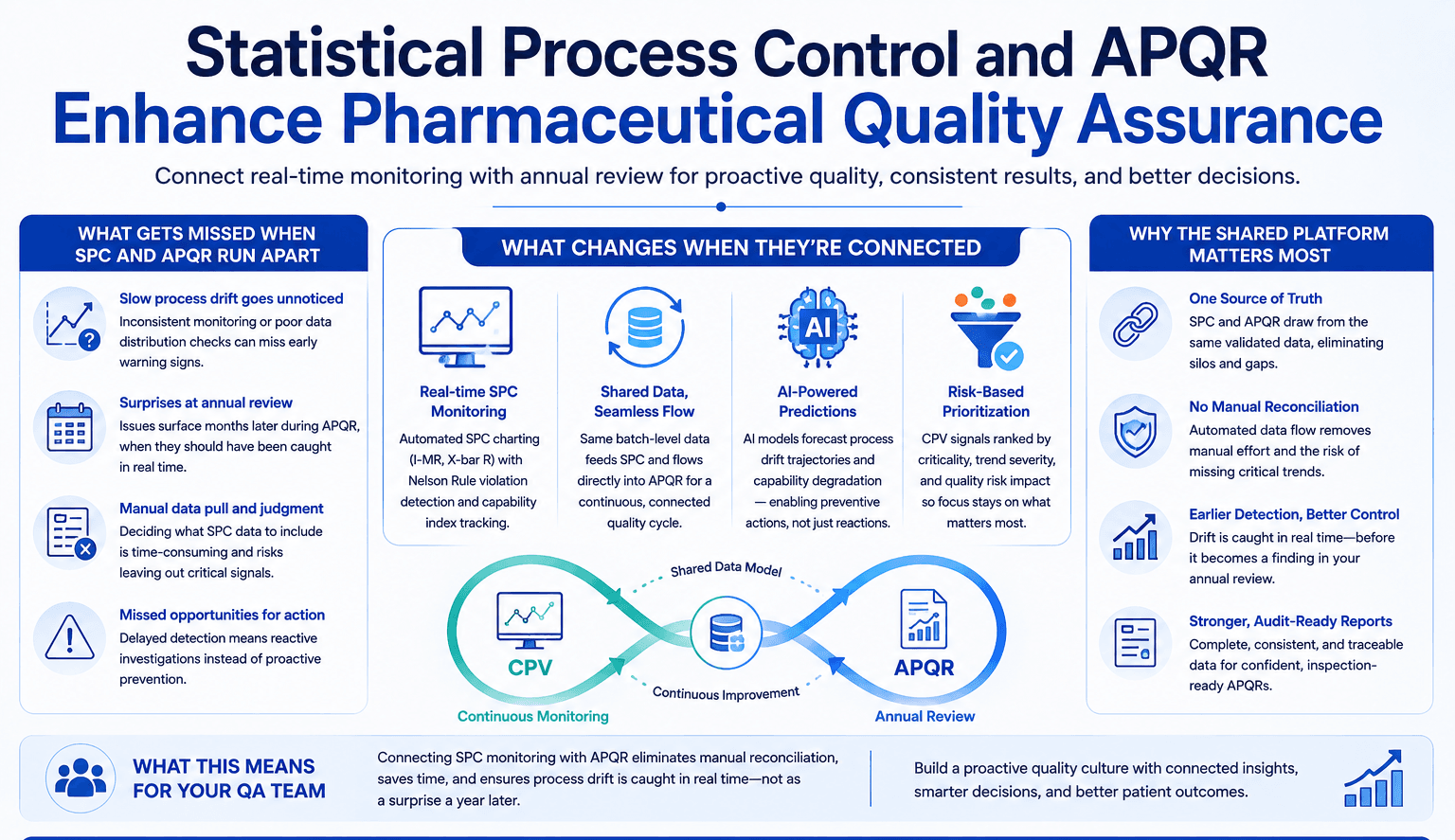
Statistical Process Control and the Annual Product Quality Review serve related but distinct purposes in pharmaceutical manufacturing. SPC is meant to catch process drift as it happens, monitoring critical process parameters and critical quality attributes in near real time. APQR is the periodic, retrospective look across a full year of batches, meant to confirm consistency and surface the need for changes in specifications or controls. The two are often run through separate tools, on separate schedules, by people who don't always talk to each other. That separation is where quality assurance loses its edge.
What gets missed when SPC and APQR run apart
If SPC data lives in one system and APQR compilation happens separately once a year, a few things tend to go wrong. A process that shows a slow, statistically meaningful drift across several months might not get flagged in real time if the SPC monitoring isn't rigorous about verifying data distribution before applying control limits. That same drift, if it isn't caught early, shows up as a surprise when the annual review finally aggregates a year's worth of batches. By then, it's not a monitoring win, it's a retrospective finding that should have been caught months earlier.
What changes when they're connected
AmpleLogic runs Continued Process Verification and APQR on a single platform with shared data and shared analytics, which changes the relationship between the two:
Real-time monitoring of CPPs and CQAs generates automated SPC charting, including I-MR and X-bar R control charts with Nelson Rule violation detection and capability index tracking
The same batch-level data feeding SPC also flows directly into the APQR, so the annual review isn't a separate data pull, it's a rollup of monitoring that's already been happening continuously
AI-based models forecast process drift trajectories and capability degradation ahead of time, giving teams a chance for preventive control instead of reactive investigation after the fact
CPV signals are ranked by criticality, trend severity, and quality risk impact, so review attention goes to the deviations that matter most rather than being spread evenly across every minor fluctuation
Why the shared platform matters more than either capability alone
Standalone SPC tools and standalone APQR software both add value individually. What closes the real gap is having them draw from the same source data. When CPV monitoring and APQR reporting operate in silos, there's no automated feed from continuous monitoring into the annual review, which means someone has to manually decide what from a year of SPC data is worth including. A shared platform removes that judgment call and, more importantly, removes the risk of leaving something out.
What this means for your QA team
If your SPC monitoring and your APQR process currently run through separate tools with a manual reconciliation step between them, that gap is a likely source of both wasted time and missed trend signals. Connecting the two doesn't just save the review compilation time, it means the drift your SPC system should be catching in real time actually gets caught in real time, instead of showing up as a surprise a year later.
You can see how the shared data model works across both modules on the CPV software page and the APQR software page.


