Data Ingestion & Cross-System Integration
Bring manufacturing, quality, laboratory and enterprise data together so APQR preparation starts from a trusted, connected source — not from another round of spreadsheet consolidation.
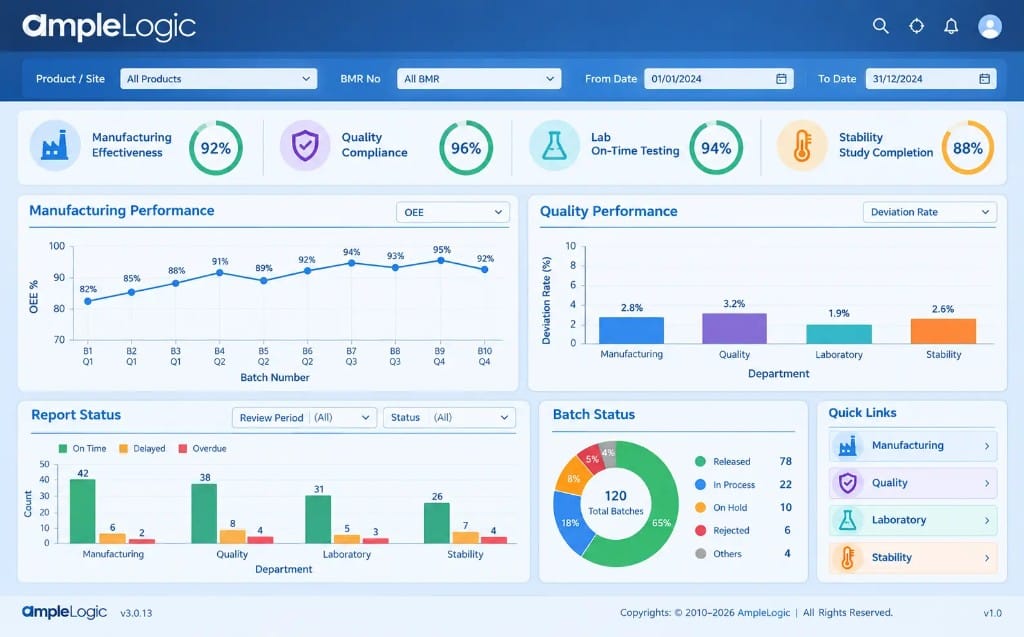
Stop hunting across systems before the quality review even begins
Before a quality team can assess product performance, it often spends days locating, extracting and reconciling data from LIMS, QMS, ERP, MES/eBMR, stability systems, DMS and other enterprise applications.
AmpleLogic APQR data ingestion and integration connects those sources into a unified APQR data foundation. Automated collection, mapping, normalization and validation reduce manual handoffs and give reviewers a consistent starting point for analysis and reporting.
The result is less time spent searching for information and more time spent evaluating product quality, trends and risk.
Back to Annual Product Quality Review SoftwareWhat Data Ingestion & Cross-System Integration enables
Practical capabilities quality teams use to reduce manual effort and improve review visibility.
Cross-system connectors
Connect LIMS, QMS, ERP, MES/eBMR, stability, DMS and other enterprise systems used in pharmaceutical quality and manufacturing.
Automated data collection
Reduce repetitive extraction work by pulling the APQR-relevant data set into a controlled review environment.
Data mapping & normalization
Align parameter names, units, product identifiers and site references so downstream charts and reports stay consistent.
Data validation checks
Surface incomplete, mismatched or unexpected values before they delay review cycles or create rework in the dossier.
Unified APQR data foundation
Create one connected dataset for batch analysis, workflow review, action tracking and regulatory-ready reporting.
Less spreadsheet consolidation
Replace fragile copy-paste workbooks with governed ingestion designed for recurring APQR and periodic review cycles.
How this capability fits the APQR process
From connected data through analysis, review, approval and reporting — adapted for this feature.
Step 01
Connect
Link quality, manufacturing, laboratory and enterprise systems that hold APQR inputs.
Step 02
Ingest
Collect product, batch, analytical, stability and quality-event data into the APQR workspace.
Step 03
Normalize
Map and validate fields so analysis and reporting use consistent definitions.
Step 04
Analyze
Feed clean, connected data into batch analysis, trending and process capability work.
Step 05
Review & report
Carry the same trusted dataset into APQR workflows, approvals and dossier assembly.
Outcomes quality teams can expect
Benefits focused on this capability — not a generic copy of every APQR advantage.
Less manual data hunting
Reduce the effort spent collecting and reconciling information from disconnected systems.
Better data consistency
Start each review cycle with mapped, validated inputs instead of conflicting workbook versions.
Faster APQR kickoff
Shorten the time between review period close and meaningful quality analysis.
Stronger audit defensibility
Maintain clearer lineage from source systems into the APQR dataset used for conclusions.
Built to support regulated pharmaceutical operations
Controls and practices most relevant to this APQR capability.
Traceability from source systems
Support visibility from originating systems through the APQR data used in analysis and reporting.
Controlled data access
Use role-based access so sensitive quality and manufacturing data is available to the right users.
Data integrity foundations
Reduce transcription risk by limiting manual transfers between systems and spreadsheets.
A shared data foundation for APQR and CPV
The same connected manufacturing and quality inputs that accelerate APQR preparation can also support continued process verification and ongoing process monitoring.
Reusable process and quality signals
Ingested CPP, CQA and quality-event data can feed both periodic APQR and ongoing CPV views.
Fewer parallel data pipelines
Avoid maintaining one spreadsheet path for APQR and another for process monitoring.
Nuestras Oficinas Globales
Estamos donde nos necesita. Conectamos a nivel global y entregamos a nivel local.
India

Melange Tower, 2nd Floor, Wing-C, Patrika Nagar, HITEC City, Madhapur, Hyderabad - 500081, Telangana, India
Estados Unidos (Dallas)

17330 Preston Road Suite 200D, Dallas, TX, 75252
Canadá (North York, Toronto)

5255 Yonge Street Suite 201, North York, ON, M2N 6P4
Australia (Melbourne)

Level 14, 330 Collins Street, Melbourne, VIC, 3000
Corea del Sur (Daegu)

Daegu Trade Centre, 8/F. 489, Dongdaegu-ro, Daegu, 41256
Irlanda (Dublín)

Block 1, Blanchardstown Corporate Park Ballycoolen Road, Dublin, D15 AKK1
Singapur

1 Scotts Road, #24-10 Shaw Centre, Singapore, Singapore, 228208
Manténgase a la vanguardia en las ciencias biológicas
Reciba las últimas actualizaciones de productos, noticias sobre cumplimiento y conocimientos de la industria en su bandeja de entrada.