Chemical Structure & Bio-Sequence Editor
Empower scientists with chemical structure drawing and CAS number identification, molecular visualization, sequence editing and annotation, biological structure management and integrated scientific documentation.
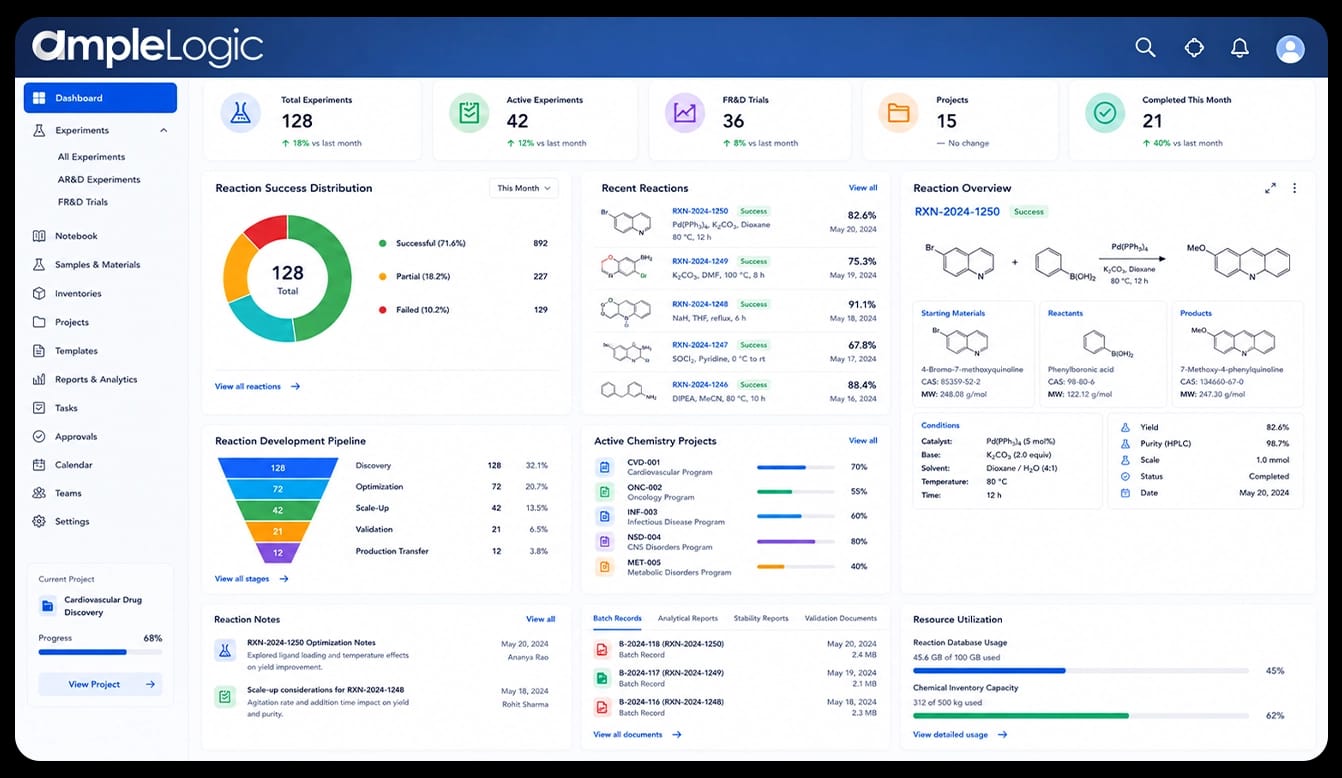
Keep chemical and biological scientific content inside the ELN record
Chemistry and biology research often store structures and sequences in tools disconnected from experiment documentation. That separation creates rework and weakens scientific context.
AmpleLogic Electronic Laboratory Notebook provides a Chemical Structure and Bio-Sequence Editor with chemical structure drawing and CAS number identification, molecular visualization, sequence editing and annotation, biological structure management and integrated scientific documentation.
Scientists can capture molecular and sequence information where research work is planned, executed and reviewed.
Explore AmpleLogic Electronic Laboratory NotebookWhat Chemical Structure & Bio-Sequence Editor enables
Practical capabilities research teams use to manage scientific work in the ELN.
Chemical Structure Drawing and CAS Identification
Draw chemical structures and support CAS number identification within scientific documentation.
Molecular Visualization
Visualize molecular structures to support scientific communication and review.
Sequence Editing and Annotation
Edit and annotate biological sequences as part of research documentation workflows.
Biological Structure Management
Manage biological structure information alongside related scientific records.
Integrated Scientific Documentation
Keep chemical and sequence content connected to experiment and research documentation.
How this capability fits the research lifecycle
From create and review through approval, distribution, use, revision and archival — adapted for this page.
Step 01
Capture structure or sequence
Create chemical structures or biological sequence content in the scientific workspace.
Step 02
Annotate and visualize
Add annotations and use molecular visualization to clarify scientific meaning.
Step 03
Link to experiments
Connect structures and sequences to experiment records and research documentation.
Step 04
Collaborate with peers
Share scientific content with collaborating researchers for review and refinement.
Step 05
Retain in research history
Preserve structure and sequence documentation with the broader scientific record.
Outcomes researchers and laboratory teams can expect
Benefits focused on this ELN capability.
Less tool switching
Scientists capture chemical and biological content without leaving the research workflow.
Richer experiment context
Structures and sequences stay connected to the experiments they describe.
Clearer scientific communication
Visualization and annotation help teams review molecular and sequence details together.
Stronger documentation continuity
Integrated scientific documentation reduces fragmented structure and sequence files.
Built to support regulated scientific research and data integrity
Controls and practices most relevant to this ELN capability.
Integrated record retention
Keep chemical and sequence content within governed ELN scientific documentation.
Role-based access
Control who can create and edit scientific structure and sequence content.
Activity history
Support review of changes associated with scientific authoring content.
Scientific authoring connected to research and transfer
Chemical and bio-sequence editing supports experiment documentation and contributes structured scientific content useful for collaboration and technology transfer workflows.
Author in context
Capture structures and sequences where experiment documentation already lives.
Share scientific detail
Support collaboration and transfer discussions with retained molecular context.
See how AmpleLogic can transform your scientific research workflows
Move from fragmented notebooks and disconnected research tools to a more connected, traceable and collaborative electronic laboratory notebook.
Speak with our ELN specialists about your current research workflows, laboratory systems and data integrity requirements.
우리의 글로벌 오피스
필요한 곳에 우리가 있습니다. 글로벌로 연결하고, 로컬로 전달합니다.
인도

Melange Tower, 2nd Floor, Wing-C, Patrika Nagar, HITEC City, Madhapur, Hyderabad - 500081, Telangana, India


아일랜드 (더블린)

Block 1, Blanchardstown Corporate Park Ballycoolen Road, Dublin, D15 AKK1

생명과학 분야의 최신 정보를 받아보세요
최신 제품 업데이트, 규정 준수 뉴스, 업계 인사이트를 받은 편지함으로 직접 받아보세요.