Ask someone responsible for stability studies what happens when a chamber goes out of range, and the answer usually isn't complicated. Someone gets an alert, someone checks the readings, and then someone starts figuring out which studies and samples might be affected.
The difficult part comes next.
Was the excursion recorded against the right study? Which batches were inside the chamber at that point? Were any samples due for a pull? Did the environmental data make it into the stability record? And if an auditor asks six months later what happened, can the team reconstruct the entire event without digging through emails, spreadsheets, and separate monitoring systems?
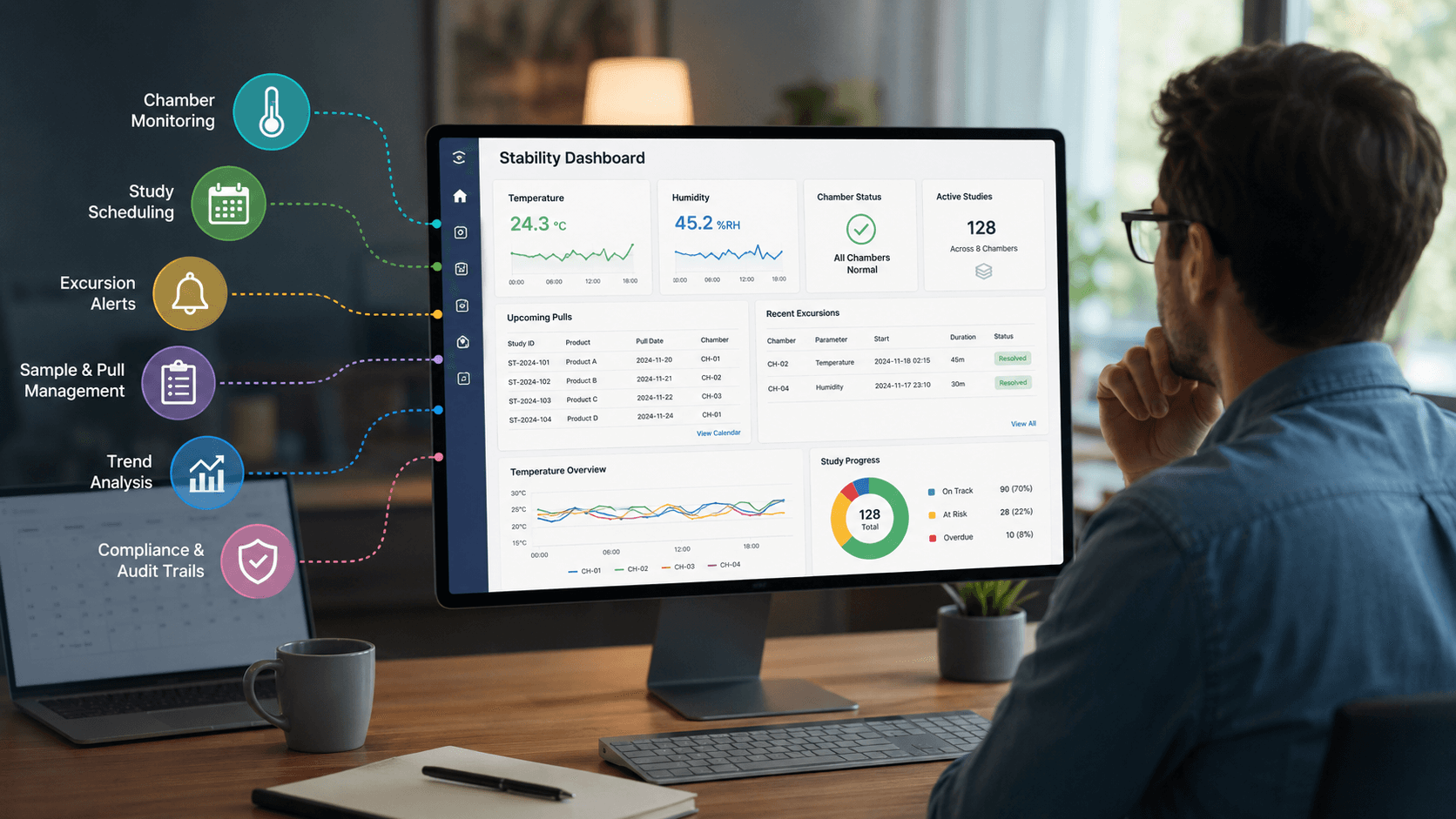
This is where stability chamber monitoring software starts to make a real difference. The purpose isn't simply to display temperature and humidity readings on another screen. The real value is connecting those readings to the stability studies, samples, schedules, and compliance records they actually affect.
The Problem Isn't Monitoring. It's Disconnected Monitoring.
Most modern stability chambers already have some form of environmental monitoring. The problem is what happens around that data.
Temperature and humidity readings may sit in one system. Stability schedules live in Excel. Sample information is maintained somewhere else. Analysts have their own testing records, while quality teams maintain the documentation needed for review.
Each system may work perfectly well on its own. Put them together, though, and the gaps become obvious.
A useful stability chamber monitoring setup should give teams visibility into:
Temperature and humidity conditions linked directly to the relevant stability studies
Excursion alerts when chamber conditions move outside defined limits
Chamber allocation, so teams know which studies and samples are being stored where
Study and pull-date visibility without maintaining another manual calendar
Traceable environmental records that can be reviewed alongside stability data
Notifications and escalation workflows when an excursion or other event requires attention
AmpleLogic's stability solution connects chamber monitoring with the broader stability workflow, including protocol creation, scheduling, sample pulls, testing, trend analysis, and reporting.
Why a Temperature Excursion Is More Than an Alert
A temperature excursion by itself doesn't tell the whole story.
Imagine a chamber moves outside its specified range overnight. The monitoring system flags it. That's useful, but the quality team still needs to establish what was inside the chamber, which studies were affected, how long the excursion lasted, and whether any scheduled activity needs to be reviewed.
This is where disconnected systems create unnecessary work.
With an integrated approach, environmental data can be associated with stability study records rather than treated as an isolated stream of numbers. AmpleLogic supports real-time temperature and humidity monitoring, automated excursion alerts, sensor integration, and linking environmental data to stability study records.
That connection matters because stability decisions depend on context.
The Spreadsheet Problem Doesn't Stop at Scheduling
Spreadsheets are still heavily used for stability schedules. There's a reason for that. They're familiar, flexible, and easy to start with.
The trouble begins when the number of studies grows.
A stability team may have dozens or hundreds of active studies, different storage conditions, multiple chambers, several pull points, and analysts working across overlapping schedules. A spreadsheet can record all of this, but maintaining it accurately becomes another job in itself.
The result can be missed pull points, scheduling conflicts, or uncertainty about what is coming next.
AmpleLogic's stability platform provides a centralized schedule calendar with pull dates, chamber assignments, analyst allocation, reminders, and dynamic rescheduling.
What Makes Software Useful for Stability Teams?
Not every stability software product needs to do everything. But for organizations managing regulated stability programs, a few capabilities are particularly useful.
A practical platform should bring together:
Stability protocol management
Automated study scheduling
Chamber monitoring
Sample and pull management
Test execution and result capture
Trend analysis
Shelf-life determination
Regulatory reporting
Complete audit trails
The advantage is less about having a long feature list and more about removing the handoffs between them.
AmpleLogic takes this end-to-end approach inside its LIMS environment. The platform connects protocol creation and scheduling with chamber monitoring, analytical testing, trend analysis, shelf-life projection, and regulatory reporting.
Where AI Can Actually Help
There is plenty of AI language being added to laboratory software right now, so it's worth separating useful functionality from marketing noise.
For stability programs, analytics can have a practical role. AmpleLogic's stability data management software includes multi-batch trend analysis, degradation curve fitting, OOT/OOS detection, and predictive shelf-life forecasting.
That doesn't mean software should make quality decisions on its own. It means teams can get from raw stability data to a clearer view of emerging trends without spending hours building charts and compiling information manually.
That's a much more useful application of automation.
Compliance Is Where the Difference Becomes Visible
Stability programs generate a considerable amount of information, and regulators need confidence that the information is reliable and traceable.
AmpleLogic's stability testing software solution supports audit trails with timestamped, user-identified records and lists compliance alignment with requirements and frameworks including FDA 21 CFR Part 11, FDA 21 CFR Part 211.166, EU GMP Annex 11, GAMP 5, ICH Q1A, and ALCOA+ data integrity principles.
The practical benefit is straightforward: instead of reconstructing evidence when an audit arrives, the relevant activity is captured as the stability program runs.
The Bottom Line
Stability chamber monitoring software is most valuable when it stops being just a monitoring tool.
Temperature and humidity data matter because they affect real stability studies. Chamber excursions matter because they can affect samples, schedules, and ultimately the conclusions drawn from a study. Pull dates matter because missed time points can create their own problems.
Connecting those pieces gives stability teams something spreadsheets and isolated monitoring tools struggle to provide: context.
AmpleLogic brings chamber monitoring into a broader stability management workflow, giving teams a single environment for study scheduling, environmental monitoring, testing, analysis, and compliance documentation.
For organizations still managing chamber data, stability schedules, and study records across separate systems, that connection may be the part worth rethinking first.


